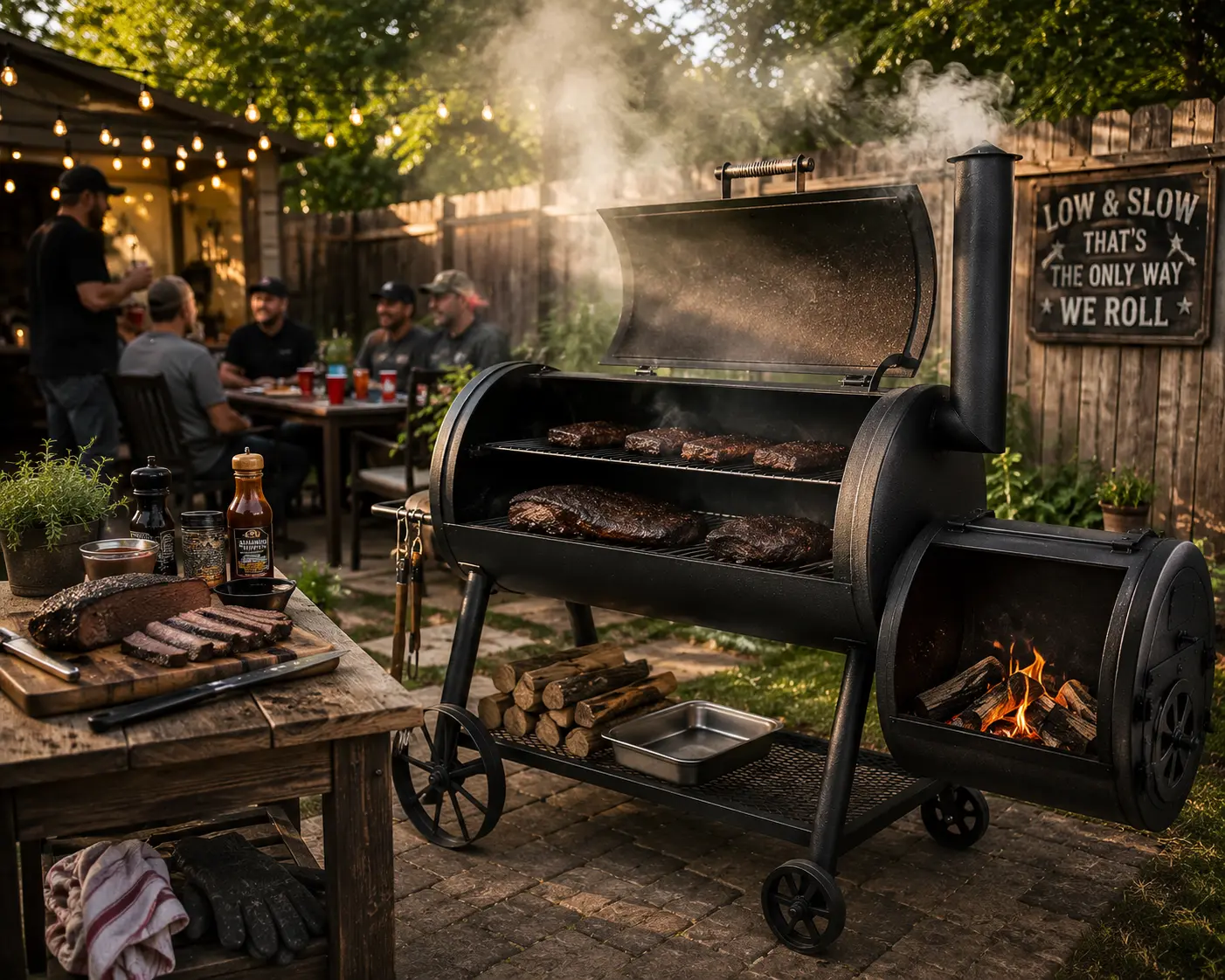
Buying your first offset smoker is an exciting step toward creating authentic wood-fired barbecue at home. However, finding the best offset smoker for beginners can be challenging because models differ considerably in price, construction, cooking capacity, firebox size, and temperature control.
A beginner-friendly offset smoker should provide manageable cooking space, adjustable airflow, convenient firebox access, simple cleaning, and reasonably stable temperatures. It should also fit your available outdoor space and budget without including complicated features you may never use.
This guide compares four suitable beginner offset smokers and explains the essential techniques you need to produce flavorful brisket, ribs, pork shoulder, chicken, and other smoked foods.
Quick Answer: The Royal Gourmet CC1830S is a suitable low-cost choice for learning the basics. The Oklahoma Joe’s Highland offers the best overall balance of size, construction, capacity, and long-term usability for most beginners.
Beginner Tip: Start with charcoal to establish a stable heat source, then add one small piece of seasoned hardwood for smoke. This method is easier to control than trying to manage an all-wood fire during your first few cooks.
Best Offset Smokers for Beginners: Quick Comparison
| Smoker | Best for | Cooking capacity | Difficulty |
| Royal Gourmet CC1830S | Small budgets and patios | Approx. 823 sq. in. total | Easy to moderate |
| Char-Griller Smokin’ Pro | Grilling and smoking | Approx. 1,130 sq. in. total | Moderate |
| Oklahoma Joe’s Highland | Best overall beginner choice | Approx. 900 sq. in. total | Moderate |
| Old Country Pecos | Long-term skill development | 630 sq. in. main grate | Moderate |
Prices and availability can change, so check the manufacturer or authorized retailer before purchasing.
What Is an Offset Smoker?
An offset smoker consists of a horizontal cooking chamber connected to a smaller side firebox. Charcoal or hardwood burns inside the firebox, while heat and smoke flow through the main chamber before exiting through the chimney.
This arrangement cooks food with indirect heat rather than placing it directly over the fire. The method is particularly effective for traditional low-and-slow barbecue because meat can gradually become tender while absorbing natural wood smoke.
An offset smoker requires more active involvement than most electric, gas, or pellet smokers. You must manage the fire, adjust airflow, add fuel, and monitor temperature. Although this creates a learning curve, it also teaches the fundamental skills behind traditional barbecue.
If you have never used this design, read our complete offset smoker guide before your first cook.
Is an Offset Smoker Suitable for a Beginner?
An offset smoker is suitable for a beginner who wants to learn traditional fire management and does not mind checking the smoker regularly.
It is not a set-it-and-forget-it cooking appliance. Temperature can change because of fuel quantity, airflow, weather, steel thickness, and the size of the fire. These variables require patience, especially during your first few cooking sessions.
However, you do not need professional experience to start. Using charcoal as a stable base fuel, adding small wood splits, and monitoring the cooking chamber with a digital thermometer can make the process much easier.
What to Look for in a Beginner Offset Smoker
Strong Construction
Steel thickness influences heat retention and temperature stability. Lightweight smokers are affordable and easy to move, but they lose heat more quickly in cold or windy weather.
A heavier smoker is normally easier to keep stable once it reaches the desired temperature. However, it costs more and may require a permanent location.
Inspect the doors, hinges, wheels, grates, handles, welds, and paint finish in addition to the thickness of the cooking chamber.
Manageable Cooking Capacity
A larger smoker is not always better for a beginner. Large cooking chambers require more fuel and take longer to preheat.
Choose a smoker that can comfortably hold the food you regularly prepare. A small family may need space for one brisket or two racks of ribs, while frequent gatherings require a larger primary cooking grate.
Do not rely only on the advertised total cooking area. Some manufacturers include the firebox grate, warming rack, and upper shelves in that measurement.
Adjustable Airflow
A beginner offset smoker needs an adjustable firebox intake and a functional chimney. The intake controls how much oxygen reaches the fire, while the chimney allows heat and smoke to move through the cooking chamber.
Avoid models with extremely small vents or poor-fitting components that make airflow difficult to regulate.
Accessible Firebox
You should be able to add charcoal or wood without opening the main cooking chamber. Every time the cooking lid is opened, heat escapes and the cooking temperature drops.
A side or top firebox door makes fuel additions easier. A removable charcoal basket or grate can also improve combustion by allowing air to move beneath the fuel.
Simple Cleaning
Look for removable cooking grates, accessible ash removal, a grease drain, or a slide-out ash pan. Ash should be removed once the smoker has cooled because it can absorb moisture and contribute to rust.
Space for Thermometer Probes
Built-in lid thermometers may measure a different temperature from the area surrounding the food. A beginner should use a digital thermometer at grate level and a separate probe inside the meat.
1. Royal Gourmet CC1830S: Best Budget Choice
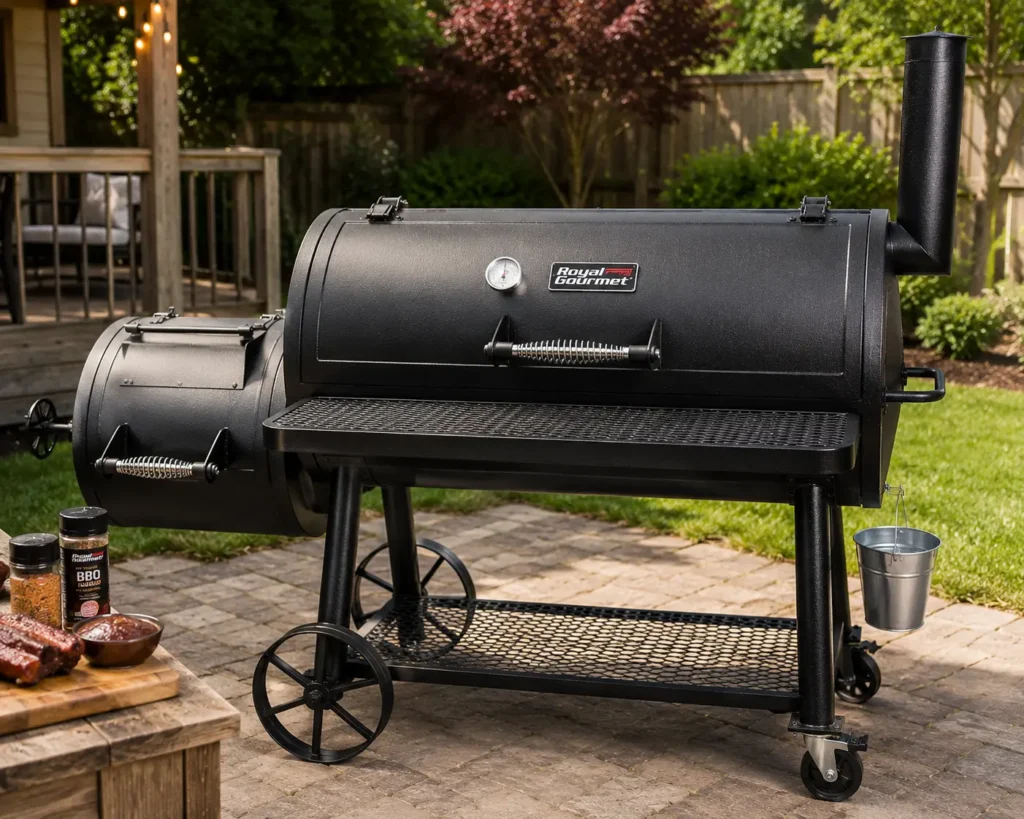
The Royal Gourmet CC1830S is an affordable combination charcoal grill and offset smoker. It provides enough functionality for beginners to learn both direct grilling and indirect smoking without purchasing separate appliances.
According to the official Royal Gourmet specifications, it includes approximately 475 square inches of primary cooking grate, a 151-square-inch warming rack, and a 197-square-inch offset firebox area.
Key Features
- Approximately 823 square inches of combined cooking space
- Attached side firebox
- Adjustable chimney
- Firebox air vent
- Adjustable charcoal pan
- Side table and bottom storage shelf
- Built-in lid thermometer
- Compact backyard footprint
Advantages for Beginners
The CC1830S has a relatively low entry price and does not occupy as much space as a large heavy-duty smoker. Its combination design allows you to grill burgers and steaks directly or smoke meat using indirect heat.
Its smaller chamber requires less charcoal to preheat than a large offset smoker. This can make short practice sessions more affordable.
Limitations
The lightweight steel loses heat faster than thicker material. Beginners may experience temperature variations during wind, rain, or cold weather.
The small firebox also requires careful fuel management. Large wood splits may not fit correctly, so charcoal and small hardwood chunks are usually easier to control.
Best For
This smoker is best for:
- First-time buyers with a limited budget
- Small families
- Patios with limited space
- Occasional smoking
- People who want one appliance for grilling and smoking
For a closer look at similar construction and performance, read our Royal Gourmet offset smoker review.
2. Char-Griller Smokin’ Pro: Best for Grilling and Smoking
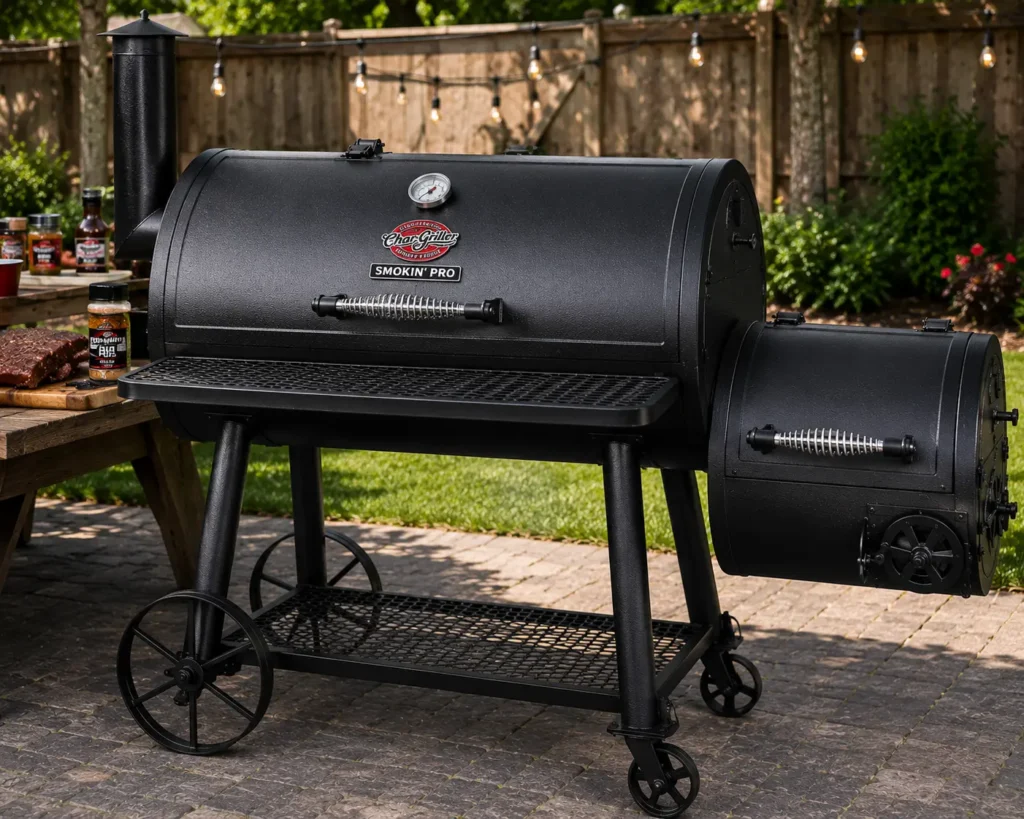
The Char-Griller Smokin’ Pro is another combination cooker that provides both a large charcoal grill and a side firebox. It offers more capacity than many entry-level models, making it suitable for beginners who regularly cook for groups.
The official Char-Griller specifications list approximately 580 square inches of primary cooking area and around 1,130 square inches of total cooking space.
Key Features
- Approximately 1,130 square inches of total cooking area
- Large barrel-style cooking chamber
- Side firebox for indirect smoking
- Cast-iron cooking grates
- Adjustable dampers
- Side shelf and storage rack
- Removable charcoal drawers
- Suitable for grilling and smoking
Advantages for Beginners
The large cooking chamber provides enough room for several cuts of meat. Cast-iron grates are also useful for direct grilling and can retain heat effectively when properly preheated.
The removable charcoal drawers simplify fuel access and ash removal. This is valuable for beginners who are still learning how much fuel is needed for different cooking temperatures.
Limitations
Like many affordable combination smokers, the Smokin’ Pro may allow some heat and smoke to escape around the doors. Owners may need to learn its hot spots and rotate food during long cooking sessions.
Its advertised total capacity includes more than the primary smoking grate, so check the individual grate dimensions before purchasing.
Best For
Choose this model if:
- You want a charcoal grill and offset smoker together.
- You regularly cook for family gatherings.
- You want more space than a compact smoker.
- You are willing to learn temperature management.
- You value cooking versatility.
3. Oklahoma Joe’s Highland: Best Overall for Beginners
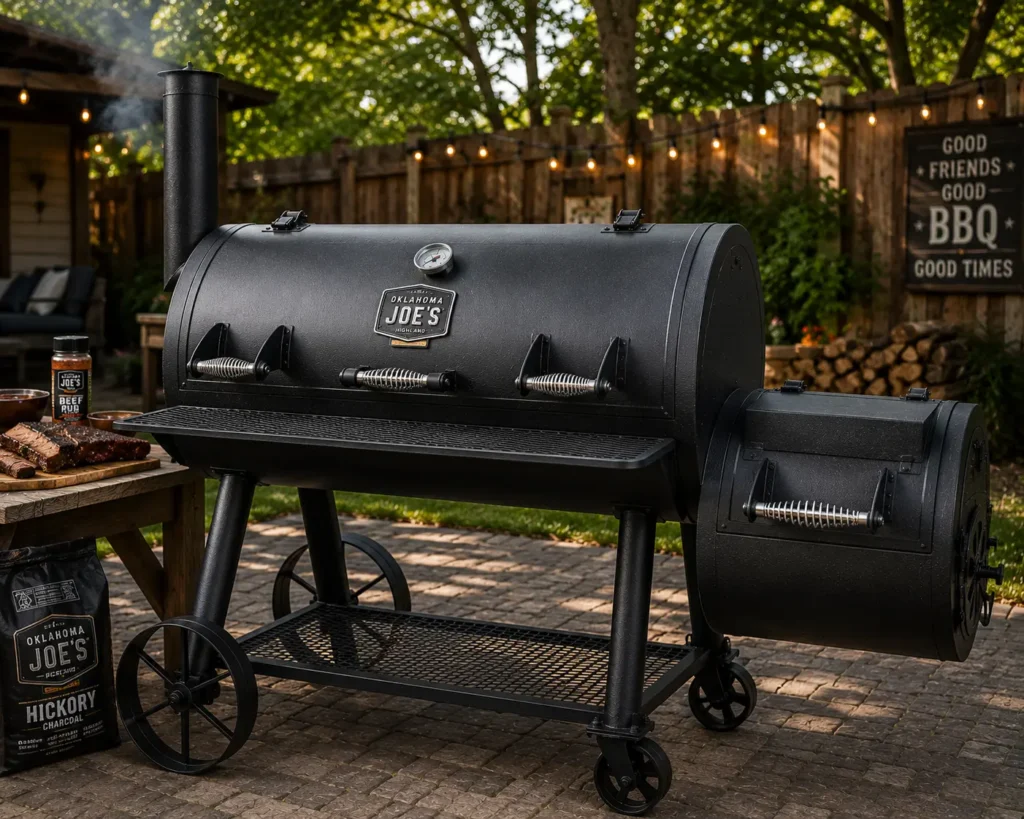
The Oklahoma Joe’s Highland is our overall choice for the best offset smoker for beginners. It offers a traditional layout, useful cooking capacity, accessible firebox, and stronger construction than many inexpensive grill-and-smoker combinations.
Its size is large enough for brisket and multiple racks of ribs without becoming as difficult to manage as an oversized competition smoker.
Key Features
- Approximately 900 square inches of total cooking capacity
- Traditional horizontal cooking chamber
- Side firebox with convenient access
- Heavy-gauge steel construction
- Multiple adjustable dampers
- Porcelain-coated cooking grates
- Front and lower storage shelves
- Large wheels for backyard movement
Advantages for Beginners
The Highland provides enough room for a beginner to develop genuine offset-smoking skills. Its firebox can accommodate charcoal and appropriately sized wood splits, making it suitable for charcoal-and-wood or all-wood cooking as your experience improves.
Replacement parts, accessories, covers, charcoal baskets, and sealing products are also widely available for this popular design.
Limitations
The Highland still requires active temperature and fire management. It should not be purchased with the expectation of automatic temperature control.
Because it is heavier than compact budget models, moving it across steps or uneven ground can be difficult. Some owners may also choose to install high-temperature gasket material around areas where smoke escapes.
Best For
The Highland is best for:
- Beginners serious about learning traditional barbecue
- Families and medium-sized gatherings
- Brisket, ribs, pork shoulder, and chicken
- Buyers who want room to improve their skills
- People who expect to use the smoker regularly
Read our complete Oklahoma Joe’s Highland offset smoker review for a more detailed breakdown.
4. Old Country Pecos: Best Upgrade for a Serious Beginner
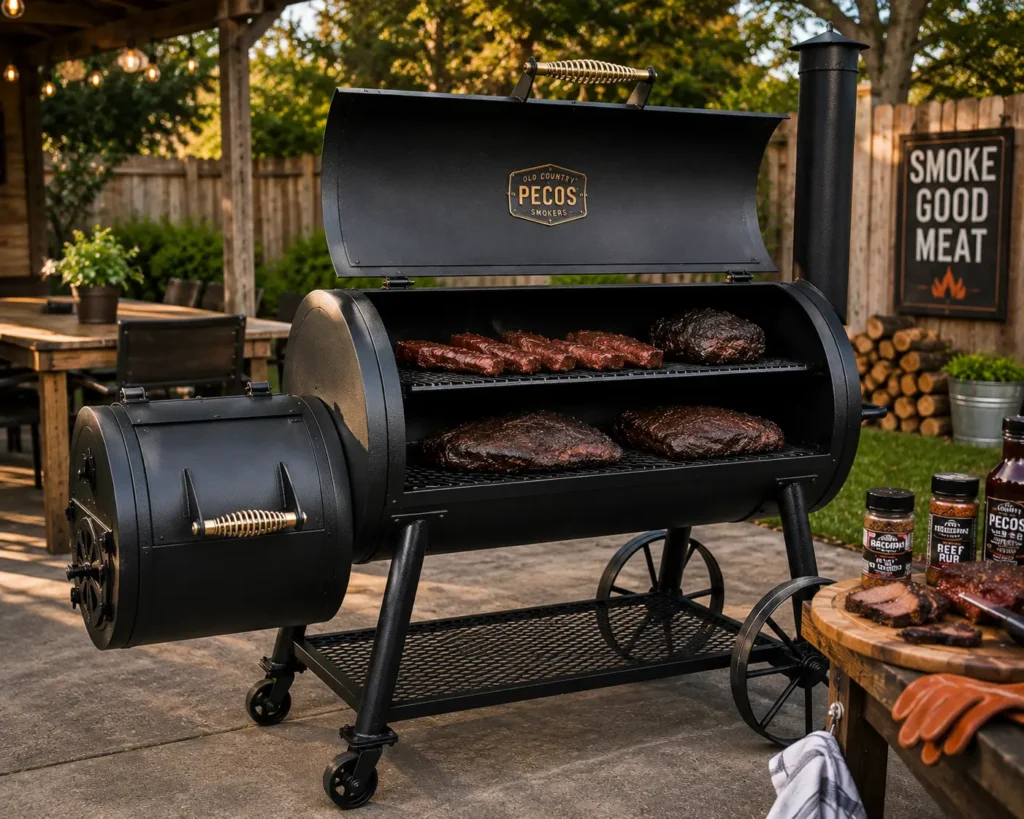
The Old Country Pecos is a suitable choice for a beginner who prefers stronger welded construction and expects to continue smoking for many years.
Academy Sports lists the Old Country Pecos with an all-welded body, approximately 630 square inches on the main grate, and an additional firebox cooking grate.
Key Features
- All-welded steel construction
- Approximately 630-square-inch main grate
- Large side firebox
- Slide-out main cooking grate
- Heavy-duty fuel grate
- Drop-in front table
- Bottom storage shelf
- Wagon-style wheels
- Suitable for charcoal, chunks, and wood splits
Advantages for Beginners
The welded construction reduces assembly work and provides greater rigidity than many bolted entry-level smokers. Its larger firebox is better suited to clean-burning hardwood fires.
It gives a beginner enough quality to improve without needing an immediate replacement after mastering basic fire management.
Limitations
The Pecos costs more than most starter smokers and weighs approximately 222 pounds. It also does not include a built-in thermometer, so you must purchase a dependable digital thermometer separately.
Its stronger construction makes temperature management easier, but it still requires practice and attention.
Best For
Choose the Pecos if:
- You want stronger welded construction.
- Your budget is approximately $600.
- You plan to smoke food regularly.
- You want to learn wood-fire management.
- Long-term value matters more than portability.
Which Beginner Offset Smoker Should You Choose?
Choose the Royal Gourmet CC1830S if affordability and compact size are your priorities.
Choose the Char-Griller Smokin’ Pro if you need a large combination grill and smoker for regular family gatherings.
Choose the Oklahoma Joe’s Highland if you want the best overall balance of capacity, construction, accessibility, and beginner-friendly performance.
Choose the Old Country Pecos if you are prepared to spend more for welded construction and long-term skill development.
How to Use Your First Offset Smoker
1. Season the Smoker
Clean and season a new smoker before cooking food. This removes manufacturing residue and creates a protective coating on the interior steel.
The general process includes:
- Remove packaging, stickers, plastic, and loose debris.
- Wash the grates according to the manufacturer’s directions.
- Allow all surfaces to dry.
- Apply a thin coating of high-smoke-point cooking oil.
- Heat the empty smoker at the recommended temperature.
- Allow it to cool naturally.
Follow our detailed guide on how to season an offset smoker for complete instructions.
2. Begin With Charcoal and Wood
Charcoal provides a predictable heat source, while hardwood adds smoke flavor. This combination is easier for most beginners than using wood alone.
Light charcoal in a chimney starter. Once it is fully lit, place it in the firebox and add one small piece of seasoned hardwood.
Never use painted, chemically treated, moldy, or unidentified wood.
3. Preheat the Smoker
Allow the cooking chamber to stabilize before adding food. For many low-and-slow recipes, a cooking range of approximately 225°F to 275°F works well.
Use a digital thermometer at grate level because the built-in lid gauge may not accurately represent the temperature beside the food.
4. Control Heat With Fire Size and Airflow
Keep the exhaust chimney open so smoke can move freely through the cooking chamber. Use the fire size and intake damper to manage the temperature.
Small changes are better than aggressive adjustments. After moving a damper, wait several minutes to observe the result before changing it again.
Our guide on how to control heat in an offset smoker explains this process in greater detail.
5. Look for Clean Smoke
Thin, nearly transparent blue smoke indicates efficient combustion. Thick white or gray smoke can produce a bitter or unpleasant flavor.
Use dry, seasoned hardwood and maintain enough airflow to keep the fire burning cleanly. Do not overload the firebox with wood.
6. Place Food Away From the Firebox
The cooking grate is usually hottest near the firebox. Place delicate or lean foods farther away, while thicker cuts can tolerate the warmer side.
A digital probe at each side of the grate can help you identify the temperature difference.
7. Monitor Internal Meat Temperature
Cooking time is only an estimate. Use a food thermometer to determine whether meat has reached a safe internal temperature.
The USDA’s guidance for smoking meat and poultry recommends using thermometers to monitor both smoker temperature and the internal temperature of the food.
8. Rest Meat Before Slicing
Large cuts such as brisket and pork shoulder benefit from resting after cooking. Resting reduces immediate moisture loss and allows the internal temperature to become more even.
Resting time depends on the size and type of meat. A small chicken or rack of ribs requires less time than a full brisket.
Best First Foods to Smoke
Beginners should start with forgiving foods that do not require extremely precise timing.
Chicken Thighs
Chicken thighs are inexpensive, cook relatively quickly, and remain juicy because of their higher fat content.
Pork Shoulder
Pork shoulder takes several hours, but it is forgiving and provides excellent practice in fire management, bark development, and checking tenderness.
Sausages
Sausages are simple to prepare and require less cooking time than brisket or pork shoulder. Monitor their internal temperature carefully because different sausage types have different requirements.
Ribs
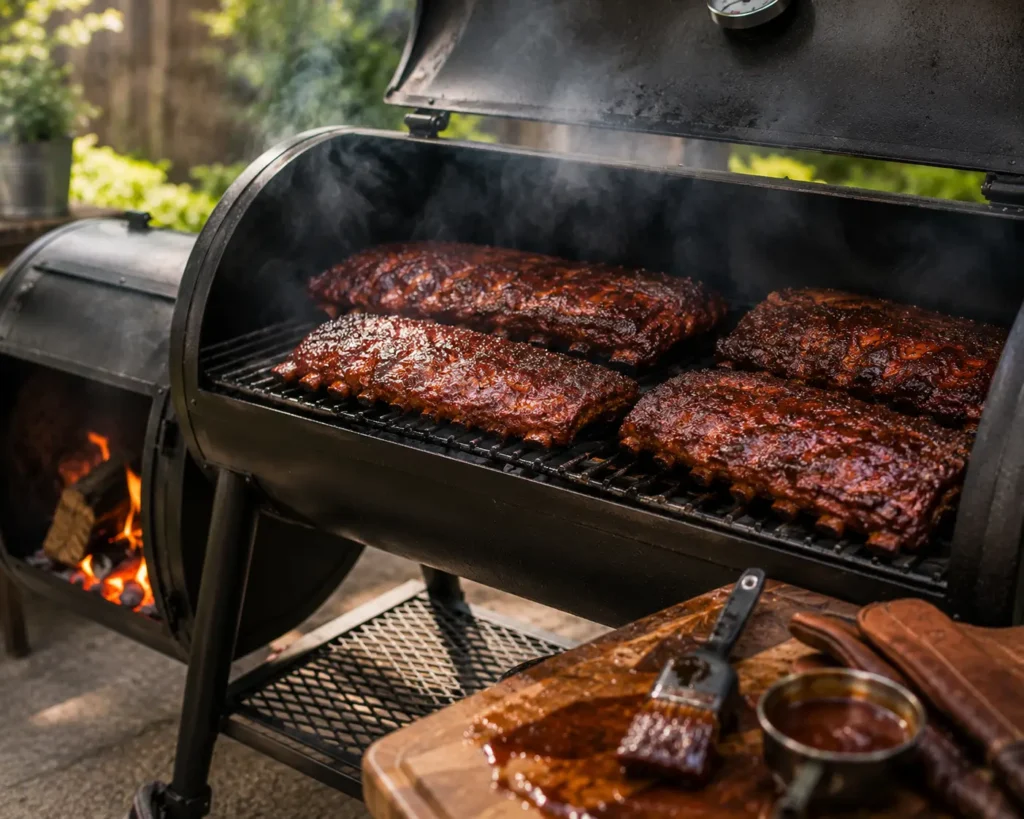
Ribs provide practice with seasoning, temperature control, wrapping, tenderness, and sauce application. Follow our guide on how to smoke ribs in an offset smoker when you are ready.
A full brisket is better attempted after you can maintain a relatively stable fire for several hours.
Common Beginner Mistakes to Avoid
Using Too Much Wood
More smoke does not automatically create better flavor. Excess wood can reduce combustion efficiency and coat food in bitter-tasting residue.
Closing the Chimney
Restricting the exhaust traps stale smoke and can reduce airflow through the firebox. Keep the chimney open and control heat primarily with fire size and intake airflow.
Constantly Opening the Lid
Every lid opening releases heat and increases cooking time. Use thermometer probes so you can monitor the smoker without repeatedly opening it.
Chasing Every Temperature Change
Small temperature fluctuations are normal. Continuously adjusting the dampers can create larger swings. Focus on maintaining a reasonable range rather than one exact number.
Trusting Only the Built-In Gauge
A lid-mounted thermometer can differ from the grate temperature. Always use a dependable digital probe beside the food.
Overcrowding the Cooking Chamber
Crowding restricts airflow and can cause uneven cooking. Leave space between pieces of meat so heat and smoke can circulate.
Leaving Ash in the Firebox
Ash absorbs moisture and can accelerate corrosion. Remove it after the smoker has cooled completely.
Starting With Brisket
Brisket is expensive and requires a long, stable cook. Practice with chicken, sausages, ribs, or pork shoulder before attempting a full packer brisket.
Essential Accessories for a Beginner
- Dual-probe digital thermometer
- Charcoal chimney starter
- Heat-resistant barbecue gloves
- Long metal tongs
- Charcoal basket
- Small ash shovel
- Grill brush or scraper
- Food-safe spray bottle
- Butcher paper or aluminum foil
- Weather-resistant smoker cover
- Fire extinguisher suitable for your cooking area
Choose the Right Beginner Offset Smoker with Confidence
The best offset smoker for beginners should make it possible to learn fire management without requiring an excessive investment.
The Royal Gourmet CC1830S is suitable for buyers who want an inexpensive and compact first smoker. The Char-Griller Smokin’ Pro provides more capacity and useful grilling versatility.
The Oklahoma Joe’s Highland is our best overall recommendation because it offers a traditional offset design, useful cooking capacity, an accessible firebox, and enough long-term potential for improving your skills.
The Old Country Pecos is the strongest choice for serious beginners who prefer welded construction and expect to smoke food regularly.
Whichever model you choose, focus on learning how fuel, airflow, fire size, weather, and steel temperature work together. The smoker provides the equipment, but consistent practice produces great barbecue.
Frequently Asked Questions
The Oklahoma Joe’s Highland is one of the best overall beginner options because it combines manageable size, useful cooking capacity, traditional firebox access, and widely available accessories.
Offset smokers have a steeper learning curve than electric, gas, or pellet smokers. However, beginners can simplify the process by using charcoal as a base fuel and adding small amounts of hardwood for flavor.
A combination of charcoal and seasoned hardwood is generally easiest. Charcoal supplies stable heat, while hardwood produces smoke flavor.
Many low-and-slow recipes use a cooking range between 225°F and 275°F. The correct temperature depends on the food, recipe, and desired cooking time.
Choose enough primary grate space for the amount of food you normally cook. A family does not need a competition-sized smoker, while frequent gatherings may justify a larger cooking chamber.
Yes. The chimney should generally remain open during cooking to maintain airflow and allow stale smoke to escape. Control heat through fire size and the firebox intake.
Yes, but an all-wood fire requires more practice. Beginners usually find charcoal with small hardwood additions easier to control.
Chicken thighs, sausages, ribs, and pork shoulder are suitable first cooks. They are generally more forgiving and less expensive than brisket.