Shopping for your first serious BBQ smoker and torn between a reverse flow vs standard offset smoker? We’ve spent countless hours comparing these two designs — digging into specs, builder details, and what experienced pitmasters actually report — and here’s the honest truth: both use an offset firebox to create indirect heat and wood-fired smoke, but the way heat and smoke travel through the cooking chamber couldn’t be more different.
A standard offset smoker sends heat and smoke directly from the firebox across the cooking chamber and out through the chimney. A reverse flow smoker adds a heavy baffle plate beneath the cooking grate, forcing heat and smoke to travel toward the far end of the chamber before reversing direction and passing back over the food.
That difference affects BBQ smoker heat distribution, offset smoker temperature control, cooking zones, fire management, smoke exposure, cleanup, and the overall cooking experience.
The important thing to understand is that neither design automatically produces better BBQ. A well-built standard offset can outperform a poorly constructed reverse flow smoker, while a quality reverse flow pit can provide a more forgiving and consistent cooking environment. Build quality, airflow, steel thickness, firebox design, seals, and proper fire management all matter.
This guide breaks down the reverse flow vs standard offset smoker debate so you can choose the design that fits the way you actually want to cook.
Reverse flow smokers provide more even heat and consistent cooking, while standard offset smokers offer better cooking zones and more hands-on fire control. Choose reverse flow for consistency and standard offset for traditional BBQ versatility.
What Is a Standard Offset Smoker?
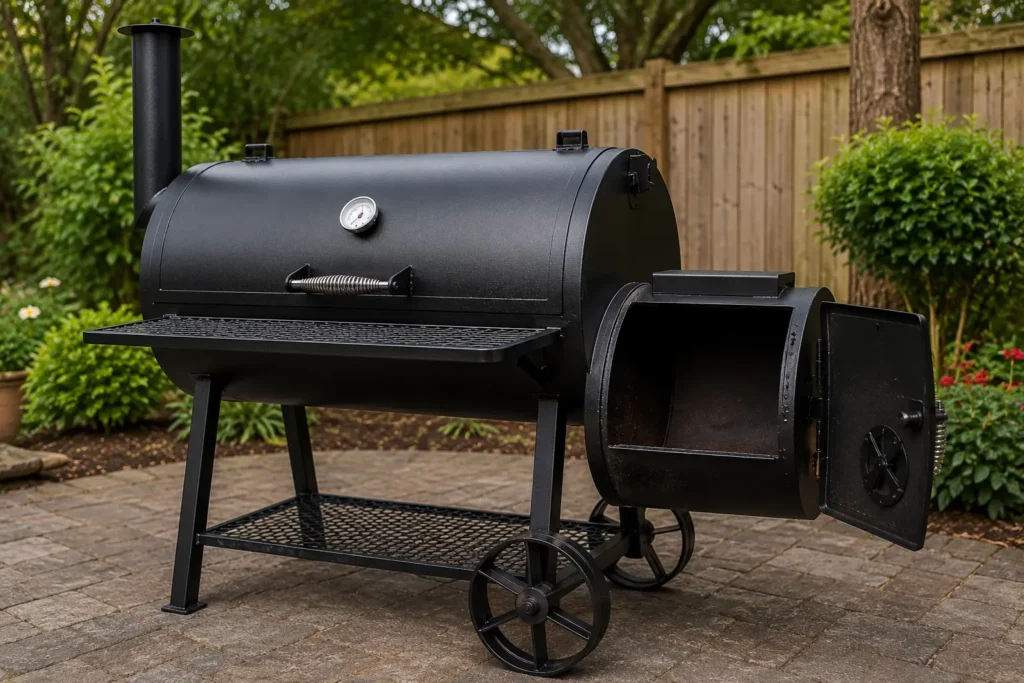
This is the classic — the design most of us picture when someone says “offset smoker.” A standard offset smoker has two main sections: a firebox and a separate cooking chamber, with the firebox sitting beside the chamber rather than directly underneath it.
Wood or charcoal burns inside the firebox, creating heat and smoke that enter the cooking chamber through an opening. The smoke travels across the food and eventually leaves through a chimney or exhaust stack on the opposite side.
This is the classic offset smoker design that many BBQ enthusiasts associate with traditional wood-fired barbecue — and its simplicity is one of its biggest advantages. There’s no large baffle plate forcing the smoke to travel underneath the cooking grate first. Instead, the fire produces heat and smoke, and you manage airflow, fuel, exhaust, and food placement to control the cook. It’s hands-on in the best way.
A standard offset can also create useful temperature zones. The area closer to the firebox may run warmer, while the far end can be cooler. Rather than seeing this only as a disadvantage, experienced pitmasters use those differences strategically — a cut that needs more heat can be positioned closer to the firebox, while another piece can be placed farther away to cook more gently.
The honest downside is that inexpensive or poorly designed standard offsets can develop substantial temperature differences across the cooking grate. BBQ Report’s guide to offset smoker baffle plates explains how baffles and tuning plates can help address heat-distribution problems in traditional offset smokers.
How Does a Standard Offset Smoker Work?
The basic airflow path is simple:
Firebox → Cooking Chamber → Food → Chimney
The firebox produces the heat and smoke. The smoke enters the cooking chamber, moves across the cooking grate, transfers heat and flavor to the food, and eventually exits through the chimney.
Because the heat enters from one side, the cooking chamber can naturally develop temperature differences — and that’s exactly why offset smoker temperature control is such an important skill. Instead of simply setting a temperature and walking away, you need to understand how your fire, airflow, fuel size, exhaust, weather, and food placement affect the cooking environment.
Learning how heat and airflow behave inside the smoker is one of the foundations of successful offset smoking. You can explore more practical smoking techniques and equipment guides at Offset Smoker Pro.
What Is a Reverse Flow Smoker?
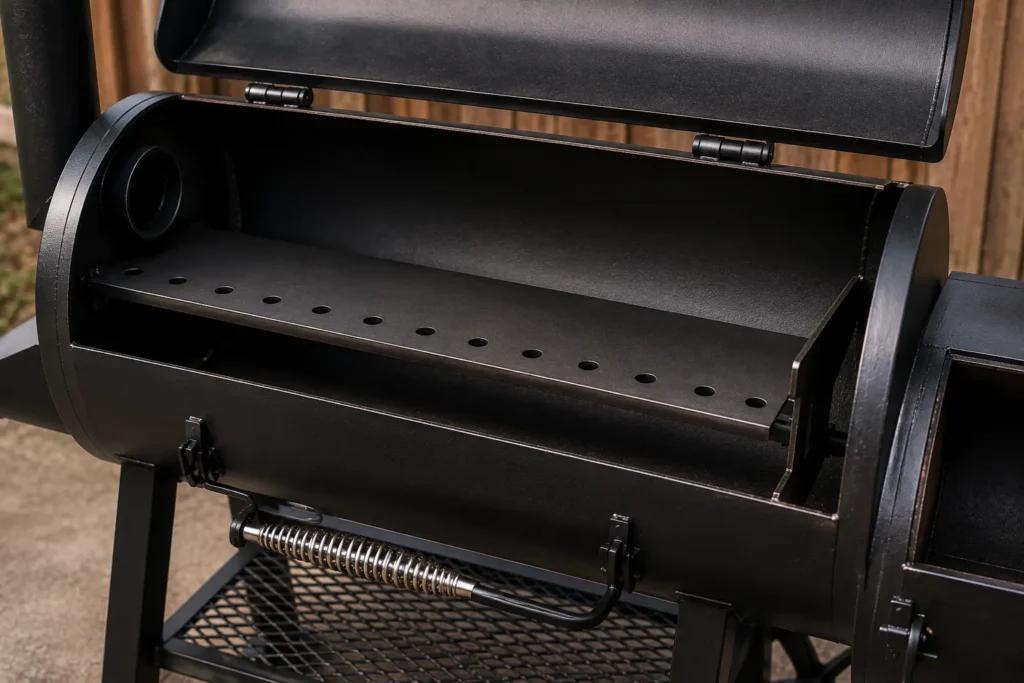
A reverse flow smoker is a type of offset smoker that uses a large steel baffle plate beneath the cooking grate — one extra piece of steel that changes everything about how heat moves through the pit.
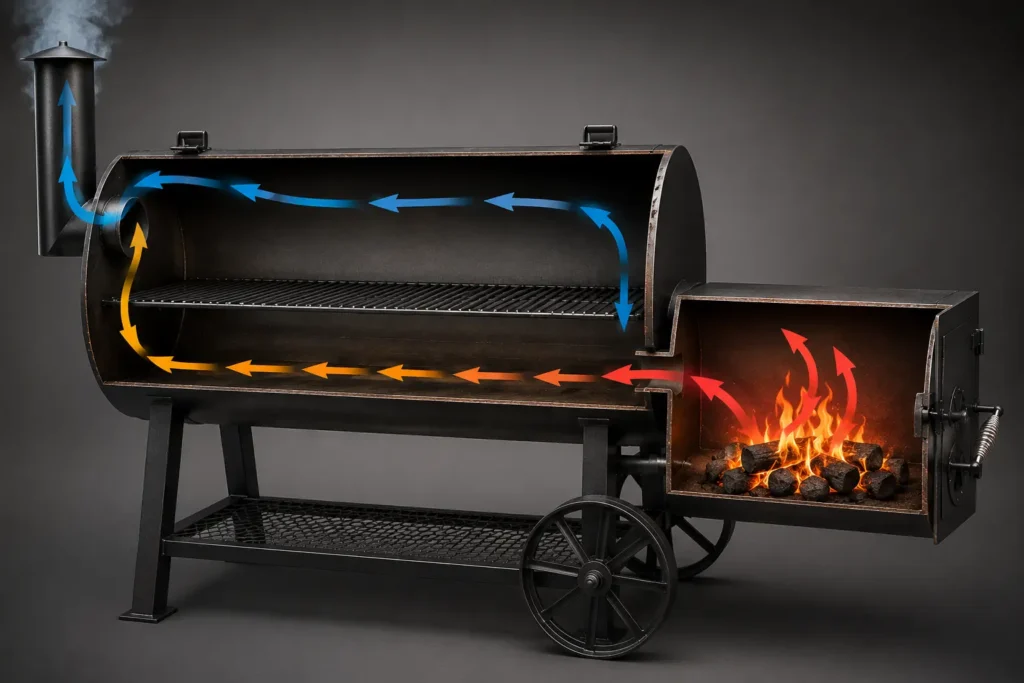
The firebox remains on the side of the cooking chamber, but the baffle changes the path taken by the heat and smoke. Instead of immediately moving across the top of the cooking chamber, heat and smoke are directed underneath the baffle toward the far end. Once they reach that area, they rise into the cooking chamber and travel back across the food before exiting through the exhaust.
The basic airflow pattern becomes:
Firebox → Under Baffle Plate → Far End → Across Food → Chimney
This additional path is the defining feature of a reverse flow design. The baffle plate also adds thermal mass to the smoker, which can help stabilize the cooking environment once the smoker has reached operating temperature.
Reverse-flow smoker manufacturers such as Lang BBQ Smokers build pits specifically around this reverse-flow principle, where heat travels beneath a plate before reversing across the cooking surface.
How Does a Reverse Flow Smoker Work?
It all comes down to the reverse flow smoker baffle plate — the key component of the whole design.
When the fire produces heat and smoke, the baffle prevents that energy from immediately rising directly toward the food. Instead, it forces the flow beneath the plate. The heat travels toward the far end of the cooking chamber, rises, and then reverses direction — the smoke and heat move back across the cooking grate before leaving through the exhaust.
This design creates a longer airflow path and spreads heat more evenly across the cooking chamber. The baffle can also reduce direct radiant heat from the firebox side, which is one reason reverse flow smokers can provide a more uniform cooking environment.
However, the design has a trade-off. The heavy plate takes time to heat during startup, and large temperature changes may happen more slowly because of the additional thermal mass. Pro tip: give a reverse flow pit extra time to warm up before judging its performance — patience at startup pays off for the whole cook.
Reverse Flow vs Standard Offset Smoker: Key Differences
Understanding the differences between these smokers becomes much easier when you compare the factors that actually affect a BBQ cook. Let’s walk through them one by one.
1. Heat Distribution
However, the design has a trade-off. The heavy plate takes time to heat during startup, and large temperature changes may happen more slowly because of the additional thermal mass. Pro tip: give a reverse flow pit extra time to warm up before judging its performance — patience at startup pays off for the whole cook.
This does not necessarily make a standard offset inferior — experienced pitmasters can deliberately use those different temperatures as cooking zones, and a well-built standard offset can achieve relatively consistent temperatures when the cooking chamber, firebox, airflow, and exhaust are properly designed.
A reverse flow smoker is specifically designed to reduce temperature differences. The baffle redirects heat beneath the cooking surface before allowing it to rise and return across the food, so a larger portion of the cooking grate operates under similar conditions.
Winner: Reverse Flow Smoker for more even heat distribution.
2. Smoke Circulation
In a standard offset smoker, smoke enters from the firebox and travels directly across the cooking chamber before reaching the exhaust. This direct airflow is part of the traditional offset-smoking experience.
A reverse flow smoker creates a longer path: smoke first travels beneath the baffle, rises at the opposite end, reverses direction, and passes over the food before exiting. That does not necessarily mean reverse flow produces stronger smoke flavor — smoke flavor also depends heavily on combustion quality, wood species, airflow, cooking temperature, moisture, and how long the meat is exposed to smoke.
Here’s what we always tell people: a clean-burning fire is far more important than simply trying to produce large amounts of visible smoke.
Winner: Tie. Both designs can produce excellent smoke flavor when operated correctly.
3. Temperature Control
Offset smoker temperature control requires active fire management regardless of which design you choose. A standard offset tends to react directly to changes in the fire — adjusting fuel or airflow can influence temperatures relatively quickly. The trade-off is that you may need to monitor different parts of the cooking chamber because temperature variation can occur across the grate.
A reverse flow smoker adds thermal mass through the baffle plate. Once everything is properly heated, this can create a more stable cooking environment. However, reverse flow does not turn an offset smoker into a set-and-forget appliance — you still need to maintain a clean fire, add wood when necessary, and manage airflow.
Winner: Reverse Flow Smoker for a generally more forgiving cooking environment.
4. Smoke Flavor and Bark
Both standard and reverse flow offset smokers can produce excellent smoke flavor and bark, but the way heat and smoke move through the cooking chamber can affect the cooking environment.
A standard offset smoker usually exposes food to a more direct flow of heat and smoke as it travels from the firebox toward the chimney. This can create stronger temperature zones and may produce more pronounced bark on food positioned closer to the firebox.
A reverse flow smoker sends heat and smoke beneath a baffle plate before directing it back across the cooking chamber. This creates a more even cooking environment and can help provide consistent smoke exposure across different areas of the grate.
The quality of smoke flavor depends more on clean combustion, proper airflow, wood selection, and fire management than on smoker design alone. Both types can produce deep smoke flavor and a well-developed bark when operated correctly.
5. Cooking Zones
This is one category where the standard offset smoker has a genuine advantage. Because heat enters from one side, traditional offsets naturally develop warmer and cooler areas.
Experienced pitmasters can use these offset smoker cooking zones strategically: a large cut that needs stronger heat can be positioned closer to the warmer side, while food that requires gentler heat can sit farther away. You can also move meat during a long cook depending on bark development, color, and cooking speed.
A reverse flow smoker is specifically intended to reduce these temperature differences. That creates consistency but also reduces the number of naturally distinct temperature zones.
Winner: Standard Offset Smoker for cooking-zone versatility.
6. Fuel Efficiency
Fuel efficiency is more complicated than simply saying one smoker design always burns less wood. Smoker construction, steel thickness, outside temperature, leaks, fire size, cooking temperature, wood quality, and fire-management technique can all influence fuel consumption.
The baffle inside a reverse flow smoker adds thermal mass. Once heated, that mass can help stabilize the cooking chamber — but heating the baffle itself also requires energy during startup. A poorly sealed reverse flow smoker may consume more fuel than a well-built standard offset, while a heavy, properly constructed reverse flow pit may maintain heat very effectively during a long cook.
For this reason, offset smoker fuel efficiency should be evaluated by individual smoker quality rather than airflow style alone.
Winner: Tie — build quality and fire management matter more.
7. Moisture, Radiant Heat, and Cooking Results
The baffle plate in a reverse flow smoker does more than redirect heat and smoke. As it heats up, it also creates a strong radiant heat source beneath the cooking grates, helping stabilize temperatures across the chamber. This more even radiant heat can reduce sharp hot spots and provide steadier cooking conditions for larger cuts such as brisket and pork shoulder. The baffle plate can also help catch some grease and drippings, which may reduce flare-ups depending on the smoker design.
A standard offset smoker usually has more direct heat variation from the firebox side to the chimney side. This can be useful when you want different cooking zones, but it may require more food rotation or positioning to avoid overcooking one side.
One honest note: neither design automatically keeps meat more moist. Moisture retention still depends mainly on cooking temperature, meat composition, airflow, wrapping method, and when the food is removed from the smoker.
8. Grease Management
Grease management varies between individual smoker models. Many reverse flow smokers use their baffle plate as part of the grease-management system — grease can be directed along the plate toward a drain rather than accumulating near the firebox. This can reduce the chance of grease reaching extremely hot surfaces and can simplify cleanup, though the effectiveness depends on how the baffle and drainage system are designed.
Standard offset smokers may also include grease drains, drip trays, tuning plates, or other systems. When buying either design, check where grease collects and how easily it can be removed.
Winner: Reverse Flow Smoker in many designs, but this is model-dependent.
9. Cleaning and Maintenance
Both smoker designs require regular cleaning, but their internal layouts can make maintenance slightly different. A standard offset smoker usually has a simpler cooking chamber, which can make ash, grease, and residue easier to access and remove — cleaning typically involves brushing the grates, removing grease buildup, and clearing ash from the firebox.
A reverse flow smoker includes a baffle plate beneath the cooking grates. This plate can collect grease and drippings, so it may need extra attention during cleaning — depending on the smoker design, the plate may be removable or fixed in place.
Regular maintenance is important for both types. Keeping the cooking chamber, firebox, grease drains, and airflow paths clean helps maintain stable temperatures and reduces unwanted smoke or residue buildup.
10. Startup and Heat Recovery
A standard offset generally has less steel inside the cooking chamber because there is no large reverse-flow baffle to heat — so the cooker can respond more quickly when you change the fire.
A reverse flow smoker needs enough time for its baffle plate and cooking chamber to reach operating temperature, and that additional thermal mass can make startup slower. Once heated, however, the same mass can help stabilize the cooking environment.
This creates a simple trade-off:
Standard Offset: Faster response and greater control over changing temperatures.
Reverse Flow: Slower thermal response but potentially greater stability once fully heated.
Reverse Flow vs Standard Offset Smoker Comparison
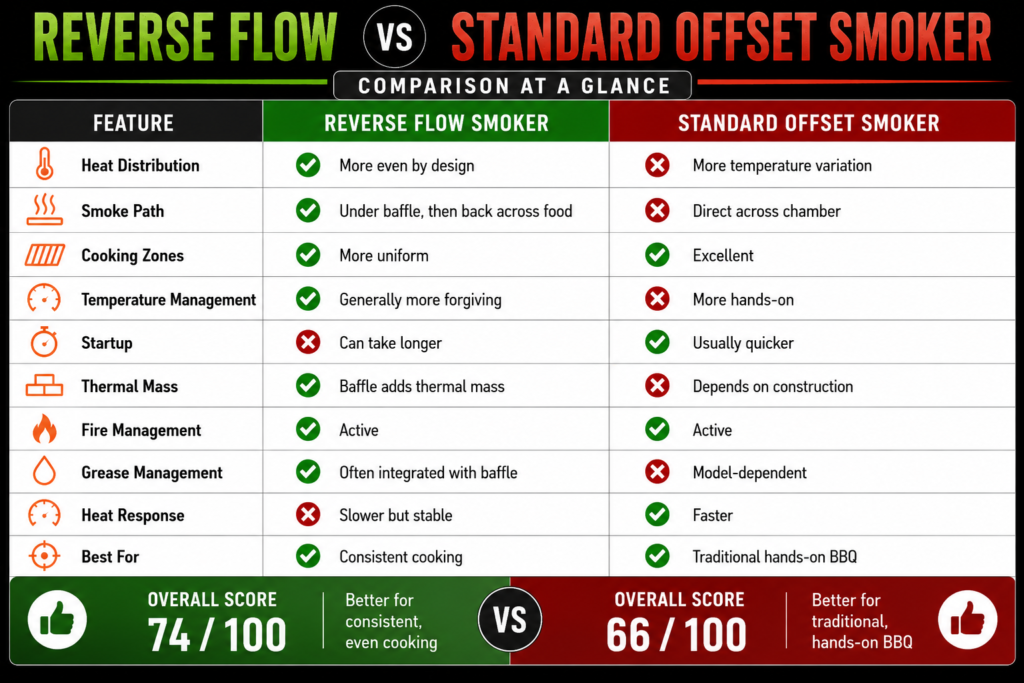
The comparison shows why there is no single smoker that is best for everyone — it all depends on what matters most to you.
Price, Weight, and Long-Term Value
Reverse flow smokers are often heavier than standard offset smokers because they include an internal baffle plate and, in many cases, thicker steel construction. This extra material can increase both the purchase price and the overall weight of the smoker.
Standard offset smokers are available across a wider price range, including many entry-level models. However, lower-cost units may use thinner steel, which can lose heat more quickly and require more active fire management.
Long-term value depends more on overall build quality than on airflow design alone. A well-built standard offset smoker with thick steel, tight door seals, and a durable firebox can outperform a poorly constructed reverse flow model.
When comparing price, consider steel thickness, weld quality, cooking capacity, replacement parts, and expected durability rather than choosing based only on whether the smoker uses standard or reverse flow.
Reverse Flow Smoker Pros and Cons
Understanding reverse flow smoker benefits as well as the disadvantages can help determine whether the design fits your cooking style. Here’s the honest breakdown.
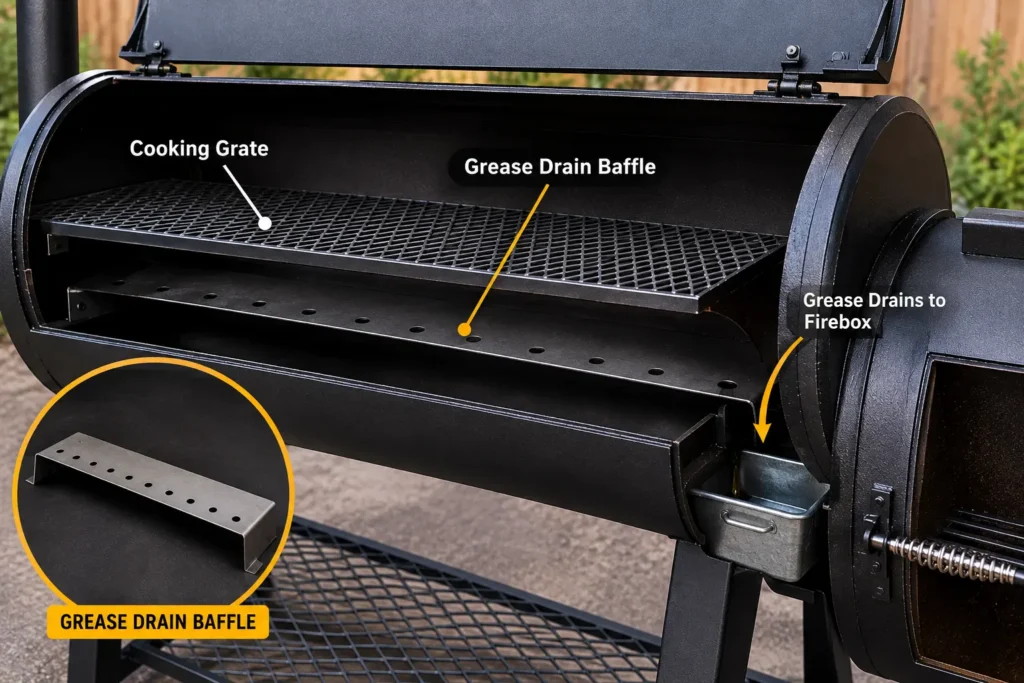
Advantages of a Reverse Flow Smoker
More Even Heat Distribution
The baffle spreads heat across the cooking chamber and reduces extreme hot and cold areas — the signature advantage of the design.
Consistent Cooking Surface
A larger portion of the cooking grate can operate at similar temperatures, which is particularly useful when smoking several pieces of meat simultaneously.
More Forgiving Temperature Management
Once fully heated, the added thermal mass can help stabilize cooking temperatures.
Reduced Direct Heat
The baffle provides a barrier between the firebox opening and the food, reducing direct radiant heat on the firebox side.
Potentially Better Grease Management
Some reverse flow designs use the baffle and drainage system together to direct grease away from critical areas.
Disadvantages of a Reverse Flow Smoker
Longer Startup
The baffle plate must absorb significant heat before the smoker stabilizes — plan for a longer warm-up.
Slower Temperature Changes
Additional thermal mass means temperature adjustments may take longer to become noticeable.
Fewer Natural Cooking Zones
More uniform temperatures provide less flexibility for intentionally cooking foods at different heat levels.
Baffle Maintenance
Grease and carbon can accumulate on the plate, requiring regular cleaning.
Fuel Efficiency Is Not Guaranteed
A reverse-flow design alone does not guarantee lower wood consumption.
Standard Offset Smoker Pros and Cons
A standard offset remains popular because it provides flexibility and the classic experience of managing a live wood fire. Here’s the full, honest picture.
Advantages of a Standard Offset Smoker
Traditional BBQ Experience
Traditional offsets provide the classic combination of wood combustion, airflow management, temperature zones, and hands-on cooking — the full pitmaster experience.
Excellent Cooking Zones
The natural temperature gradient can be used strategically when smoking different foods at the same time.
Responsive Temperature Control
Changes to the fire can affect cooking temperatures relatively quickly — you stay in direct command of the cook.
Excellent for Learning Fire Management
Managing a traditional offset teaches you how wood size, oxygen, fire intensity, and exhaust affect BBQ. It’s the fastest way to build real fire-management instincts.
Modification Potential
Many standard offsets can be upgraded with tuning plates, baffles, charcoal baskets, gaskets, and other accessories, so the pit can grow with your skills.
Disadvantages of a Standard Offset Smoker
Greater Temperature Variation
Lower-quality smokers can have substantial differences between the firebox and chimney ends.
Steeper Learning Curve
Fire management, airflow, and food placement require practice — expect a few learning cooks.
More Monitoring
You may need to check temperatures at different locations and reposition meat during longer cooks.
Build Quality Is Critical
Thin steel, poor seals, and badly designed fireboxes can make temperature control frustrating — buy the best-built pit you can.
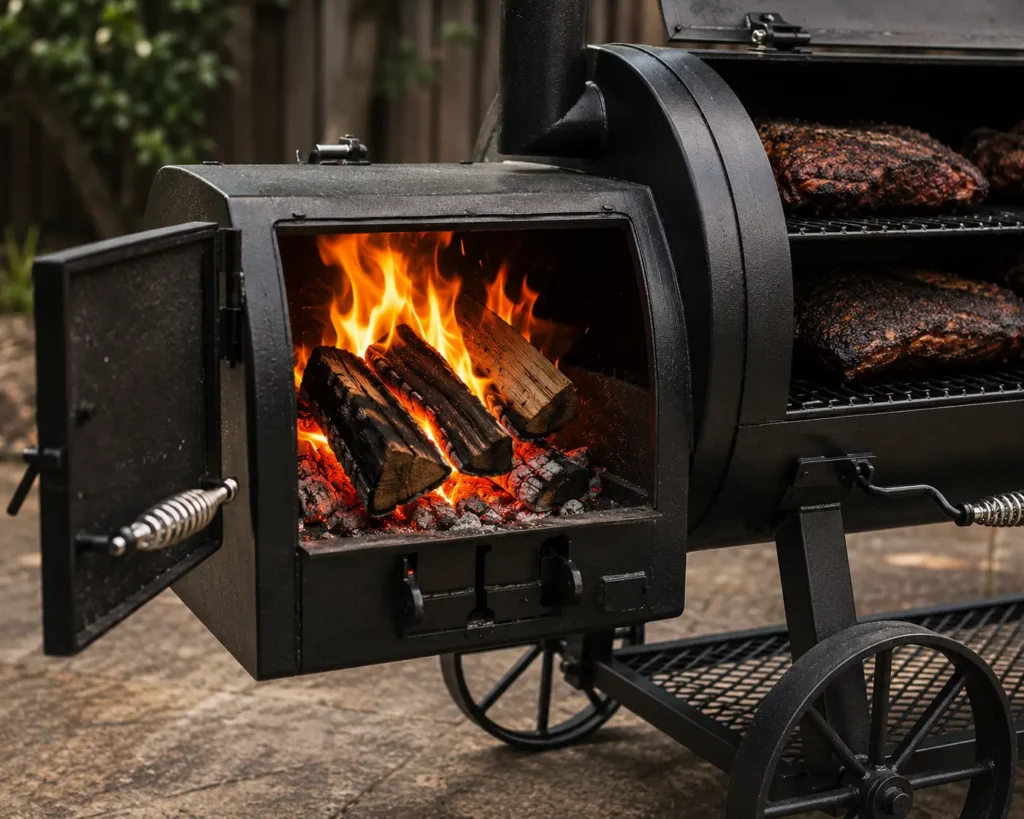
Which Offset Smoker Is Better for Beginners?
This is one of the most common questions we hear, and the honest answer is: it depends on how you want to learn. A reverse flow smoker can be easier for beginners because it is designed to reduce large temperature differences across the cooking grate — so beginners may spend less time worrying about whether one side of the meat is cooking much faster than the other.
However, beginners should not automatically avoid standard offsets. A well-built standard offset can be one of the best tools for learning real fire management. Understanding how airflow, fuel size, combustion, and temperature zones interact will improve your BBQ skills regardless of what smoker you eventually use.
Choose reverse flow if you want a more forgiving cooking environment. Choose standard flow if you want to learn the traditional hands-on approach from the beginning.
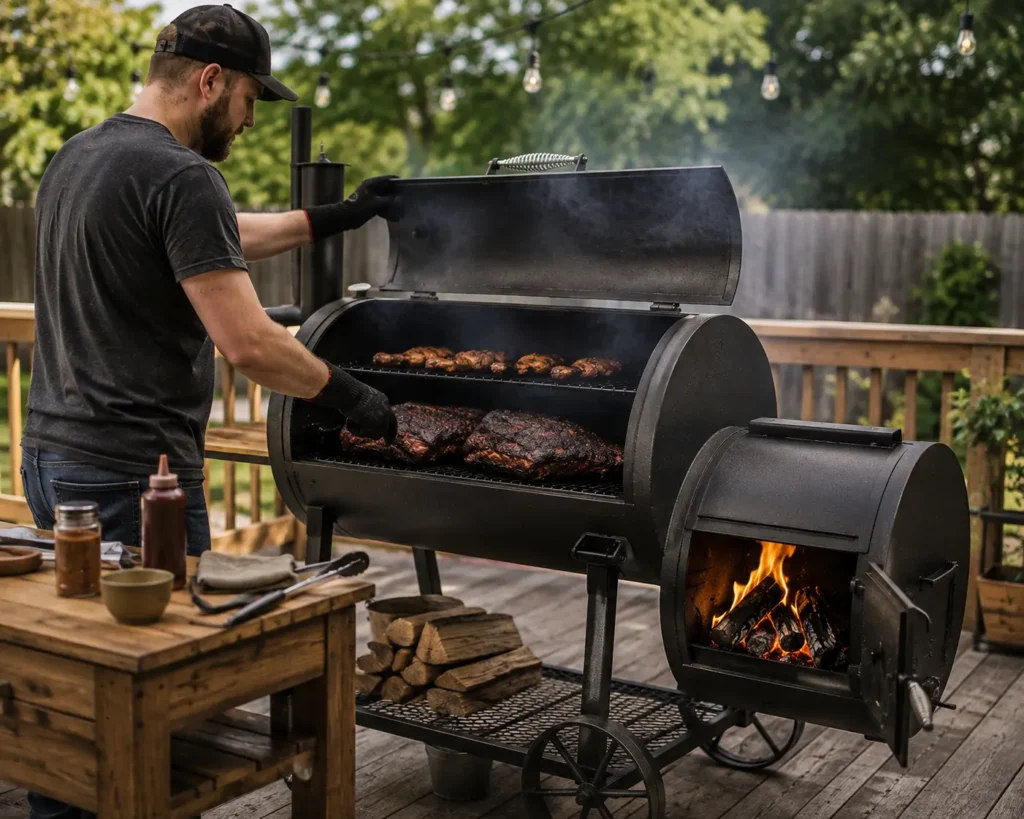
Which Smoker Is Better for Brisket?
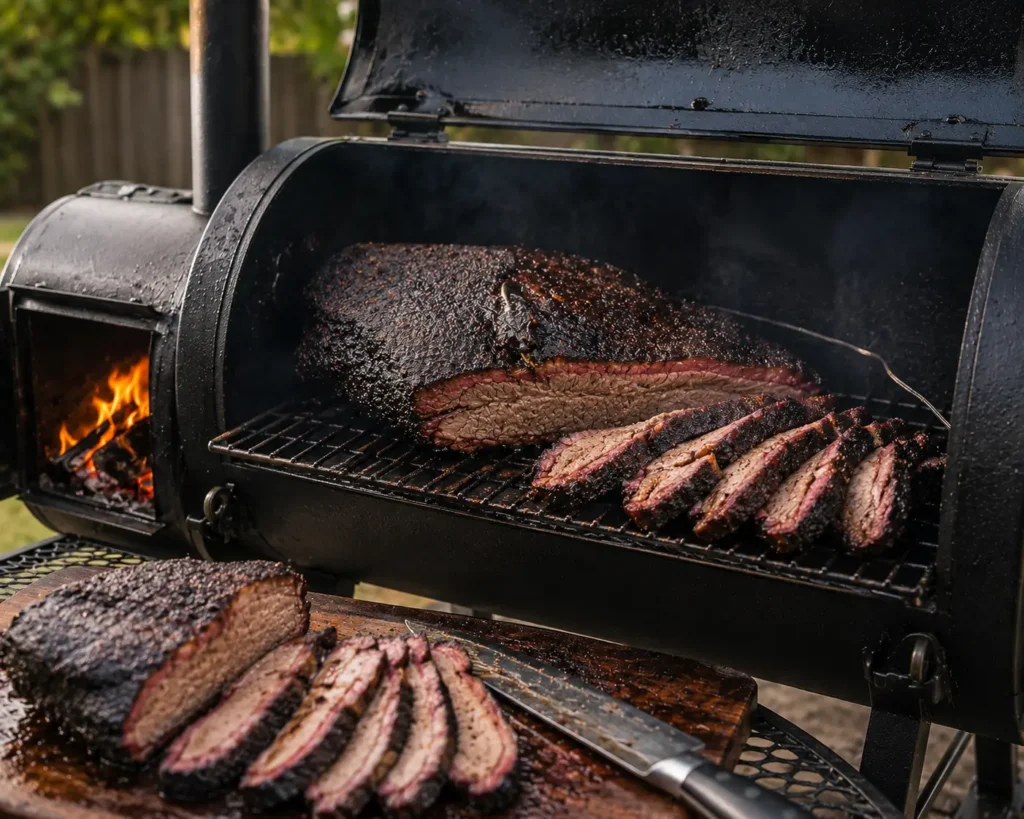
Both designs can produce outstanding brisket. A standard offset allows you to take advantage of different temperature zones and position the brisket according to the way your particular smoker cooks, while a reverse flow smoker provides a more uniform cooking environment, which can simplify placement during a long brisket cook.
And here’s the perspective that matters most: the smoker design itself is only part of the equation. Fire quality, clean smoke, cooking temperature, bark development, wrapping strategy, internal temperature, and resting technique can all have a major impact on the final brisket.
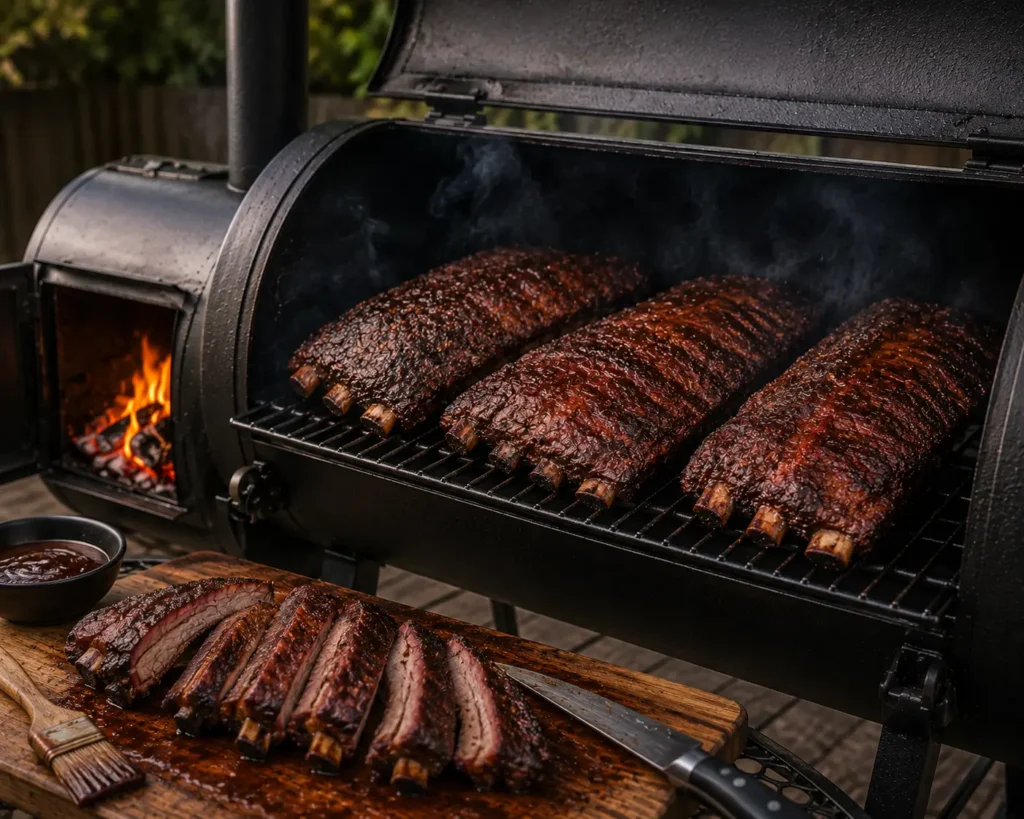
Which Smoker Is Better for Ribs?
Both standard and reverse flow smokers work extremely well for ribs. Reverse flow can be particularly useful when smoking several racks because similar temperatures across the grate can help them cook more consistently — while a standard offset offers another advantage: you can move individual racks between hotter and cooler zones depending on how quickly they are developing.
The short version: for large batches where consistency is the priority, reverse flow may be more convenient. For active temperature-zone management, standard offset provides more flexibility.
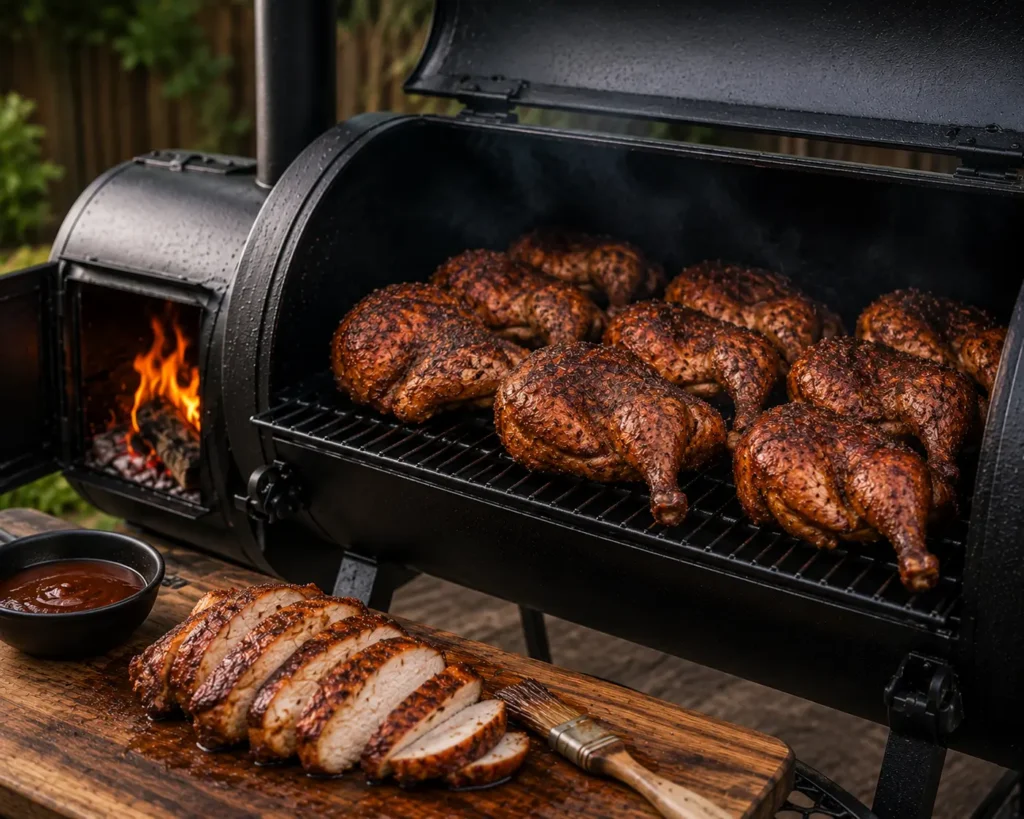
Which Smoker Is Better for Chicken?
Chicken works well in either design. A standard offset’s warmer zone can be useful when you want stronger heat for skin development, while cooler areas can provide gentler cooking. A reverse flow smoker makes it easier to expose multiple pieces of chicken to similar temperatures.
For chicken, cooking temperature, fire quality, and internal meat temperature will usually matter more than choosing between standard and reverse flow.
If you want to put these techniques into practice, try this smoked chicken breast recipe for a complete example of preparing and smoking chicken breast.
What Should You Look for When Buying an Offset Smoker?
A good BBQ smoker buying guide should focus on construction rather than marketing terminology alone. Do not buy a smoker simply because the manufacturer calls it reverse flow — here’s what we actually compare when evaluating a pit.
Steel Thickness
Heavier steel provides more thermal mass and generally handles changing weather conditions better than extremely thin metal.
Door Seals
Large uncontrolled leaks can make fire management difficult. A well-fitting door gives you greater control over airflow.
Firebox Design
The firebox should provide enough room for a clean-burning fire using appropriately sized wood splits.
Exhaust Design
A smoker needs effective airflow from intake to exhaust. The chimney is therefore a functional component, not just a place for smoke to escape.
Cooking Chamber Size
Choose enough cooking area for the amount of food you regularly prepare. A larger chamber provides capacity but also requires more energy to heat.
Grease Drainage
Look for a practical drainage system that can be accessed and cleaned easily.
Thermometer Placement
Built-in thermometers can provide useful information, but grate-level probes generally provide a better understanding of the actual temperature around your food. Pro tip: never trust the lid thermometer alone — a probe at grate level tells the real story.
Build Quality Matters More Than Reverse Flow vs Standard Flow
This is one of the most important points in the entire reverse flow vs standard offset smoker comparison — and one we can’t stress enough.
A smoker is not automatically superior because it has a reverse-flow baffle. A poorly built reverse flow smoker with thin steel, large air leaks, weak welds, or an inefficient firebox can be difficult to operate — while a well-built standard offset with good airflow and proper seals can provide excellent temperature stability.
Experienced smoker manufacturers and builders emphasize construction quality because smoker performance depends on how the entire system works together. When comparing two smokers, ask:
How thick is the steel?
How well do the doors seal?
Is the firebox appropriately sized?
How is airflow controlled?
Where is the exhaust positioned?
How does grease drain?
Can the cooking chamber be cleaned easily?
These details can matter more than the reverse-flow label itself.
Can You Improve a Standard Offset Smoker?
Yes. If you already own a standard offset, you do not necessarily need to replace it with a reverse flow smoker.
Tuning plates can help redistribute heat across the cooking chamber. A baffle installed near the firebox opening can reduce direct radiant heat and help spread heat farther into the chamber. High-temperature gasket material can reduce uncontrolled leaks around doors, and a charcoal basket can help organize the fire depending on how you operate your smoker.
However, modifications cannot replace proper fire management. Use appropriately sized wood splits, maintain airflow, avoid smoldering fires, and learn where the natural hot and cool areas are inside your smoker. Rather than trying to make every inch of the cooking chamber exactly the same temperature, learn how to use the smoker’s characteristics to your advantage.
How to Get Better Results From a Reverse Flow Smoker
Reverse flow does not eliminate the need for good BBQ technique. Start with a clean-burning fire and allow the smoker enough time to stabilize before adding meat — the baffle needs to become fully heated, so avoid rushing the startup process.
Keep the exhaust sufficiently open to support clean airflow and control your fire primarily through fuel management and the smoker’s intended airflow controls. Avoid constantly opening the cooking chamber — each opening releases heat and changes airflow.
You should also keep the reverse-flow plate and grease-drainage system clean enough to function properly. Once you understand how your particular smoker stores and releases heat, maintaining stable temperatures becomes much easier.
Reverse Flow vs Standard Offset Smoker: Which Should You Buy?
Your decision should ultimately match the way you enjoy cooking.
Choose a Reverse Flow Smoker If:
You prioritize even heat distribution, regularly cook large amounts of food, want fewer extreme hot spots, and prefer a more consistent cooking environment. Reverse flow can also be attractive to beginners who want to focus on learning fire management without simultaneously dealing with major grate-temperature differences.
Choose a Standard Offset Smoker If:
You enjoy traditional wood-fired BBQ, want multiple cooking zones, like actively managing the fire, and prefer greater control over food placement. Standard offsets can be especially rewarding for pitmasters who enjoy learning exactly how their smoker responds to different fires and airflow conditions.
Final Verdict: Reverse Flow vs Standard Offset Smoker
There is no universal winner in the reverse flow vs standard offset smoker debate. A reverse flow smoker has a clear design advantage when your priority is a more uniform cooking environment — its baffle directs heat beneath the cooking surface before sending it back across the food, helping reduce temperature differences.
A standard offset provides direct airflow, natural cooking zones, and the traditional hands-on BBQ experience. Experienced pitmasters can turn the natural temperature gradient into an advantage by strategically positioning different foods.
Most importantly, reverse flow does not automatically mean better. A high-quality standard offset with thick steel, good airflow, strong seals, and an efficient firebox can outperform a cheaply constructed reverse flow smoker. Likewise, a well-built reverse flow smoker can make long cooks easier by creating more consistent temperatures across the cooking surface.
If consistency and reduced temperature variation are your priorities, choose a quality reverse flow smoker. If you enjoy traditional fire management and want useful cooking zones, choose a quality standard offset smoker. Either way, learning your equipment and maintaining a clean-burning fire will have a greater impact on your BBQ than the label attached to the smoker.
Frequently Asked Questions
A standard offset sends heat and smoke directly from the firebox across the cooking chamber toward the chimney. A reverse flow smoker uses a baffle plate to send heat and smoke beneath the cooking surface before reversing the flow back across the food.
Not always. Reverse flow smokers generally provide more even heat distribution, while standard offsets provide better cooking-zone flexibility and a more traditional hands-on BBQ experience. Build quality is also extremely important.
Yes. Charcoal can be used in a reverse flow smoker as a steady heat source, often together with wood splits or chunks for smoke flavor. The exact setup depends on the smoker design, so always follow the manufacturer’s fuel recommendations and maintain clean airflow for efficient combustion.
A reverse flow smoker is a type of offset smoker. Both use a separate firebox attached to the cooking chamber, but a reverse flow smoker adds a baffle plate that directs heat and smoke underneath the cooking chamber before sending it back across the food toward the chimney.
A standard offset smoker is usually easier to clean because it has a simpler cooking chamber with fewer internal components. Reverse flow smokers include a baffle plate that can collect grease and drippings, so they may require a little more cleaning around and beneath the plate.
Cleaning difficulty also depends on the smoker’s specific design, including whether the baffle plate is removable and how accessible the grease drain and firebox are.
A reverse flow smoker generally provides more even heat distribution because the baffle plate helps spread heat across the cooking chamber.
They can be. More uniform temperatures can reduce the need to constantly reposition food because of hot and cool spots. However, beginners still need to learn proper fire and airflow management.
Not necessarily. Fuel consumption depends on steel thickness, smoker construction, leaks, outside weather, fire management, cooking temperature, and wood quality as well as smoker design.
Many do have a warmer area near the firebox and a cooler area toward the chimney. How large that difference is depends heavily on smoker construction and fire management.
Yes. Many standard offsets can be modified with baffle or tuning plates to help redistribute heat and reduce extreme temperature differences.
Both can produce excellent brisket. Reverse flow offers a more uniform cooking surface, while standard offsets allow experienced cooks to take advantage of different temperature zones.
Both are suitable. Reverse flow can make cooking several racks at similar temperatures easier, while a standard offset gives you more flexibility to move individual racks between warmer and cooler areas.
Not automatically. Smoke flavor depends on wood choice, combustion quality, airflow, cooking temperature, meat surface, and exposure time. The reverse-flow design changes the smoke path but does not guarantee stronger flavor.
Generally, thicker steel provides greater thermal mass and can help stabilize temperatures. However, airflow, seals, firebox design, weld quality, and overall construction are also important.
Choose reverse flow if you prioritize even cooking temperatures and a consistent cooking surface. Choose a standard offset if you prefer traditional fire management, multiple temperature zones, and more hands-on control.
Choosing the Right Offset Smoker for Your BBQ Style
The reverse flow vs standard offset smoker decision ultimately comes down to how you want to cook. Reverse flow gives you a controlled heat path and generally more uniform temperatures. Standard offset gives you direct airflow, distinct cooking zones, and the classic hands-on offset-smoking experience.
Neither design eliminates the need for good fire management. The best smoker is one that matches your cooking style, provides solid construction, maintains clean airflow, and gives you enough control to produce consistently great BBQ.
Still on the fence? Revisit the winner calls in the key-differences section above, then ask yourself which list sounds more like you. Whichever way you lean, you’ll be cooking real wood-fired barbecue — and that’s what we’re all here for.