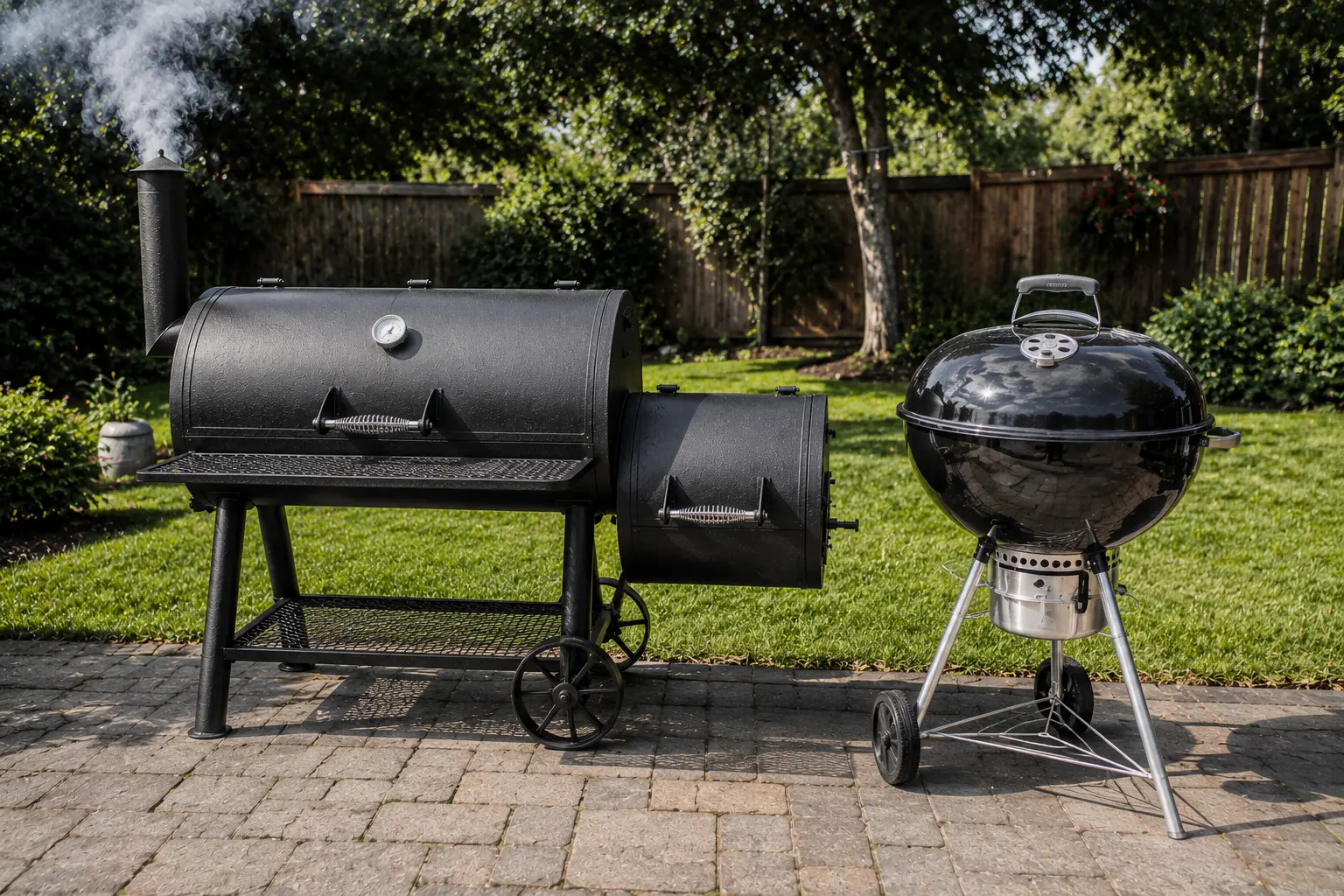
Choosing between an offset smoker vs charcoal grill depends on how you prefer to cook. An offset smoker specializes in low-and-slow barbecue, while a charcoal grill is designed primarily for faster direct-heat cooking.
Offset smokers use a separate side firebox to circulate heat and smoke through a horizontal cooking chamber. This design is ideal for brisket, ribs, pork shoulder, and other cuts that benefit from several hours of indirect cooking.
Charcoal grills place the fuel inside the main cooking body, usually beneath or beside the food. They reach higher temperatures more quickly, making them better for burgers, steaks, kebabs, vegetables, and other foods that require searing. A charcoal grill can also smoke food when it has a lid and enough room for a two-zone fire.
⚡ Quick Answer: Choose an offset smoker for large cuts, long cooking sessions, maximum smoke flavor, and greater cooking capacity. Choose a charcoal grill for faster meals, high-heat searing, portability, and greater everyday versatility.
Best Overall Choice: If smoking brisket and ribs is your main goal, buy an offset smoker. If you mostly cook burgers, steaks, chicken, and vegetables but occasionally want to smoke meat, a lidded charcoal grill is more practical.
Offset Smoker vs Charcoal Grill: Quick Comparison
| Feature | Offset smoker | Charcoal grill |
| Main purpose | Low-and-slow smoking | Direct grilling and searing |
| Fire position | Separate side firebox | Inside the main grill |
| Typical cooking temperature | Approximately 225°F–275°F | Approximately 350°F–600°F+ |
| Cooking speed | Slow | Fast |
| Smoke flavor | Strong and pronounced | Mild to strong |
| Cooking capacity | Usually large | Small to medium |
| Fuel consumption | Moderate to high | Low to moderate |
| Portability | Usually heavy | Often compact and portable |
| Learning curve | Moderate to difficult | Easy to moderate |
| Best foods | Brisket, ribs and pork shoulder | Steaks, burgers and vegetables |
These temperature ranges are general rather than fixed. Both appliances can operate outside their typical ranges when their design and manufacturer’s instructions allow it.
What Is an Offset Smoker?
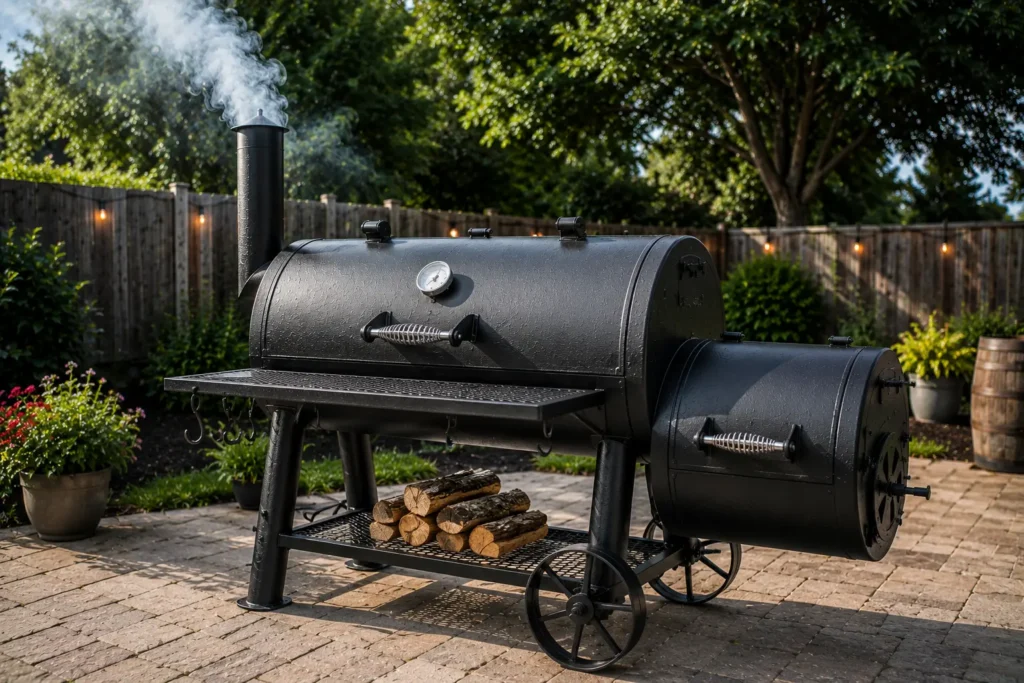
An offset smoker consists of a horizontal cooking chamber connected to a smaller firebox. Charcoal or hardwood burns inside the firebox, while heat and smoke travel through the cooking chamber before leaving through the chimney.
Separating the fire from the food creates an indirect cooking environment. This allows large cuts to cook slowly while absorbing smoke and gradually becoming tender.
A typical offset smoker includes adjustable dampers, a firebox door, cooking grates, a chimney, and one or more temperature gauges. Heavy-duty models use thick steel that stores heat and provides better temperature stability. Less expensive smokers may use thinner steel, which can lose heat more quickly in cold or windy conditions.
Many people use charcoal to establish a reliable coal bed before adding seasoned hardwood splits or chunks. The charcoal provides stable heat, while the wood creates the desired smoke flavor.
Our complete offset smoker guide explains how the cooking chamber, firebox, chimney, and dampers work together.
What Is a Charcoal Grill?
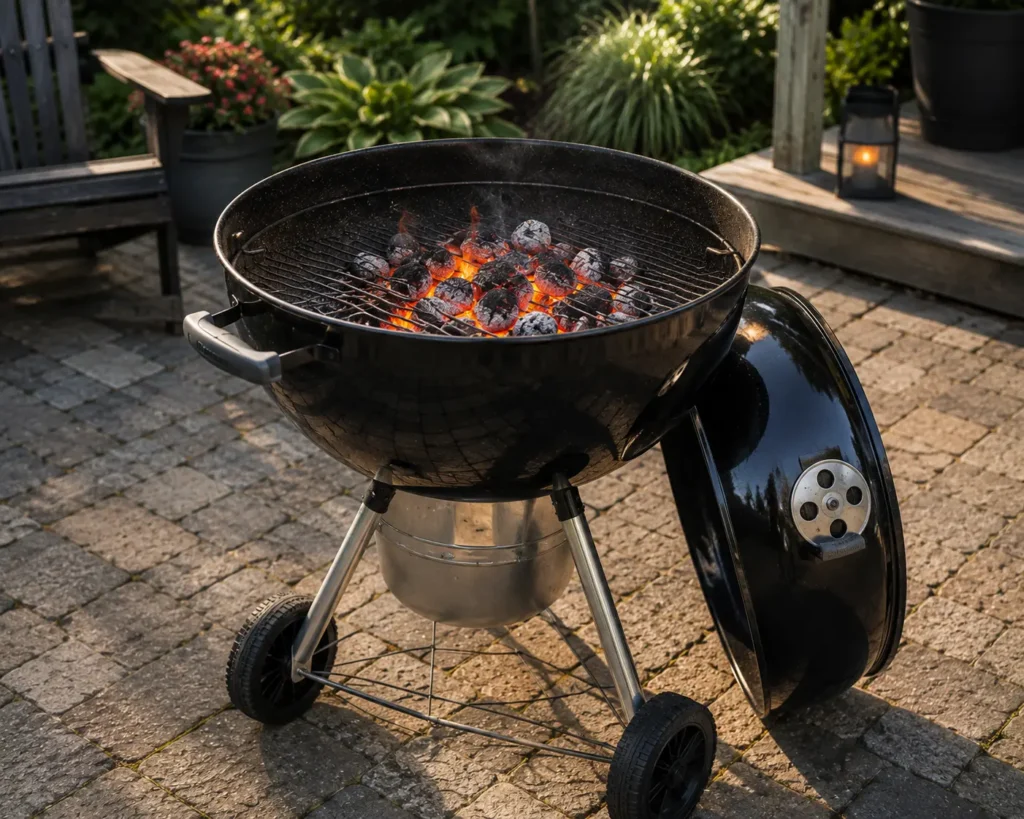
A charcoal grill uses lump charcoal or charcoal briquettes as its main heat source. The charcoal is arranged inside the grill beneath or beside the cooking grate.
Charcoal grills are available in several designs, including kettle, barrel, hibachi, ceramic, and portable grills. Most have adjustable vents that control oxygen flow and a lid that traps heat.
When the charcoal is positioned directly beneath the food, the grill produces high heat suitable for steaks, burgers, kebabs, chicken pieces, seafood, and vegetables. When the charcoal is moved to one side and the food is placed on the opposite side, the grill creates an indirect cooking zone.
A lidded charcoal grill can therefore roast and smoke food as well as grill it. Wood chunks can be added to the charcoal to create smoke flavor, although its cooking capacity and fire access may be more limited than those of a dedicated offset smoker.
Main Differences Between an Offset Smoker and Charcoal Grill
Cooking method: An offset smoker specializes in indirect cooking. The fire remains inside a separate firebox and does not sit directly beneath the food. A charcoal grill can use either direct or indirect heat, depending on how the charcoal is arranged.
Cooking temperature: Offset smokers normally operate at lower temperatures for several hours. Charcoal grills are better at reaching the high temperatures required for browning and searing.
Cooking time: Brisket, pork shoulder, and ribs can require several hours in an offset smoker. Burgers, steaks, vegetables, and chicken pieces can be cooked much more quickly on a charcoal grill.
Smoke flavor: Offset smokers can burn hardwood continuously, producing a deep wood-fired flavor. Charcoal grills also create smoke flavor, particularly when wood chunks are added, but the result may be less pronounced during shorter cooks.
Capacity: Offset smokers generally provide wide cooking grates suitable for full briskets and several rib racks. Charcoal grills are often smaller, although large barrel and ceramic models can provide substantial space.
Fire access: Fuel can be added to an offset smoker through the firebox door without opening the main cooking chamber. On some charcoal grills, the cooking grate or food may need to be moved before more fuel can be added.
Fuel efficiency: A charcoal grill usually consumes less fuel because it has a smaller cooking chamber and shorter cooking times. An offset smoker must heat a larger steel body and maintain that heat for many hours.
Portability: Charcoal grills are generally lighter and easier to transport. Offset smokers can be wide, heavy, and difficult to move across steps or uneven surfaces.
Learning curve: Both appliances require airflow and fuel management. However, maintaining a clean wood fire in an offset smoker normally requires more practice than preparing a two-zone fire in a charcoal grill.
Benefits and Drawbacks of an Offset Smoker
The biggest advantage of an offset smoker is its ability to produce authentic wood-fired barbecue. Clean-burning hardwood creates a pronounced smoke aroma, dark bark, and a flavor that is difficult to reproduce during a short grilling session.
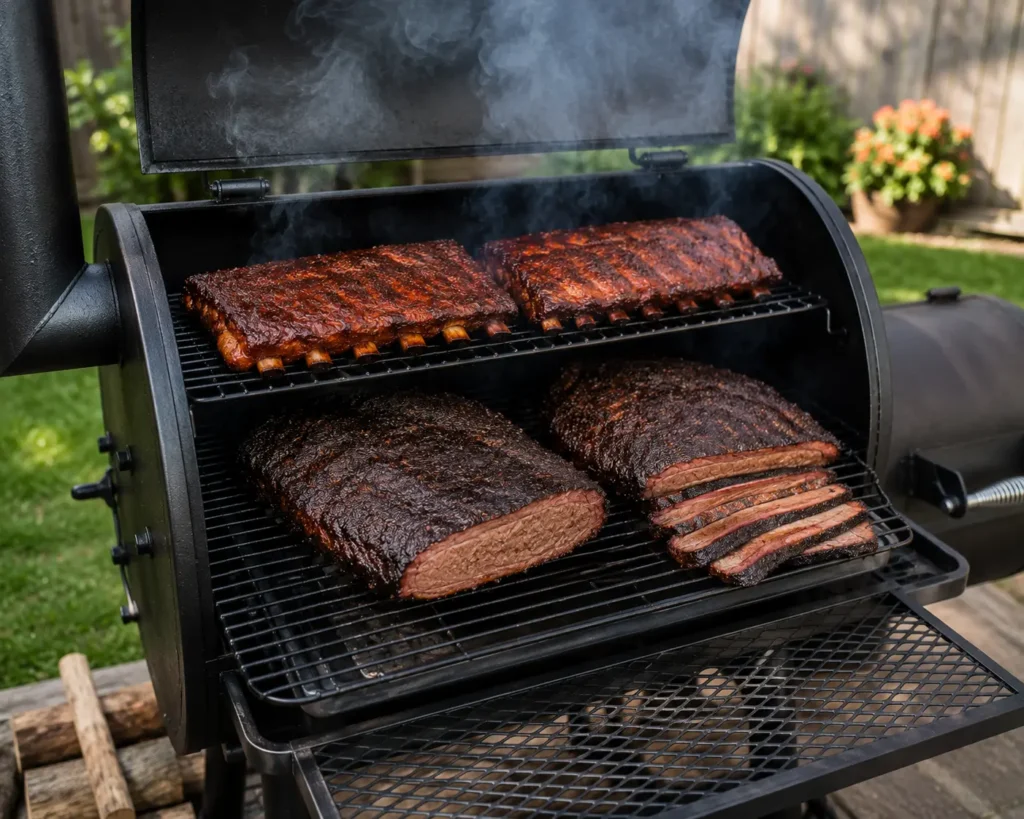
Offset smokers also offer large cooking chambers. Depending on the model, you may be able to prepare several pork shoulders, multiple rib racks, chickens, or full packer briskets simultaneously. This makes an offset smoker suitable for family events, parties, competitions, and catering.
The separate firebox allows fuel to be added without repeatedly opening the cooking chamber. Some models also include a cooking grate inside the firebox for direct grilling.
However, an offset smoker requires patience and active attention. Fire size, airflow, wood quality, outside temperature, wind, and steel thickness can all influence the cooking temperature.
Traditional offset smokers also develop a hotter zone near the firebox. Food may need to be positioned carefully or rotated during long cooking sessions. Larger models consume considerable amounts of wood and charcoal and require more cleaning than a compact grill.
Our offset smoker fire management tips explain how to maintain stable heat and cleaner smoke.
Benefits and Drawbacks of a Charcoal Grill
A charcoal grill is more versatile for everyday outdoor cooking. It can sear steaks, grill burgers, roast chicken, cook vegetables, and smoke smaller cuts when arranged for indirect heat.
Charcoal grills heat up more quickly than most offset smokers and require less fuel for short meals. Compact kettle and portable models are also easier to store, transport, and use in small outdoor spaces.
A lidded charcoal grill can create two cooking zones. Charcoal is placed on one side for direct heat, while the opposite side remains cooler for indirect cooking. This arrangement allows you to sear food before finishing it more gently away from the coals.
The main limitation is cooking capacity. A smaller grate can make it difficult to prepare full briskets, multiple pork shoulders, or several rib racks. Fuel access can also be inconvenient during long cooks unless the grill has hinged cooking grates.
A charcoal grill does not provide the same continuous hardwood-fire experience as an offset smoker. It can produce excellent smoked food, but managing smoke and temperature for an extended period may require additional charcoal and careful vent adjustments.
Can You Smoke Food on a Charcoal Grill?
Yes. A charcoal grill with a lid can be configured for smoking by creating separate hot and cool zones.
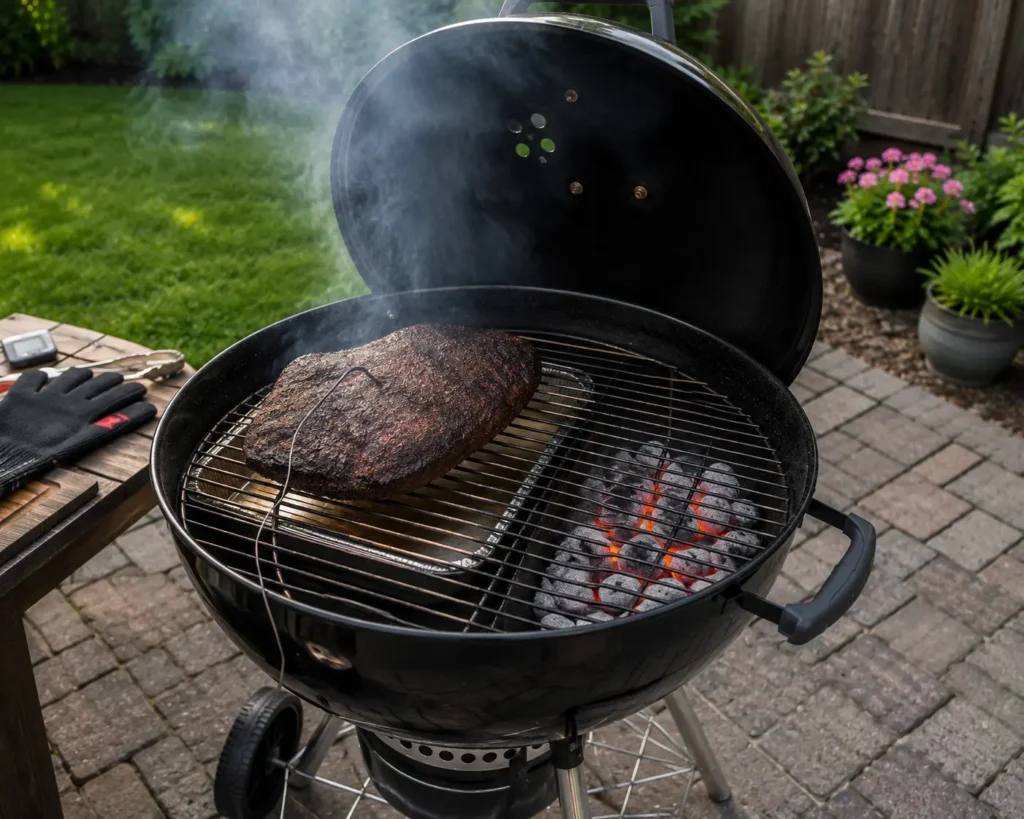
Place the charcoal on one side of the grill and position the food on the opposite side. This prevents the food from sitting directly above the heat. A drip or water pan can be positioned beneath the food when appropriate for the recipe and grill design.
Add a small amount of seasoned hardwood to the charcoal for smoke. Wood chunks generally last longer than small chips and do not need soaking. Avoid adding excessive wood because dense smoke can produce bitter food.
Adjust the intake and exhaust vents to maintain the required cooking temperature. Keep the lid closed and position its exhaust vent over or near the food side when the grill design permits. This encourages heat and smoke to travel across the food before leaving the grill.
A charcoal grill works well for smoking chicken, sausages, ribs, pork loin, and smaller pork shoulders. A dedicated offset smoker is generally more convenient for multiple large cuts and extremely long cooking sessions.
Can You Use an Offset Smoker as a Charcoal Grill?
Some offset smokers can be used for direct charcoal grilling, but this depends on the model.
Many smokers include a grate inside the firebox that can be used for burgers, steaks, or other small foods. Certain combination models also allow charcoal to be placed safely inside the main chamber.
Do not place burning charcoal inside the cooking chamber unless the manufacturer specifically permits it. The paint, grease system, cooking grate, and airflow may not be designed for direct fire.
For more information about combination models, see our offset smoker grill guide.
Which One Should You Choose?
Choose an offset smoker if low-and-slow barbecue is your main priority. It is the stronger choice for full briskets, pork shoulders, beef ribs, multiple rib racks, and large gatherings.
An offset smoker is also suitable if you enjoy managing a fire and experimenting with different hardwoods. Oak produces balanced smoke, hickory creates a stronger barbecue profile, and fruitwoods such as apple or cherry provide a milder flavor.
Choose a charcoal grill if you need one appliance for everyday outdoor cooking. It is better for quick meals, high-temperature searing, small patios, camping, and buyers with a limited budget.
A charcoal grill is also the practical choice if you only smoke food occasionally. A correctly configured kettle or barrel grill can prepare ribs, chicken, pork, and smaller cuts without requiring a separate smoker.
If you want both functions regularly, consider owning a charcoal grill for quick cooking and an offset smoker for long barbecue sessions. Alternatively, select a combination offset smoker that is officially designed for both direct grilling and indirect smoking.
Tips for Better Cooking Results
Season new equipment: Clean and season a new offset smoker before its first cook. Follow our guide on how to season an offset smoker for the correct process.
Use a chimney starter: A chimney starter lights charcoal evenly without relying on lighter fluid. Allow the charcoal to ignite properly before arranging it inside the grill or firebox.
Control temperature through airflow: Opening the intake allows more oxygen to reach the fire and generally increases heat. Restricting the intake reduces combustion. Avoid closing the exhaust completely because clean airflow is essential.
Use a digital thermometer: Built-in lid gauges may not show the temperature at cooking-grate level. Use one probe beside the food and another inside the meat.
Maintain clean smoke: The ideal smoke is thin and almost transparent. Thick white or gray smoke usually indicates inefficient combustion, wet wood, insufficient airflow, or too much fuel.
Avoid opening the lid: Every lid opening releases heat and increases cooking time. Check the food only when necessary.
Create heat zones: Offset smokers naturally have hot and cool areas. On a charcoal grill, arrange the coals to create deliberate direct and indirect cooking zones.
Do not rush large cuts: Brisket and pork shoulder become tender through time and controlled heat. Increasing the temperature excessively will not necessarily produce the same texture more quickly.
Clean after cooking: Once the equipment is completely cool, remove ash because it can absorb moisture and contribute to corrosion. Clean cooking grates and grease buildup regularly.
Food Safety and Health Considerations
Neither smoking nor charcoal grilling should automatically be described as the healthier cooking method. The result depends on the food, temperature, duration, smoke exposure, flare-ups, and preparation technique.
The US National Cancer Institute explains that high-temperature cooking can form heterocyclic amines, while smoke generated when fat drips onto flames can contain polycyclic aromatic hydrocarbons. PAHs can also be formed during meat smoking. See the NCI’s cooked-meat fact sheet for more information.
Avoid excessive charring and uncontrolled flare-ups. Trim heavily burned areas, prevent fat from repeatedly dripping onto open flames, and use indirect heat when appropriate.
Food must also reach a safe internal temperature. Use a calibrated food thermometer rather than relying only on cooking time, color, or texture. The USDA’s smoking meat and poultry guidance explains safe temperature monitoring during smoking.
Offset Smoker vs Charcoal Grill: Which One Should You Choose?
The offset smoker vs charcoal grill decision comes down to smoking specialization versus everyday versatility.
An offset smoker is better for long cooking sessions, deep hardwood-smoke flavor, large cuts, and substantial cooking capacity. It provides a traditional barbecue experience but requires more fuel, outdoor space, cleaning, and fire-management practice.
A charcoal grill is better for high-heat searing, quick meals, smaller spaces, portability, and lower initial cost. It can also smoke food when configured for indirect cooking, making it the more versatile single appliance for many households.
Choose an offset smoker if brisket, ribs, and pork shoulder will be your primary focus. Choose a charcoal grill if you mostly cook burgers, steaks, chicken, seafood, and vegetables but want the option to smoke food occasionally.
Both can produce excellent results. Your cooking habits, available space, budget, and willingness to manage a long fire should determine the better choice.
Frequently Asked Questions
An offset smoker is better for low-and-slow cooking and large quantities of smoked meat. A charcoal grill is better for quick grilling, high-heat searing, portability, and everyday versatility.
Yes. Charcoal itself creates a grilled flavor, and hardwood chunks can be added for a stronger smoke profile. Use indirect heat and keep the lid closed.
Some models include a firebox cooking grate or support charcoal grilling in the main chamber. Check the manufacturer’s instructions before using direct heat.
An offset smoker is generally better for a full brisket because it provides more horizontal space and easier fuel access during a long cooking session.
A charcoal grill is normally better for steaks because it can create intense direct heat for browning and searing.
Neither method is automatically healthier. High-temperature grilling and prolonged smoke exposure can both form undesirable compounds. Avoid excessive charring and flare-ups, and eat smoked or heavily grilled meat in moderation.
Yes. Arrange the charcoal for indirect cooking, add a small amount of hardwood, and place the ribs away from the coals. A full guide to ribs is available in our article on smoking ribs in an offset smoker, although the grill setup will differ.
A charcoal grill generally uses less fuel because it has a smaller chamber and is often used for shorter cooking sessions.
Not necessarily. A lidded charcoal grill can perform direct and indirect cooking. However, owning both is convenient if you frequently sear food and regularly smoke large cuts.