
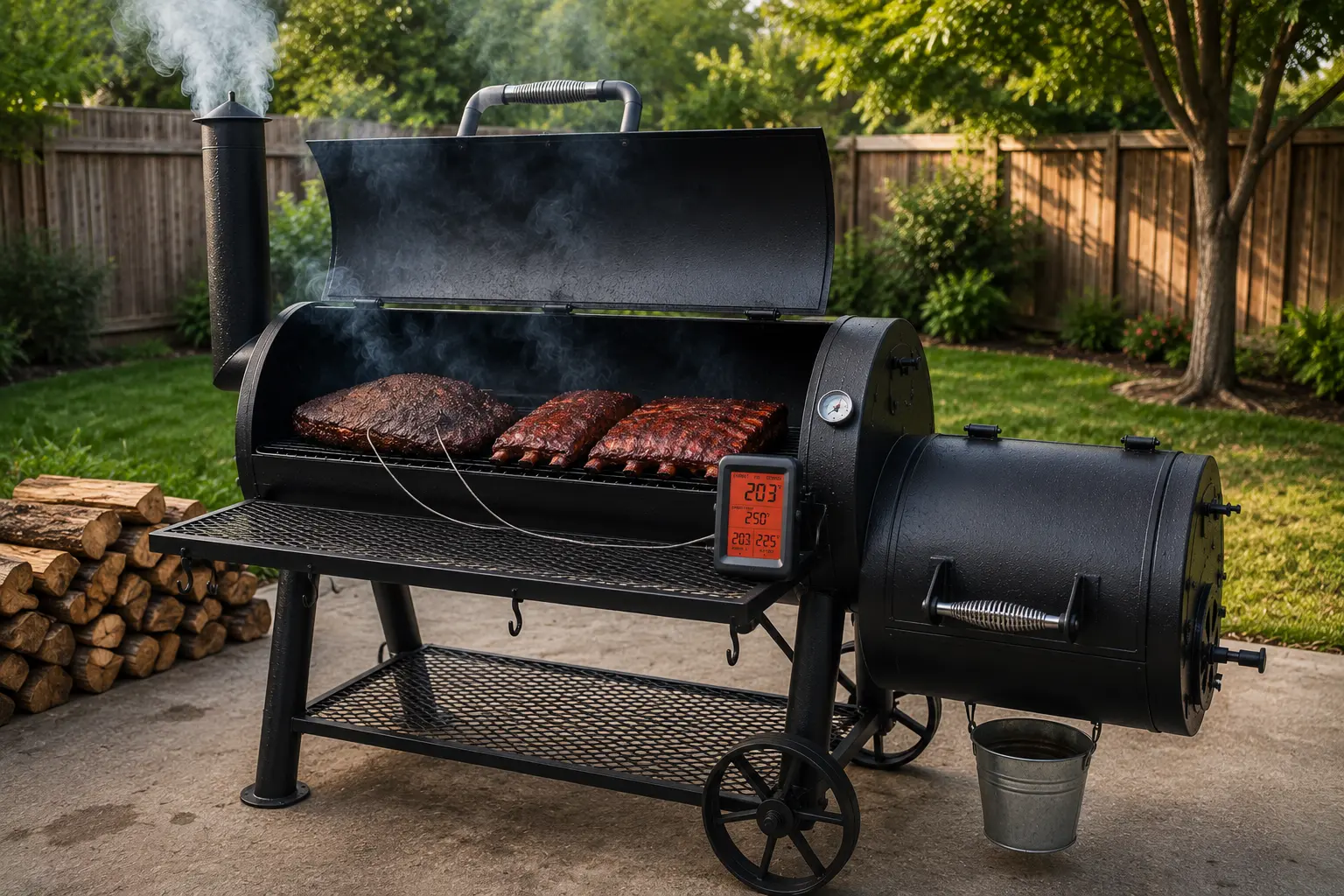
An offset smoker thermometer upgrade is one of the most practical improvements you can make to your smoker. Many factory-installed lid thermometers measure the temperature high above the cooking grate, where conditions can differ considerably from the heat surrounding your food.
An upgraded thermometer allows you to monitor the cooking chamber at grate level and check the internal temperature of the meat. Better temperature information helps you respond to changes in the fire, airflow, fuel, and weather without repeatedly opening the smoker.
You can replace an inaccurate analog gauge, add grate-level probes, install thermometers at both ends of the chamber, or use a wireless multi-probe system. The best option depends on your budget, smoker design, cooking habits, and whether you want remote monitoring.
Quick Answer: The most useful offset smoker thermometer upgrade is a dual-probe digital system. Place one ambient probe at cooking-grate level and insert the second probe into the thickest part of the meat.
Best Upgrade Setup: Keep the original lid thermometer as a quick reference, then add two grate-level probes—one near the firebox and another near the chimney. This setup reveals the smoker’s hot and cool zones without requiring permanent modifications.
Why Upgrade an Offset Smoker Thermometer?
A factory-installed thermometer is not always defective, but its position can limit its usefulness. Most built-in gauges are mounted in the lid, several inches above the cooking grate. Because hot air rises, the lid temperature may be different from the temperature beside the meat.
A dependable offset smoker thermometer upgrade provides several benefits:
- More accurate grate-level readings: An ambient probe measures the temperature where the food actually cooks instead of high inside the lid.
- Better understanding of heat zones: Two probes can reveal the temperature difference between the firebox side and chimney side of the cooking chamber.
- Simultaneous meat monitoring: Multi-probe thermometers can track the smoker temperature and the internal temperature of one or more cuts of meat.
- Fewer lid openings: Wireless monitoring lets you check temperatures without releasing heat and smoke from the cooking chamber.
- Useful alerts: Many digital units can warn you when the smoker becomes too hot or cold or when the meat approaches a selected temperature.
- More consistent results: Accurate information makes it easier to repeat successful brisket, ribs, pork shoulder, and poultry cooks.
A thermometer does not control the smoker automatically. It provides information that helps you decide when to adjust the fire, add fuel, reposition food, or change the intake damper.
Our guide on how to control heat in an offset smoker explains how to use temperature readings to make effective fire and airflow adjustments.
Types of Thermometers for Offset Smokers
| Thermometer type | Best use | Main advantage | Main limitation |
| Analog dial thermometer | Permanent lid or door installation | Simple and battery-free | May measure above grate level |
| Wired digital thermometer | Grate and meat monitoring | Accurate, affordable and versatile | Probe wires require careful routing |
| Wireless RF thermometer | Remote monitoring | Good range without Wi-Fi | Separate receiver required |
| Bluetooth thermometer | Short-range phone monitoring | Convenient smartphone display | Range may drop through walls |
| Wi-Fi thermometer | Monitoring from different locations | Internet-based alerts and graphs | Requires power and Wi-Fi |
| Instant-read thermometer | Checking meat manually | Fast internal readings | Cannot remain inside the smoker |
| Infrared thermometer | Surface temperature checks | Quick and contact-free | Cannot measure internal meat or air temperature |
An analog dial thermometer is suitable when you want a permanent replacement for the factory gauge. Choose a model with an appropriate stem length, readable face, suitable temperature range, and calibration adjustment. A dial mounted closer to grate level provides more useful information than one positioned at the top of the lid.
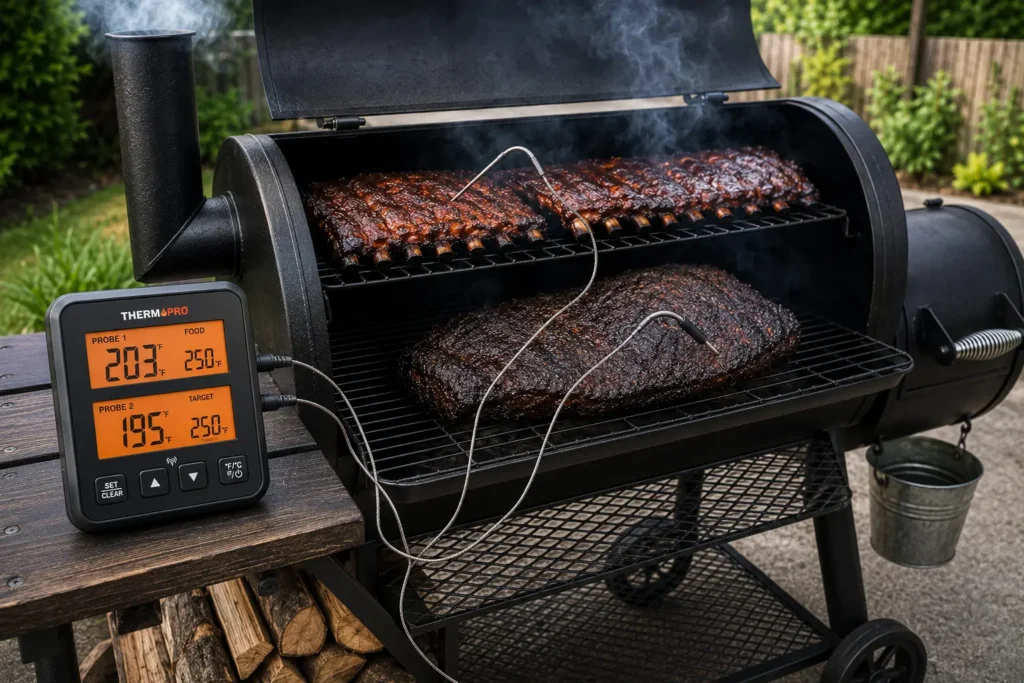
A wired digital thermometer uses heat-resistant probes connected to an external display. One probe can monitor the cooking chamber while another remains inside the meat. These systems are generally affordable and do not require permanently drilling the smoker.
Wireless RF, Bluetooth, and Wi-Fi thermometers provide similar probe functionality with remote monitoring. RF models use a dedicated receiver, Bluetooth models connect directly to a nearby phone, and Wi-Fi systems can send readings over a network. Actual range depends on walls, interference, batteries, and the thermometer design.
An instant-read thermometer is designed for quick manual checks. It is useful for testing several areas of brisket, poultry, or pork shoulder, but it should not be left inside the meat throughout the cook unless the manufacturer specifically describes it as oven-safe.
An infrared thermometer measures surface temperature. It can help identify hot areas on grates, baffle plates, or exterior steel, but it cannot measure the air temperature inside the smoker or the internal temperature of food. It should therefore supplement rather than replace probe thermometers.
Choosing the Right Thermometer Upgrade
For most backyard cooks, a digital thermometer with at least two probes provides the best balance of accuracy, flexibility, and cost. One probe monitors the cooking chamber while another tracks the meat.
If you regularly cook multiple briskets or pork shoulders, consider a four-probe system. Two probes can monitor the firebox and chimney sides of the grate while the remaining probes monitor separate cuts.
Check the following specifications before purchasing:
- Temperature range of the probes
- Maximum heat exposure for the probe wires
- Number of supported probes
- Accuracy specification
- Water-resistance rating
- Battery life
- Display readability
- Wireless range
- High- and low-temperature alarms
- Replacement-probe availability
- Calibration or temperature-offset capability
- Manufacturer warranty
Do not assume that the display unit, transmitter, or probe connectors are heat-resistant. The electronic components normally remain outside the smoker even though the metal probes and part of their cables are designed for cooking temperatures.
Probe failure is more common than failure of the display unit. Choosing a system with readily available replacement probes can improve its long-term value.
Correct Probe Placement
Thermometer placement is just as important as thermometer quality. Even an accurate thermometer provides misleading information when positioned in the wrong location.
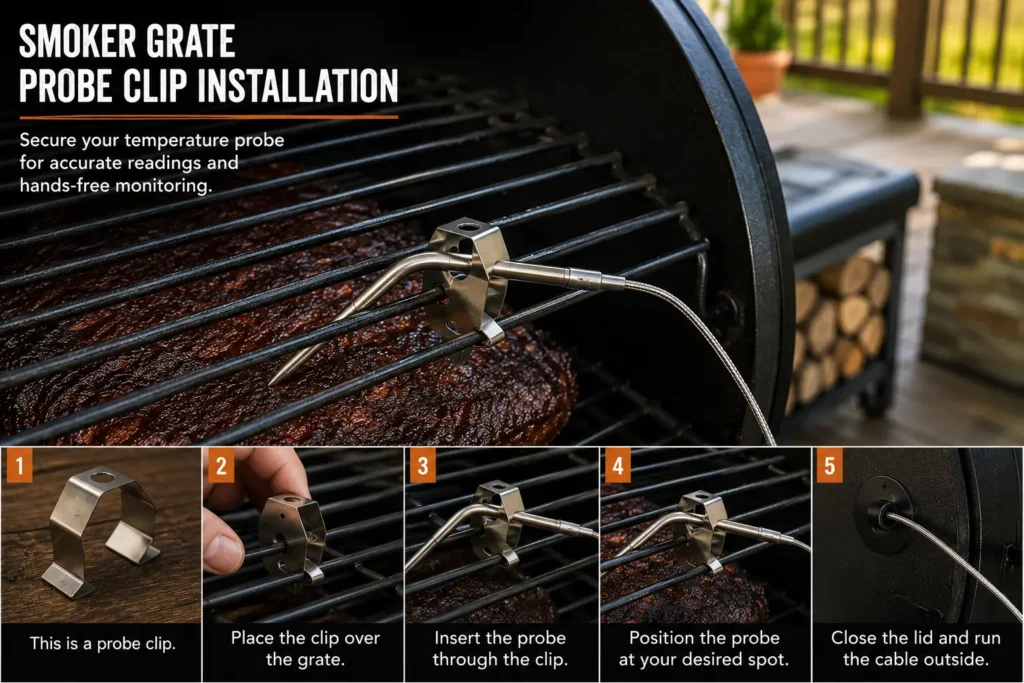
Attach the ambient probe to the cooking grate using a purpose-built clip. Position it close enough to represent the temperature surrounding the food but not so close that the cold meat directly influences the reading.
Keep the probe approximately one to two inches away from the meat, cooking-chamber wall, baffle plate, water pan, and direct stream of heat entering from the firebox. Do not allow the tip to touch metal because it may measure the grate rather than the surrounding air.
A traditional offset smoker normally has a hotter area near the firebox. For a more complete picture, place one probe near the firebox side and another toward the chimney side. The temperature difference will help you determine where to place or rotate different foods.
Insert a meat probe into the thickest part of the cut while avoiding bones and large pockets of fat. For brisket, the flat generally provides a more useful monitoring location than the heavily marbled point. For poultry, follow appropriate food-safety guidance for checking the thickest areas.
Do not pinch probe cables beneath a heavy lid. Repeated crushing can damage the internal wires and produce unstable readings. Route them through a manufacturer-provided probe port or install a heat-resistant probe grommet when appropriate.
Installing an Analog Thermometer
Before replacing or adding a permanent analog thermometer, check the smoker manufacturer’s warranty and instructions. Drilling new holes or modifying the cooking chamber may affect warranty coverage or damage the smoker’s finish.
If you are replacing an existing gauge, measure the hole diameter, thread size, stem length, mounting method, and available clearance. Purchase a replacement designed for the existing opening whenever possible.
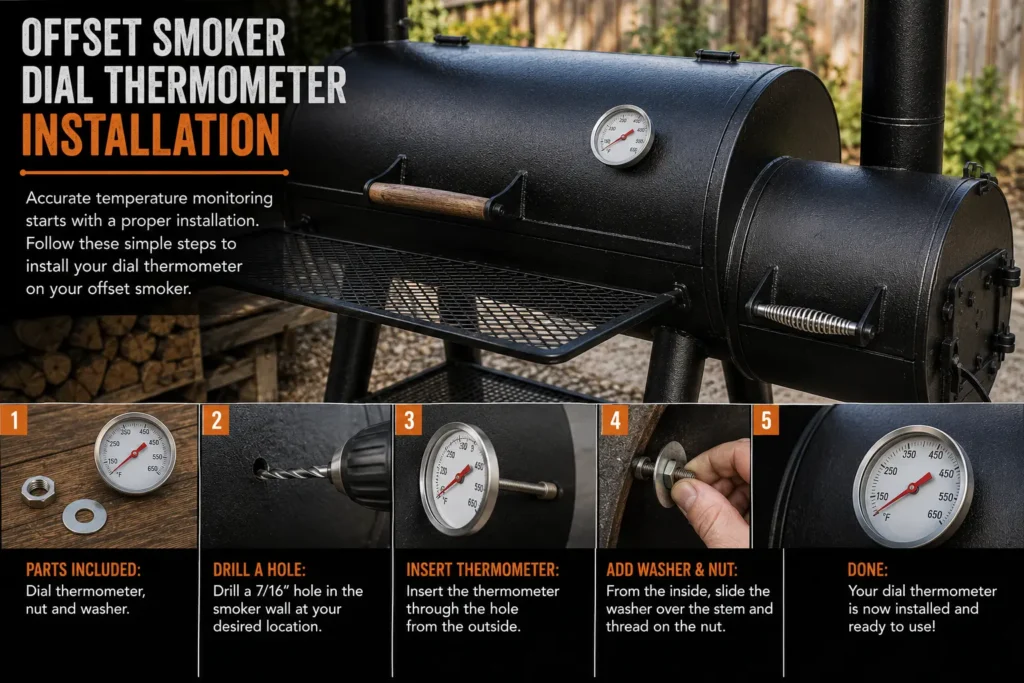
For a new installation, position the thermometer stem near cooking-grate height without allowing it to interfere with food, grates, shelves, or the smoker lid. Confirm the position from both inside and outside before drilling.
A typical installation process includes:
- Allow the smoker to cool completely.
- Remove cooking grates and loose interior components.
- Mark the selected position carefully.
- Confirm that the thermometer will not obstruct the food or lid.
- Drill a small pilot hole when required.
- Enlarge it gradually to the manufacturer’s specified diameter.
- Remove all metal shavings from the cooking chamber.
- Protect exposed steel against corrosion.
- Install the thermometer with its supplied hardware.
- Tighten it securely without damaging the gauge or smoker wall.
- Test for unwanted air leakage around the fitting.
Use only high-temperature, food-area-appropriate materials recommended for grills or smokers. Avoid applying ordinary household sealants inside the cooking chamber.
Installing two matching dial thermometers at grate level—one near each end—can display the smoker’s temperature difference at a glance. However, digital grate probes will normally provide more flexible placement.
Setting Up a Digital or Wireless Thermometer
A digital system usually requires no permanent modification if the smoker already has a probe port or if the cables can be safely routed without crushing them.
Inspect each probe and cable before use. Insert the probe plugs fully into the display or transmitter, and confirm that the correct probe number appears on the screen.
Clip the ambient probe at grate level and insert the food probe correctly into the meat. Keep the transmitter and display unit away from the hot cooking chamber, firebox, rain, and grease unless the manufacturer provides a suitable protection rating.
Set high and low chamber alarms based on your target cooking range. For example, if you want to cook around 250°F, you might choose an alert range that allows normal fluctuations without creating constant unnecessary notifications.
Do not make an airflow adjustment in response to every small temperature change. Offset smokers naturally fluctuate. Look at the overall temperature trend and allow time for each fire or damper adjustment to take effect.
For recommended cooking ranges, consult our offset smoker cooking temperature guide.
Testing and Calibrating the Thermometer
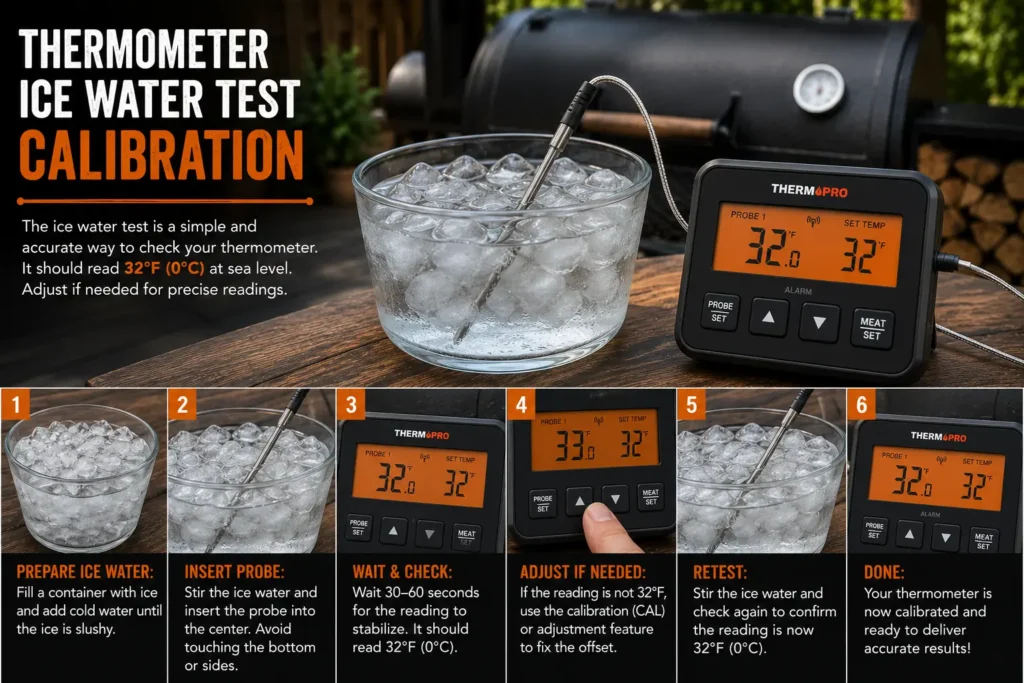
Test a new thermometer before relying on it during a long cooking session. It should also be checked if readings become unusual, after a hard impact, or when a probe has been exposed to excessive heat or moisture.
The ice-water test is a convenient way to check thermometer accuracy:
- Fill a glass with crushed ice.
- Add enough clean water to fill the spaces between the ice.
- Stir and allow the mixture to stabilize.
- Insert the probe into the center of the ice slurry.
- Keep it away from the bottom and sides of the glass.
- Wait until the reading stabilizes.
- At normal atmospheric conditions, it should read close to 32°F or 0°C.
An adjustable analog thermometer may have a calibration nut beneath the dial. Hold the nut with an appropriate tool and turn the dial according to the manufacturer’s directions.
Some digital thermometers allow you to enter a calibration offset. Others cannot be adjusted. If a non-adjustable thermometer is consistently inaccurate beyond its stated tolerance, replace the probe or contact the manufacturer.
Boiling water can also be used for testing, but its boiling temperature changes with altitude and atmospheric pressure. The expected value must therefore be adjusted for your location.
Do not immerse the entire probe connector, cable junction, transmitter, or display unless the manufacturer confirms that the component is waterproof and submersible.
Common Problems and Mistakes
Comparing different locations: A lid thermometer and grate probe may both be accurate while showing different readings because they measure different parts of the smoker. Test them side by side before deciding that one is faulty.
Touching the grate: An ambient probe touching metal may report the grate’s surface temperature rather than the surrounding air.
Positioning beside the firebox opening: Direct heat entering the chamber can make the probe read considerably hotter than the area surrounding most of the food.
Placing the probe too close to cold meat: A large cold brisket can temporarily reduce the temperature immediately around the probe.
Damaging probe cables: Pinching, bending, pulling, or exposing a cable junction to excessive heat can cause intermittent readings or complete failure.
Exceeding the temperature limit: Meat and ambient probes have maximum rated temperatures. Direct flames or firebox temperatures may permanently damage them.
Opening the lid unnecessarily: Installing a remote thermometer provides little benefit if the lid is still opened repeatedly to check the food.
Relying on only one chamber probe: One reading cannot reveal the temperature difference across a large offset smoker.
Confusing surface and internal temperatures: An infrared thermometer cannot confirm that meat has reached a safe internal temperature.
Ignoring low batteries: Weak batteries can cause connection loss, reduced wireless range, or unstable readings.
Is an Offset Smoker Thermometer Upgrade Worth It?
For most offset-smoker owners, the upgrade is worthwhile. A basic dual-probe thermometer can provide more useful information than an expensive modification because it directly measures both the cooking environment and the food.
The upgrade is particularly valuable for thin-steel smokers, large cooking chambers, reverse-flow systems, and long brisket or pork-shoulder sessions. These situations benefit from knowing how temperatures change across the cooking grate and throughout the cook.
Potential disadvantages include purchase cost, probe replacement, batteries, smartphone setup, connection problems, and additional equipment to clean and store. Advanced wireless features may also be unnecessary for someone who remains beside the smoker.
A simple wired dual-probe thermometer is sufficient for many users. Wireless connectivity is a convenience rather than a requirement for accurate barbecue.
Food-Safety Considerations
Accurate temperature monitoring is not only about tenderness and flavor. It is also essential for checking whether meat and poultry have reached safe internal temperatures.
The USDA recommends using a thermometer to monitor the air temperature inside a smoker or grill. Its smoking meat and poultry guidance advises keeping the smoker between approximately 225°F and 300°F throughout the cooking process.
Use a separate food probe or instant-read thermometer to check the internal temperature. Different foods have different minimum safe temperatures, so follow current guidance for the specific meat rather than using one temperature for every recipe.
A chamber thermometer cannot determine whether the center of the meat is safe. Similarly, a meat probe does not tell you whether the smoker has maintained an appropriate cooking environment. Both measurements serve different purposes.
Why Upgrading Your Offset Smoker Thermometer Is Worth the Investment
An offset smoker thermometer upgrade provides more accurate information about the conditions surrounding your food. The most practical setup for most users is a digital system with at least one grate-level ambient probe and one meat probe.
For a large cooking chamber, using ambient probes near both the firebox and chimney sides will reveal temperature zones that a single lid thermometer cannot show. You can use this information to position food, rotate larger cuts, and adjust the fire more effectively.
An analog replacement is suitable if you prefer a simple, battery-free gauge, but it should be installed near cooking-grate height whenever possible. Infrared thermometers are useful for surface checks but cannot replace ambient or internal food probes.
Whichever system you choose, correct placement, regular testing, careful cable handling, and proper calibration matter as much as the thermometer’s price. Accurate readings combined with clean fire management can make every smoking session more predictable and repeatable.
Frequently Asked Questions
Place an ambient probe at cooking-grate level near the food without touching the meat, grate, wall, or water pan. For a large smoker, use one probe near the firebox and another near the chimney.
You need to monitor both chamber and internal food temperatures. A multi-probe digital system can perform both tasks with one display.
They may be measuring different locations. Hot air rises, so the temperature near the lid can differ from the temperature at cooking-grate level.
Test the probe in a properly prepared ice-water slurry. It should read close to 32°F or 0°C. Follow the manufacturer’s directions before making calibration adjustments.
Only leave-in probes designed for continuous cooking should remain inside. Never leave a handheld instant-read thermometer inside unless its manufacturer explicitly permits it.
An infrared thermometer measures only the surface. It cannot confirm the internal temperature of meat or accurately measure the air inside the smoker.
Increase airflow through the firebox intake or add a small amount of fuel. Make one adjustment at a time and allow the smoker to respond before making another change.
No. These features provide remote monitoring and alerts, but a basic wired digital thermometer can be equally useful when you remain near the smoker.
Yes. Incorrect drilling can damage the finish, expose steel to rust, create air leaks, or affect the warranty. Confirm the position and manufacturer’s instructions before making permanent modifications.