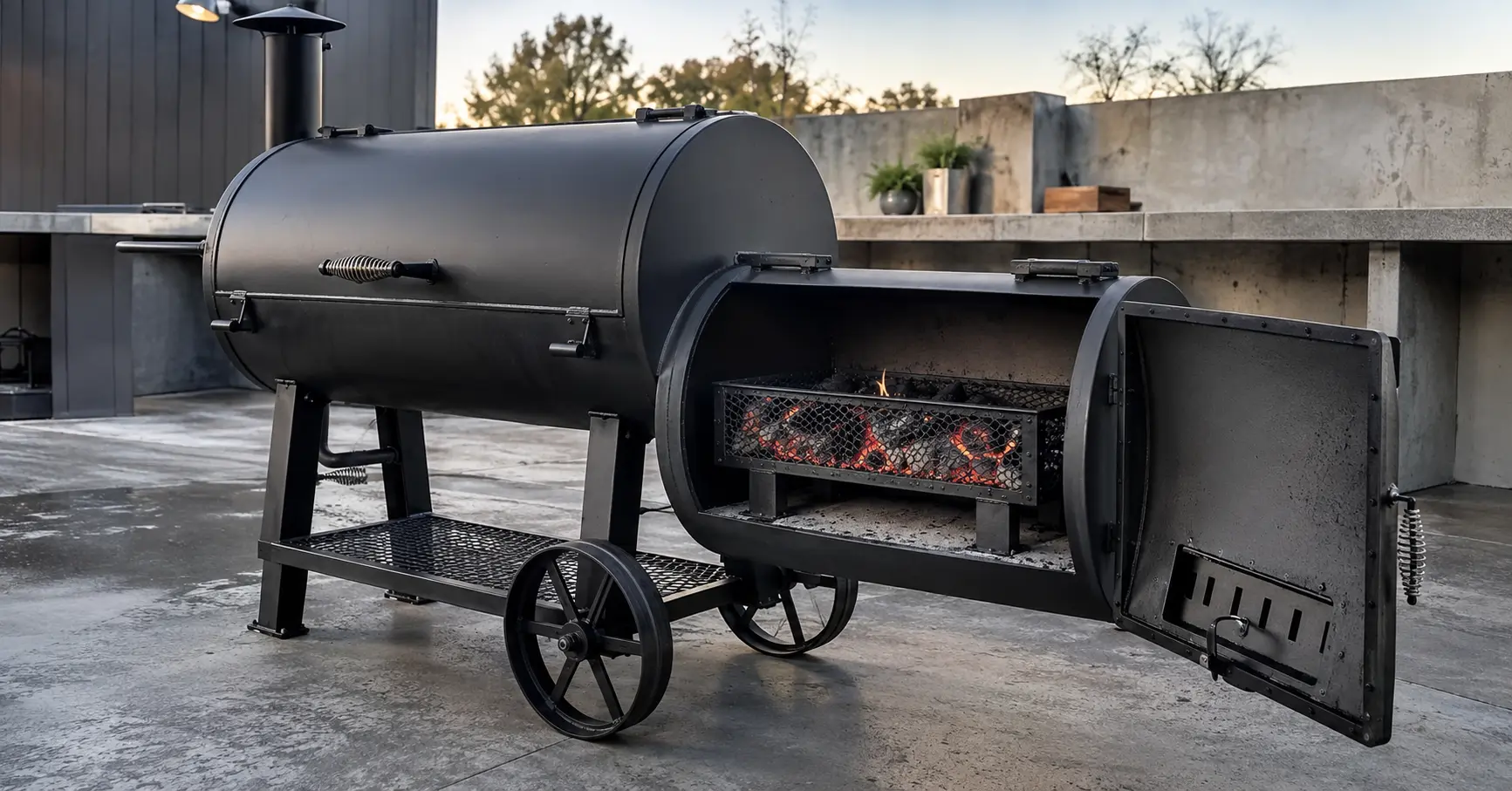
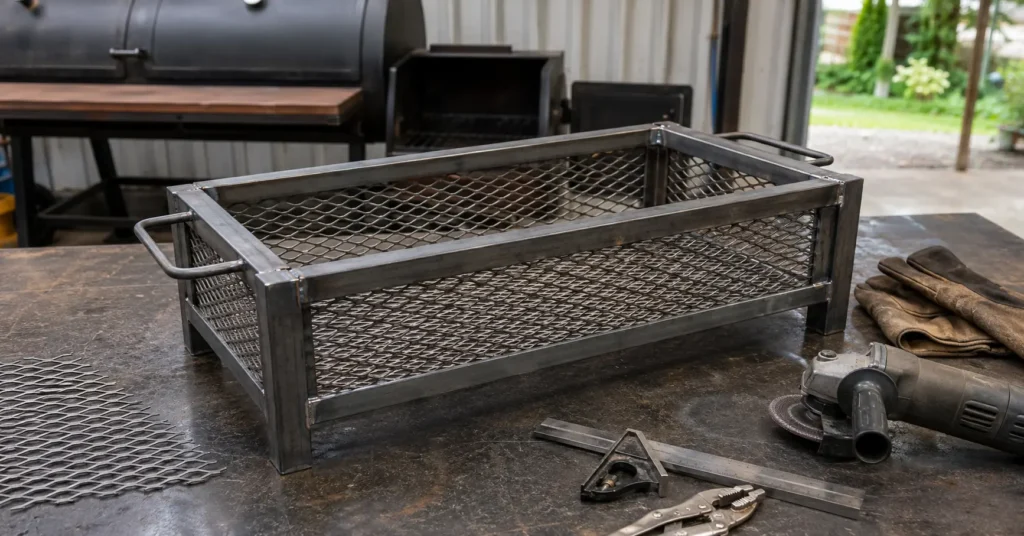
An offset smoker firebox basket is a metal container designed to hold charcoal, burning wood, or a combination of both inside the smoker’s firebox. Its raised and ventilated construction allows air to circulate underneath and around the fuel, helping the fire burn more cleanly and consistently.
Although an offset smoker can operate without a basket, adding one can make fire management considerably easier. It keeps the fuel together, prevents hot coals from spreading across the firebox floor, reduces airflow restrictions caused by ash, and simplifies cleanup after a long smoking session.
A properly sized firebox basket is particularly useful in small or budget smokers that are difficult to keep at a stable temperature. However, the basket must leave enough space around its sides for air circulation and must not block the intake vent or opening between the firebox and cooking chamber.
An offset smoker firebox basket holds charcoal and wood above the firebox floor, allowing ash to fall away while oxygen continues reaching the fire. This can improve combustion, temperature stability, fuel organization, and cleanup. Choose a heavy-duty steel basket that fits comfortably inside the firebox without restricting the intake vent or the passage into the cooking chamber.
What Is an Offset Smoker Firebox Basket?
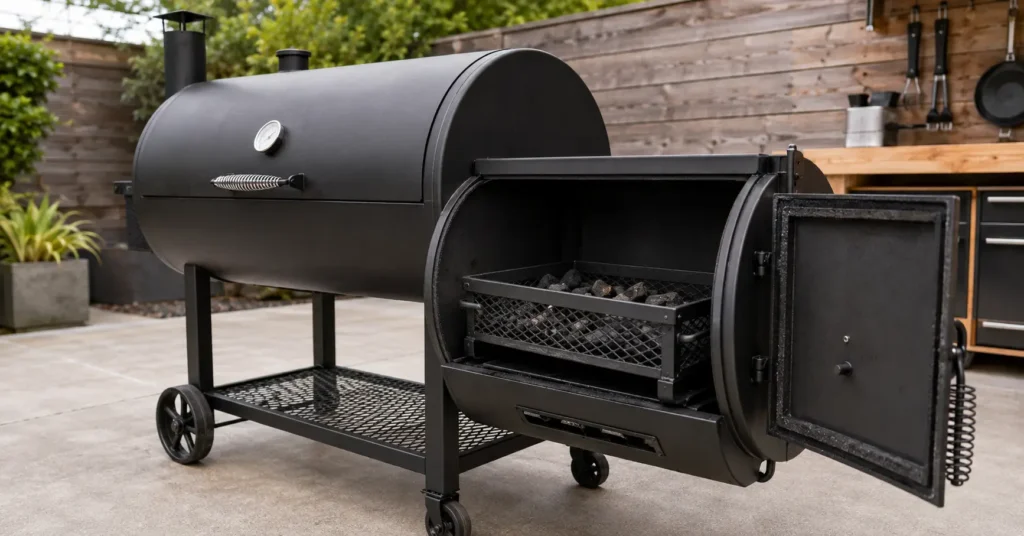
An offset smoker firebox basket, also called a smoker fire basket or charcoal basket, is normally made from expanded metal, welded steel mesh, or perforated steel. It sits inside the side firebox and provides a contained, elevated area in which fuel can burn.
Its open construction performs two important jobs:
- It allows fresh air to reach the underside of the fire.
- It allows ash to fall below the burning fuel.
Without sufficient clearance, ash can accumulate around the charcoal and reduce the amount of available oxygen. The fire may then smolder, lose heat, or produce thick white smoke. A raised basket helps separate the active fire from the accumulated ash.
This accessory does not automatically control the smoker. You will still need to manage fuel quantity, vent positions, weather conditions, and wood-split size. However, it can create a more organized foundation for following effective offset smoker fire management techniques.
How Does a Firebox Basket Work?
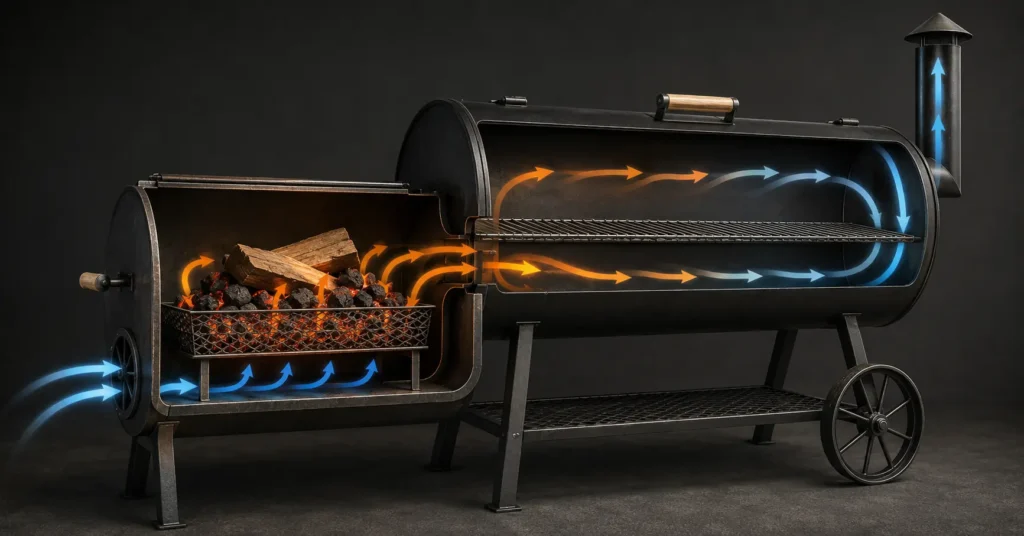
A firebox basket improves combustion by exposing more of the fuel to oxygen. Fresh air enters through the firebox intake vent, moves beneath or through the basket, and feeds the burning charcoal and wood.
As the fuel burns, ash drops through the basket openings instead of immediately surrounding the coals. This helps preserve airflow for a longer period. The hot air and smoke then move from the firebox into the cooking chamber before exiting through the chimney.
The basic airflow path is:
Intake vent → firebox basket → burning fuel → cooking chamber → chimney
For this system to work correctly, the intake vent, basket openings, cooking-chamber entrance, and chimney must remain unobstructed. A basket that is too large can interfere with this airflow and cause more problems than it solves.
Benefits of Using an Offset Smoker Firebox Basket
Better Airflow Around the Fuel
The main benefit of a firebox basket is improved airflow. Elevating the charcoal and wood allows oxygen to reach the fire from underneath as well as from the sides.
Better airflow supports more complete combustion, which helps create a cleaner fire. A clean-burning fire generally produces light, nearly transparent smoke instead of heavy white or gray smoke.
More Stable Cooking Temperatures
A basket keeps the fuel concentrated in a defined area. This makes it easier to build a compact coal bed and add fuel in controlled amounts.
Stable heat still depends on the size of your fire and the amount of oxygen reaching it. Nevertheless, organizing the fuel in a basket can reduce some of the unpredictable spreading and cooling that occurs when coals sit directly on a wide firebox floor.
For additional techniques, read this complete guide on how to control heat in an offset smoker.
Reduced Ash Interference
Ash is an unavoidable result of burning charcoal and wood. If it accumulates directly around the fuel, it can restrict airflow and weaken the fire.
The openings in a smoker fire basket allow loose ash to fall below the active coal bed. Provided there is sufficient space underneath, the burning fuel can continue receiving oxygen during a long cook.
Easier Fuel Management
Containing the charcoal in one place makes it easier to estimate how much fuel is burning. It also gives you better control over where new charcoal or wood should be added.
This can be especially helpful for beginners who are still learning how their smoker responds to different fuel quantities.
Faster Firebox Cleanup
After the smoker has cooled completely, the basket can be lifted out so that the remaining charcoal and ash can be removed. This is usually easier than scraping scattered coals from every corner of the firebox.
Always confirm that the fuel is completely extinguished before emptying the basket. Ash can conceal live embers long after the visible flames have disappeared.
Protection for the Firebox Floor
A raised basket reduces direct contact between the hottest coals and the bottom of the firebox. It cannot eliminate heat damage or rust, but it may reduce prolonged direct heat concentration on the floor.
Regular ash removal remains essential because ash can hold moisture against the metal and encourage corrosion.
Firebox Basket vs Standard Fire Grate
A basic fire grate and a basket can both raise fuel above the firebox floor, but they organize the fire differently.
| Feature | Firebox Basket | Standard Fire Grate |
| Holds fuel in one area | Yes | Limited |
| Allows airflow underneath | Yes | Yes |
| Prevents coals from spreading | Yes | No |
| Suitable for charcoal methods | Excellent | Moderate |
| Supports wood splits | Yes, if properly sized | Yes |
| Easy to remove | Usually | Depends on design |
| Ash separation | Good | Good |
| DIY customization | Easy | Moderate |
A standard grate may be sufficient for an all-wood fire, particularly in a large, heavy-duty smoker. A basket becomes more valuable when using charcoal, a charcoal-and-wood combination, or a controlled burn pattern.
How to Choose the Right Firebox Basket
Measure the Firebox Interior
Measure the usable internal width, depth, and height of the firebox—not its exterior dimensions. Also note the location of:
- The air intake
- The cooking-chamber opening
- The factory fire grate
- Any ash pan
- Door hinges and internal brackets
The basket should fit through the firebox door without being tilted dangerously over hot surfaces. It should also be removable after the smoker has cooled.
Leave Space Around the Basket
Do not select a basket that tightly fills the entire firebox. Air needs room to enter the firebox and travel around or beneath the fuel.
As a general starting point, leave approximately 1–2 inches of clearance where the smoker’s design permits. The exact clearance depends on the position of the intake vent and the shape of the firebox.
Most importantly, the basket must not block:
- The firebox intake vent
- The passage into the cooking chamber
- The firebox door
- The ash-removal area
Select a Suitable Height
A taller basket holds more charcoal, but greater capacity is not always better. Overloading a basket can create excessive heat and reduce the space available for wood splits.
Choose a height that keeps the fuel raised above accumulated ash while maintaining safe clearance from the top and sides of the firebox.
Choose Durable Material
Expanded carbon steel is commonly used because it is strong, affordable, and provides numerous openings for airflow. A useful basket should be sturdy enough to support hot fuel without sagging.
Thin metal may distort after repeated heating and cooling cycles. Galvanized metal should not be used for a DIY basket because its zinc coating is inappropriate for high-temperature cooking equipment.
Consider Handle Placement
Handles can make a cold basket easier to lift, but they must not interfere with the firebox lid or door. Never assume that a handle is safe to touch during or immediately after a cook. Use dry, heat-resistant barbecue gloves and suitable tools.
Recommended Firebox Basket Size
There is no universal size because offset-smoker fireboxes vary considerably. The following table provides general starting points rather than exact specifications.
| Firebox Type | Possible Basket Size | Best Use |
| Compact backyard smoker | 10 × 10 × 6 inches | Small charcoal fire with wood chunks |
| Medium horizontal smoker | 12 × 12 × 6 inches | Charcoal base with small wood splits |
| Large backyard smoker | 12 × 16 × 8 inches | Longer cooks and larger coal beds |
| Custom or trailer smoker | Custom measurement required | Wood splits or high-capacity cooking |
Measure your specific smoker before purchasing or building anything. Even smokers with similar cooking capacity can have very different firebox dimensions and vent locations.
How to Set Up an Offset Smoker Firebox Basket
Step 1: Clean the Firebox
Begin with a cool smoker. Remove loose ash, old charcoal, grease, and other debris from the firebox.
Inspect the metal for rust, damaged welds, sharp edges, or blocked vents. Do not place a new basket over a thick layer of old ash.
Step 2: Position the Basket
Place the basket so that incoming air can reach its lower openings. In many smokers, this means positioning it near the intake side while leaving a clear path toward the cooking chamber.
Do not push the basket tightly against the air intake. If the vent opens directly beside the basket, leave enough clearance for air to spread around the fuel.
Step 3: Check the Clearance
Confirm that:
- The basket sits securely
- The door closes normally
- The intake vent moves freely
- The basket does not block the cooking-chamber entrance
- There is enough room beneath it for ash
- Wood splits fit without touching the firebox lid
Complete these checks while the smoker is cold.
Step 4: Add Fuel
For an easy charcoal-and-wood setup, light charcoal in a chimney starter. Once the charcoal is burning properly, transfer it carefully into the basket and add one small piece of dry, seasoned hardwood.
This creates a stable coal base while the hardwood adds traditional smoke flavor. Beginners may find this approach easier than starting with a completely wood-fired setup.
Step 5: Preheat the Smoker
Open the chimney exhaust and provide sufficient intake airflow while the fire becomes established. Allow the cooking chamber to preheat and stabilize before adding food.
Avoid restricting airflow so severely that the fire begins to smolder. Temperature should be controlled primarily through fire size and measured fuel additions, supported by careful intake adjustments.
Step 6: Monitor Grate-Level Temperature
A lid-mounted gauge may not accurately represent the temperature beside the food. Position a digital thermometer probe close to the cooking grate without allowing it to touch metal.
The USDA advises using separate thermometers to monitor the smoker and the food, with the smoking chamber generally maintained between 225°F and 300°F.
How to Use a Firebox Basket with Charcoal and Wood
A combination of charcoal and wood provides a manageable starting point for many backyard smokers.
- Fully light a small chimney of charcoal.
- Pour the hot charcoal into one side or the center of the basket.
- Allow the smoker to begin preheating.
- Add one small, preheated hardwood split.
- Wait for thick startup smoke to become lighter and cleaner.
- Add food once the cooking temperature has stabilized.
- Add small amounts of fuel before the coal bed becomes too weak.
Avoid filling the basket completely with lit charcoal unless the smoker and cooking method specifically require it. A large mass of burning charcoal can rapidly overheat a thin-walled smoker.
If you are unfamiliar with offset construction and fuel placement, review this guide to offset smokers with a side firebox.
Using a Firebox Basket for an All-Wood Fire
A firebox basket can also support an all-wood fire, but the basket must be large and strong enough for the required splits. Build a small, hot fire instead of tightly packing the basket with wood.
For clean combustion:
- Use dry, seasoned hardwood.
- Choose splits appropriate for the firebox size.
- Leave space between pieces of wood.
- Maintain a healthy coal bed.
- Keep the exhaust open.
- Add one split at a time when possible.
- Preheat the next split near the firebox, not directly on an unsafe painted surface.
A weak, overcrowded fire often creates heavy smoke and bitter deposits. The goal is steady heat from active combustion, not the greatest possible amount of visible smoke.
Can You Use the Minion Method in a Firebox Basket?
The Minion Method involves placing a smaller amount of lit charcoal beside or on top of unlit charcoal so that the fuel ignites progressively. It can extend burn time, but results vary in offset smokers.
A basket can contain the fuel and help establish a controlled burn path. However, offset smokers generally have more airflow and heat loss than insulated vertical or ceramic smokers. Therefore, the charcoal may ignite faster than expected.
When testing this method:
- Begin with a modest quantity of charcoal.
- Keep the exhaust open.
- Monitor the cooking-grate temperature closely.
- Do not leave the smoker unattended.
- Adjust the amount of lit charcoal during future cooks based on your results.
Your smoker’s steel thickness, air leaks, firebox size, fuel type, and weather conditions will all affect the burn rate.
DIY Offset Smoker Firebox Basket
A DIY firebox basket can be made from uncoated, heavy-duty expanded carbon steel. The basket must tolerate repeated high temperatures and the combined weight of charcoal and wood.
Materials
- Uncoated expanded carbon steel
- Plain carbon-steel angle or flat bar
- Suitable steel fasteners or welded joints
- Metal-cutting tools
- Pliers or bending equipment
- Eye protection and heavy work gloves
Basic Construction Process
- Measure the internal firebox dimensions.
- Decide how much clearance is needed around and below the basket.
- Mark the base and four sides on the expanded steel.
- Cut the material while wearing suitable protection.
- Bend the sides upward or attach separately cut panels.
- Secure the corners with appropriate steel fasteners or welds.
- Remove dangerous burrs and sharp edges.
- Test the cold basket inside the firebox.
- Wash away fabrication debris.
- Heat-cycle or season the basket before cooking.
Do not use painted, plastic-coated, or galvanized mesh. If you are uncertain about the safety of a material or your welding ability, purchasing a basket designed for barbecue use is the safer choice.
How Much Fuel Should You Put in the Basket?
The correct amount depends on the smoker, weather, target temperature, and cooking duration. Basket capacity should not be treated as a requirement to fill it completely.
Start with a small, manageable fire and increase it gradually. A compact clean fire is easier to enlarge than an oversized fire is to cool down.
| Fire Condition | Likely Result | Recommended Response |
| Small active fire | Clean smoke and manageable heat | Add small fuel amounts as needed |
| Basket overloaded | Temperature spike or restricted airflow | Reduce future starting quantity |
| Fuel covered in ash | Weak or smoldering fire | Clear ash and restore airflow |
| Large cold wood split added | Temporary temperature drop and white smoke | Use smaller, dry splits |
| Coal bed nearly extinguished | Difficult recovery | Add fuel before heat collapses |
Learn your smoker by recording the starting fuel quantity, vent positions, weather, and temperature changes during several cooks.
Common Firebox Basket Mistakes
Buying a Basket That Is Too Large
A basket that fits tightly may block intake air or interfere with the opening to the cooking chamber. Always prioritize airflow over maximum fuel capacity.
Placing It Directly Against the Intake
Fuel requires oxygen, but the intake also needs open space to distribute that oxygen. Pressing a solid portion of the basket against the vent can obstruct airflow.
Allowing Ash to Reach the Basket
The space beneath the basket is useful only if it remains open. During very long cooks, ash may accumulate high enough to contact the fuel and restrict airflow. Check ash levels safely and remove ash only with appropriate equipment.
Adding Too Much Wood
A basket organizes fuel; it does not make an oversized fire easier to control. Several large splits can create extreme heat, dirty smoke, or both.
Closing the Exhaust to Reduce Heat
Restricting the chimney can trap stale smoke and reduce combustion quality. Keep the exhaust open in most traditional offset-smoker setups and control excessive heat by reducing fuel quantity and carefully managing the intake.
Ignoring Air Leaks
A charcoal basket cannot correct severe leaks around firebox doors or cooking-chamber lids. Uncontrolled air entering the firebox can cause fuel to burn faster and create temperature swings.
Leaving Ash in the Firebox
Ash can attract or retain moisture and contribute to corrosion. Remove it after the smoker and fuel have cooled completely.
Cleaning and Maintaining the Basket
Regular maintenance extends the useful life of both the basket and firebox.
After Every Cook
- Allow all fuel and ash to cool completely.
- Remove reusable charcoal if it is fully extinguished.
- Empty loose ash into an appropriate metal container.
- Brush away dry residue.
- Check for warped metal or failed joints.
- Clean ash from the bottom of the firebox.
Periodically
- Inspect the basket for thinning metal.
- Check welded or fastened corners.
- Remove loose surface rust.
- Apply a very light coat of cooking oil to clean bare carbon steel.
- Heat the basket to maintain its protective seasoning layer.
Do not apply oil over heavy ash or flaky rust. Clean and dry the metal first.
Does a Firebox Basket Save Charcoal?
A basket may improve practical fuel efficiency by maintaining airflow and keeping the fire concentrated. It can also make partially burned charcoal easier to recover after it has been fully extinguished.
However, fuel consumption is influenced more broadly by:
- Smoker wall thickness
- Air leakage
- Outdoor temperature
- Wind
- Cooking temperature
- Fire size
- Fuel quality
- Frequency of opening the chamber
- Length of the cook
A basket can improve fuel organization, but it cannot make a thin, leaking smoker as efficient as a well-sealed model made from heavier steel.
If efficiency is a priority when choosing equipment, compare these budget offset smokers and their important features.
Is a Firebox Basket Worth It?
A firebox basket is worth considering if you use charcoal or a charcoal-and-wood combination and regularly struggle with scattered coals, ash buildup, unstable airflow, or difficult cleanup.
It is most beneficial for:
- Beginners learning fire control
- Small backyard offset smokers
- Long charcoal-assisted cooks
- Smokers with wide firebox floors
- Owners who want easier ash cleanup
- Cooks using controlled charcoal burn patterns
It may be less necessary in a large traditional smoker designed around an elevated all-wood fire. Even in that situation, a strong basket or raised grate can still help keep the coal bed organized.
A basket should be viewed as a useful fire-management tool rather than a complete solution. Good results still require suitable fuel, sufficient airflow, accurate temperature monitoring, and regular attention.
Safety Tips
Firebox baskets operate under extremely high temperatures. Follow these basic precautions:
- Use the smoker outdoors in a well-ventilated area.
- Keep it away from combustible walls and overhead structures.
- Place it on a stable, noncombustible surface.
- Wear dry, heat-resistant gloves.
- Use long-handled barbecue tools.
- Never move a loaded hot basket by hand.
- Keep children and pets away from the smoker.
- Do not pour lighter fluid onto burning fuel.
- Keep grease from contacting the fire.
- Confirm that ash is cold before disposal.
- Use separate thermometers for the smoker and food.
Food should also reach an appropriate internal temperature. Consult the USDA’s safe minimum internal temperature chart when preparing meat or poultry.
Frequently Asked Questions
It raises and contains the fuel so that air can circulate around it and ash can fall below. This helps organize the coal bed, maintain airflow, and simplify cleanup.
No. An offset smoker can operate with a suitable fire grate. A basket is an optional accessory that is particularly useful when burning charcoal or a charcoal-and-wood combination.
Ideally, the fuel should remain elevated above the firebox floor. If the basket has no raised base or legs, place it on a suitable high-temperature steel grate that maintains enough room for airflow and ash.
Yes, provided the basket is strong and large enough and the splits do not block airflow or touch the firebox lid. Use appropriately sized pieces rather than overcrowding the basket.
It should sit high enough to permit airflow and allow ash to accumulate beneath it without quickly reaching the fuel. The ideal height depends on the firebox and intake-vent design.
It should receive air from the intake but should not block it. Position the basket so fresh air can move underneath and around the fuel before traveling toward the cooking chamber.
Suitable high-temperature stainless steel can be used, but it is usually more expensive. Heavy uncoated expanded carbon steel is more commonly used for DIY baskets.
Galvanized metal should not be used. Choose plain, uncoated steel intended for high-temperature barbecue applications.
Remove ash after every cook once everything has cooled completely. Inspect the basket periodically for warping, thinning, rust, damaged welds, or sharp edges.
Possible causes include wet wood, oversized splits, an overcrowded basket, a weak coal bed, insufficient airflow, or a blocked chimney. A basket helps airflow but cannot compensate for unsuitable fuel or incorrect vent management.
Choose the Right Offset Smoker Firebox Basket for Better Performance
An offset smoker firebox basket is a simple but valuable accessory for improving fuel organization, airflow, ash separation, and cleanup. By keeping charcoal and wood elevated and contained, it can make a clean, manageable fire easier to maintain during long smoking sessions.
For the best results, choose a basket made from durable, uncoated steel and size it according to the usable interior of your firebox. Leave sufficient clearance around and beneath it, keep the intake and cooking-chamber opening unobstructed, and resist the temptation to overload it with fuel.
A firebox basket will not replace proper technique, but when combined with dry hardwood, accurate thermometers, sensible fuel additions, and effective airflow management, it can make an offset smoker more predictable and enjoyable to use.