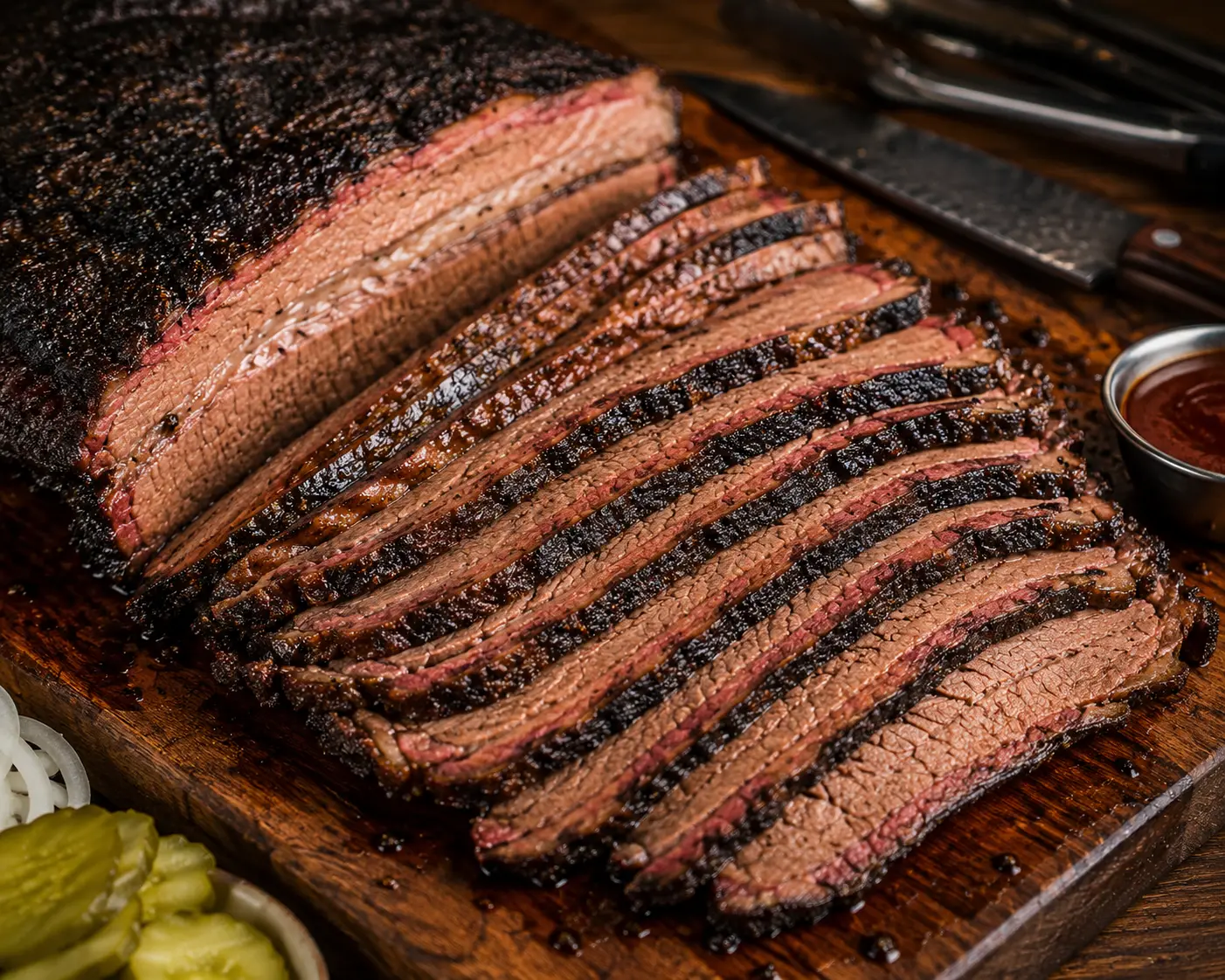
Following the right Offset Smoker Brisket Recipe can transform one of the toughest cuts of beef into tender, juicy, and deeply flavorful barbecue. Brisket is widely considered one of the most challenging meats to smoke because it requires careful preparation, consistent fire management, patience, and an understanding of how the meat changes throughout a long cooking process. When everything comes together correctly, however, few barbecue experiences are more rewarding than slicing into a beautifully smoked brisket with a dark bark and tender interior.
An offset smoker is particularly well suited for brisket because it cooks with indirect heat while continuously circulating natural wood smoke through the cooking chamber. This traditional cooking method allows the brisket to slowly absorb smoke while its tough connective tissues gradually break down. The result is authentic wood fired barbecue with a flavor and texture that are difficult to reproduce using faster cooking methods.
This complete Offset Smoker Brisket Recipe covers every important stage of the process, including selecting the right brisket, trimming excess fat, applying seasoning, preparing the smoker, managing the fire, smoking the meat, handling the stall, wrapping, monitoring tenderness, resting, and slicing. Whether you are smoking your first brisket or improving an existing technique, this beginner’s guide to offset smokers can help you build a stronger foundation before diving into this recipe.
Choosing the Right Brisket
The first step in any successful Offset Smoker Brisket Recipe is choosing a quality cut of beef. A whole packer brisket is generally the best option for traditional low and slow smoking because it contains both the flat and the point.
The flat is the leaner section of the brisket and produces the uniform slices commonly associated with traditional barbecue. The point contains more intramuscular fat and connective tissue, giving it a richer flavor and softer texture. Cooking both sections together helps protect the leaner flat during the long smoking process.
Look for a brisket with good marbling throughout the meat. Intramuscular fat gradually renders during cooking and contributes to moisture, tenderness, and flavor. A brisket that bends easily when held is often a good indication that the meat has less rigid connective tissue.
USDA Prime brisket generally contains more marbling, but USDA Choice can also produce excellent results when prepared and cooked correctly. More expensive beef does not replace good technique, so focus on selecting a fresh brisket with even thickness and good fat distribution.
Trimming the Brisket Properly
Proper trimming is an essential part of this Offset Smoker Brisket Recipe because the shape and fat distribution of the brisket directly affect how evenly it cooks. A poorly trimmed brisket may develop burnt edges, uneven bark, or large areas of unrendered fat.
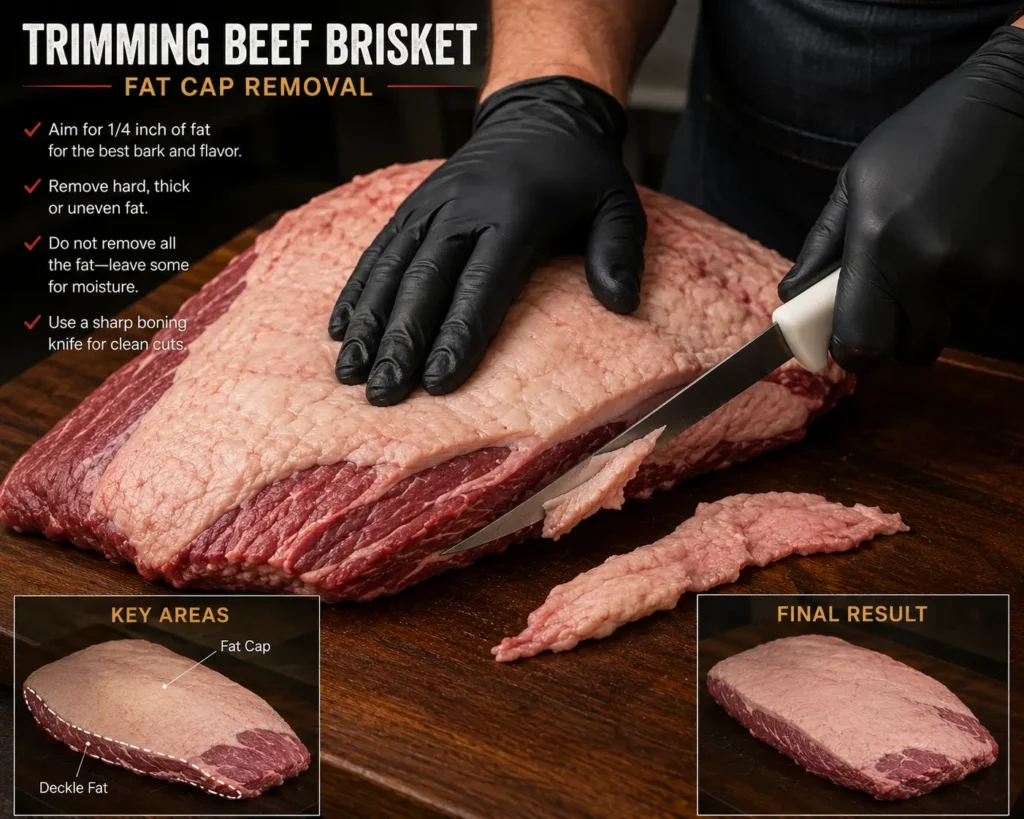
Begin with a cold brisket because chilled fat is firmer and easier to trim. Use a sharp boning knife to remove loose pieces of meat and thin edges that are likely to burn during the long cook.
Trim the fat cap to approximately one quarter inch thick. This leaves enough fat to provide protection and flavor while allowing seasoning and smoke to reach the meat. Extremely thick sections of fat may not fully render during cooking and can prevent bark from developing properly.
Remove large pieces of hard fat, particularly the dense fat located between the flat and point. This hard fat does not render as effectively as softer surface fat. The goal is to create a smooth, aerodynamic shape that allows heat and smoke to move evenly around the brisket.
Seasoning the Brisket
A traditional Offset Smoker Brisket Recipe does not require complicated seasoning. Quality beef, clean smoke, and proper cooking technique should remain the main sources of flavor.
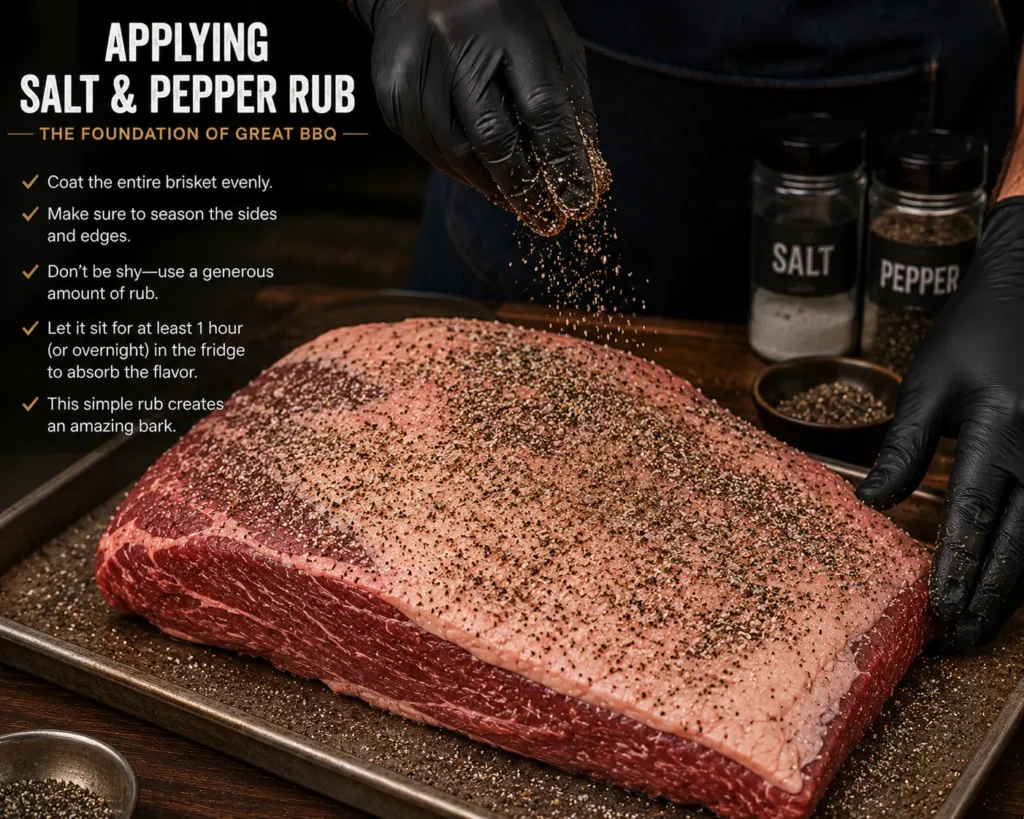
A simple combination of coarse kosher salt and coarse black pepper is a classic choice for Texas style brisket. Many pitmasters use approximately equal parts by volume, although the exact ratio can be adjusted according to personal preference.
Garlic powder and onion powder can also be added for additional savory flavor. Paprika may contribute color, but it is not essential for developing a good bark.
Apply the seasoning evenly across every surface of the brisket, including the sides and edges. The coating should be generous without creating thick piles of seasoning. Allow the seasoned brisket to rest while the smoker preheats so the rub can begin adhering to the moist surface of the meat.
Some cooks season the brisket several hours before smoking, while others apply the rub shortly before placing it in the smoker. Both methods can produce excellent results when the seasoning is distributed evenly.
Preparing the Offset Smoker
Proper smoker preparation is one of the most important stages of any Offset Smoker Brisket Recipe. Brisket requires many hours of steady cooking, so beginning with a stable and clean burning fire makes the entire process easier. If your smoker is brand new, make sure you have already gone through the process to season an offset smoker before attempting a long cook like brisket.
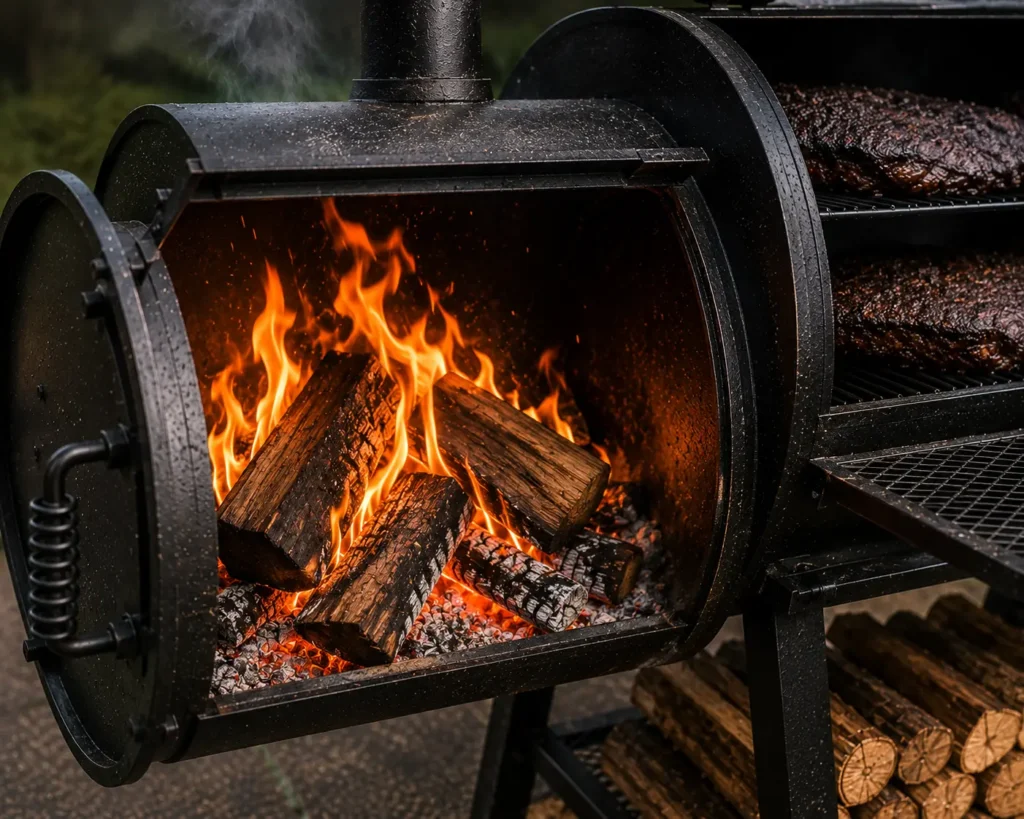
Start by removing old ash from the firebox because excessive ash can restrict airflow. Light a chimney of charcoal and allow the coals to become fully established before transferring them into the firebox.
Once a strong coal bed has formed, add a small split of seasoned hardwood. Oak is one of the best choices for brisket because it burns steadily and produces a balanced smoke flavor. Hickory provides a stronger traditional barbecue profile, while mesquite creates a much more intense flavor and should generally be used carefully. For a deeper breakdown of building and maintaining your fire correctly, see this offset smoker fire management guide.
Allow the smoker to preheat until the cooking chamber stabilizes between 225°F and 250°F. Maintain good airflow and look for clean, nearly transparent or thin blue smoke before adding the brisket.
A stable smoker at the beginning of the cook creates a much better foundation than placing meat inside while temperatures are still rising and falling dramatically.
Placing the Brisket in the Smoker
Once the cooking chamber has stabilized, the next stage of the Offset Smoker Brisket Recipe is positioning the brisket correctly. Placement matters because traditional offset smokers often have a hotter area near the firebox.
Position the brisket so the thicker point faces the hotter side of the smoker. The point contains more fat and can generally tolerate stronger heat better than the leaner flat.
The decision to cook fat side up or fat side down depends on where the strongest heat reaches the brisket. In many traditional offset smokers, the primary heat comes from the firebox side and moves across the cooking chamber. The fat cap can be positioned toward the strongest heat source to provide additional protection.
This means there is no universal rule that fat side up is always correct. Understanding the airflow and heat pattern of your specific smoker is more important than following a single method for every offset smoker.
Insert a reliable temperature probe into the thickest section of the flat while avoiding large pockets of fat. Close the cooking chamber and allow the brisket to begin its long smoking process.
Smoking the Brisket Low and Slow
The main cooking stage of this Offset Smoker Brisket Recipe requires patience and consistent fire management. Maintain the cooking chamber between 225°F and 250°F for traditional low and slow barbecue, and refer to this offset smoker cooking temperature guide if you want ideal temperature ranges for other cuts of meat as well.
During the early hours of cooking, the brisket develops much of its smoke flavor and begins forming its bark. Avoid opening the cooking chamber unnecessarily because every lid opening releases heat and interrupts the stable cooking environment.
Maintain a small, clean burning fire by adding seasoned wood splits as needed. Do not overload the firebox with several large pieces of wood at once. Smaller and more frequent additions generally produce steadier temperatures and cleaner smoke — the same core principles covered in our guide on how to control heat in an offset smoker.
The brisket should gradually darken as the rub, smoke, rendered fat, and surface moisture interact. A properly developing bark will become deep brown or nearly black without tasting burnt.
Spritzing the Brisket
Spritzing is optional in an Offset Smoker Brisket Recipe, but it can help prevent certain areas of the surface from becoming excessively dry. Common spritzing liquids include water, diluted apple cider vinegar, or beef broth.
Do not begin spritzing immediately after placing the brisket in the smoker. The seasoning needs time to adhere and the bark needs time to begin developing. Spritzing too early or too frequently can wash away seasoning and slow bark formation.
After the bark has started setting, lightly spray only the areas that appear unusually dry. The goal is not to soak the brisket. Excessive moisture cools the surface and can extend the cooking process.
A light spritz every hour or as needed is usually sufficient. If the surface already looks moist and healthy, there is no reason to spray it simply because a certain amount of time has passed.
Understanding the Brisket Stall
One of the most important stages in this Offset Smoker Brisket Recipe is the brisket stall. During the cook, the internal temperature may stop rising significantly, commonly somewhere around 150°F to 170°F.
The stall occurs largely because moisture evaporating from the surface cools the brisket. This evaporative cooling can balance the heat entering the meat, causing the internal temperature to remain nearly unchanged for several hours.
The stall is completely normal and does not mean anything is wrong with the smoker or brisket. You can simply continue cooking until the brisket naturally moves through this stage, or you can wrap it once the bark has developed to your preference.
Experienced pitmasters often focus more on the condition of the bark than on wrapping at one exact internal temperature.
Wrapping the Brisket
Wrapping is an important option in many versions of an Offset Smoker Brisket Recipe because it can reduce moisture loss and help the brisket move through the stall more efficiently.
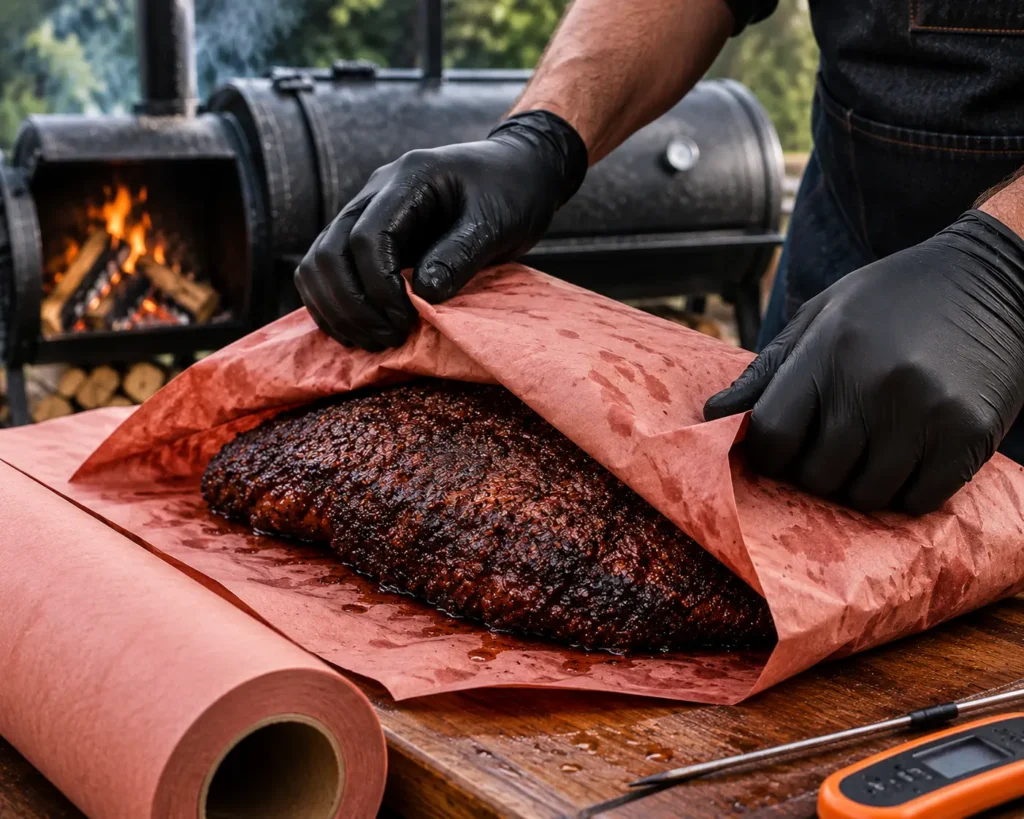
Pink butcher paper is a popular choice because it provides some protection while allowing the brisket to breathe. This helps preserve the bark better than tightly sealed aluminum foil.
Aluminum foil traps more moisture and generally speeds up the cooking process, but it can soften the bark. Both methods can produce tender brisket, so the best choice depends on the texture you prefer.
Wrap the brisket tightly once the bark has developed a deep color and no longer rubs off easily when touched. Return it to the smoker and continue cooking at a stable temperature.
The brisket is now entering the final stage where connective tissues continue breaking down and the meat gradually becomes tender.
Cooking Until the Brisket Is Probe Tender
The final cooking stage of this Offset Smoker Brisket Recipe is where patience becomes especially important. Many beginners remove brisket from the smoker as soon as it reaches a specific internal temperature, but temperature alone does not determine when brisket is truly finished. The most reliable test is tenderness.
Most briskets become tender somewhere between 195°F and 205°F, but this range should be treated as a general guide rather than a strict rule. Every brisket contains a different amount of connective tissue and marbling, so one may be ready at 198°F while another may need to reach 203°F or slightly higher.
Use a thin thermometer probe or skewer to test several areas of the flat and point. When the brisket is ready, the probe should slide into the meat with very little resistance, similar to inserting it into softened butter. The flat deserves the most attention because it is leaner and can become dry if overcooked.
Once the brisket feels consistently tender, remove it from the smoker and prepare it for the resting stage.
Why Internal Temperature Is Only a Guide
One of the most important lessons in any Offset Smoker Brisket Recipe is that internal temperature tells you where to begin checking for tenderness, not exactly when to stop cooking. Relying on one number can lead to undercooked or overcooked brisket.
A brisket may reach 200°F but still feel tight when probed. This means the connective tissue has not fully broken down and the meat needs more time. Another brisket may become tender slightly earlier because of better marbling or a different muscle structure.
The best approach is to begin checking around 195°F and continue cooking until the probe moves through the flat with minimal resistance. This combination of temperature and physical tenderness produces far more consistent results than using temperature alone.
Learning to recognize probe tenderness is one of the skills that separates average brisket from truly exceptional barbecue.
Resting the Brisket Properly
Resting is one of the most important stages of this Offset Smoker Brisket Recipe, yet it is often rushed. After many hours in the smoker, the brisket needs time for its internal temperature to gradually decrease and for the juices to redistribute throughout the meat.
If you slice the brisket immediately, a large amount of moisture can escape onto the cutting board. Resting allows the meat fibers to relax, improving both texture and juiciness.
Keep the brisket wrapped and allow it to rest for at least one hour. For better results, many pitmasters rest brisket for two to four hours in an insulated cooler or warm holding environment.
If using a cooler, wrap the brisket in a clean towel and place it inside without adding ice. The insulation helps maintain a safe serving temperature while allowing the meat to continue relaxing.
A long, controlled rest often improves brisket more than an extra hour of smoking.
Slicing the Brisket Correctly
Proper slicing is essential to completing an Offset Smoker Brisket Recipe because even a perfectly cooked brisket can seem tough if it is sliced incorrectly. Brisket contains long muscle fibers that must be cut across the grain to create tender slices.
The grain direction changes between the flat and the point, so it helps to identify the direction before cooking or make a small reference cut on one corner during trimming.
Begin with the flat and slice across the grain into pieces approximately one quarter inch thick. The slices should remain intact when lifted but separate easily with a gentle pull.
When you reach the point, rotate the brisket because the muscle fibers run in a different direction. Slice the point slightly thicker or separate it from the flat if you plan to prepare burnt ends.
Always use a long, sharp slicing knife to create clean cuts without crushing the bark or tearing the meat.
Making Burnt Ends From the Point
Burnt ends are one of the most popular ways to use the fattier point section in an Offset Smoker Brisket Recipe. The point contains more marbling and connective tissue, making it ideal for additional cooking after the main brisket is finished.
Separate the point from the flat and cut it into approximately one inch cubes. Place the cubes in a pan and lightly season them with additional rub.
Add a small amount of barbecue sauce if desired, then return the pan to the smoker for another thirty to sixty minutes. This additional cooking allows the edges to caramelize while the internal fat continues rendering.
Proper burnt ends should be rich, tender, smoky, and slightly sticky on the outside without becoming dry.
Best Wood for Smoking Brisket
Wood selection plays an important role in every Offset Smoker Brisket Recipe because brisket spends many hours exposed to smoke. The wood should produce a flavor strong enough to complement beef without overwhelming it.
Oak remains one of the best all-around choices because it burns steadily and creates balanced smoke. It is especially suitable for beginners because the flavor is noticeable without becoming excessively strong.
Hickory produces a deeper traditional barbecue flavor and pairs exceptionally well with beef. It can be used alone or combined with oak for a more complex smoke profile.
Mesquite creates very strong smoke and burns hot, so it should generally be used sparingly. Small amounts can add bold Texas-style character, but excessive mesquite may overpower the natural flavor of the brisket.
Pecan provides a slightly sweeter smoke that works well when blended with oak or hickory.
No matter which wood you choose, always use properly seasoned hardwood to maintain clean combustion and thin blue smoke.
Maintaining a Strong Bark
The bark is one of the defining characteristics of a successful Offset Smoker Brisket Recipe. It develops through a combination of seasoning, smoke, heat, rendered fat, and surface moisture.
A strong bark begins with an even layer of coarse seasoning. Salt and black pepper create texture while smoke gradually darkens the surface throughout the cook.
Avoid wrapping too early because the bark needs time to set before it is covered. If the seasoning still wipes away easily, continue cooking unwrapped until the surface becomes firm and dark.
Spritz only when necessary. Excessive spraying can soften the bark and slow surface development. Likewise, wrapping tightly in foil may produce softer bark than butcher paper.
After unwrapping or finishing the cook, the bark should feel firm without becoming hard or burnt.
Common Brisket Mistakes to Avoid
Many problems in an Offset Smoker Brisket Recipe come from rushing the process or reacting too aggressively to small changes.
Cooking with dirty smoke is one of the most damaging mistakes. Thick white smoke can create bitter flavors that remain throughout the entire brisket. Maintain a small, clean-burning fire and use properly seasoned wood — revisit our fire management guide if this is a recurring issue for you.
Constantly opening the cooking chamber also causes unnecessary temperature loss. Trust your thermometers and only open the smoker when you need to spritz, wrap, or check tenderness.
Removing the brisket based only on internal temperature can lead to tough meat. Always confirm doneness by probing for tenderness.
Skipping the resting stage is another common mistake. Even a well-cooked brisket may lose moisture if it is sliced immediately.
Finally, cutting with the grain makes the meat seem tougher than it actually is. Always slice across the grain.
Expert Tips for Better Brisket
Experienced pitmasters understand that a successful Offset Smoker Brisket Recipe depends more on consistency than complicated techniques.
Keep the fire small and clean rather than building an oversized fire. Stable heat produces better results than constant temperature corrections.
Use a digital thermometer at grate level because the built-in lid thermometer may not reflect the temperature surrounding the brisket.
Warm wood splits near the firebox before adding them to the fire. Preheated wood ignites faster and reduces the amount of dirty smoke produced after refueling.
Take notes during every cook. Record brisket weight, trimming method, seasoning, wood type, cooking temperature, wrapping point, total cook time, and final results. These notes will help you repeat successful cooks and improve weak areas over time.
Most importantly, do not rush brisket. Every brisket cooks at its own pace, and patience is often the difference between average barbecue and outstanding results.
Frequently Asked Questions
A whole packer brisket often requires approximately one to one and a half hours per pound when cooked between 225°F and 250°F. However, total cooking time varies depending on brisket size, smoker temperature, weather conditions, and the length of the stall.
Most briskets become tender between 195°F and 205°F. Begin checking for tenderness around 195°F and remove the brisket when a probe slides easily through the flat with very little resistance.
Wrapping is optional. Butcher paper helps preserve bark while reducing moisture loss, while aluminum foil speeds up cooking and traps more moisture. The best method depends on your preferred bark and cooking style.
Position the fat cap toward the strongest heat source. In many offset smokers, this may mean fat side down or angled toward the firebox. The correct position depends on your smoker’s heat pattern.
Rest the brisket for at least one hour. A two to four hour rest often produces even better texture and moisture retention.
Final Verdict
Following a reliable Offset Smoker Brisket Recipe requires patience, careful fire management, and attention to every stage of the cooking process. From choosing a well-marbled packer brisket and trimming it correctly to building a clean fire, maintaining steady temperatures, managing the stall, and resting the finished meat, each step contributes to the final result.
The best brisket is not produced by chasing one exact cooking time or internal temperature. It comes from understanding how the meat responds throughout the cook and knowing when the bark is ready, when wrapping makes sense, and when the brisket has become probe tender. These skills improve with practice and make every future cook more predictable.
Whether you are preparing brisket for your family, a backyard gathering, or a serious barbecue event, this Offset Smoker Brisket Recipe provides the foundation for producing tender, juicy, and deeply flavorful smoked beef. With quality meat, seasoned hardwood, stable heat, and a proper rest, your offset smoker can deliver authentic barbecue that rivals many professional smokehouses.
If you enjoyed this recipe, you might also want to try our guide on how to smoke ribs in an offset smoker for another classic low and slow barbecue project.