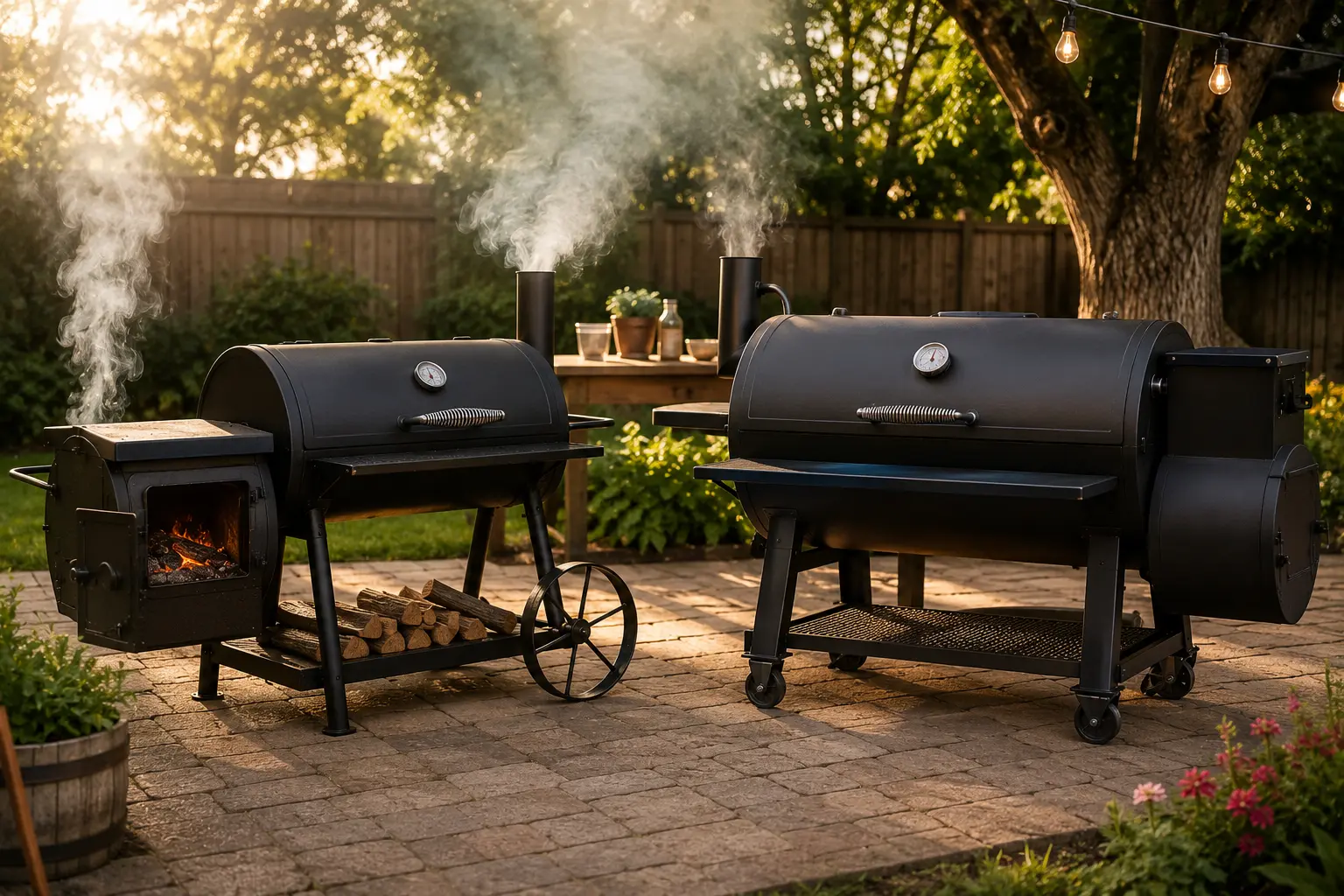
Choosing between an offset smoker vs reverse flow smoker can be difficult because both designs use a separate firebox, burn real wood or charcoal, and produce authentic low-and-slow barbecue. However, the way heat and smoke travel through their cooking chambers creates important differences in temperature consistency, smoke exposure, fuel use, maintenance, and cooking flexibility.
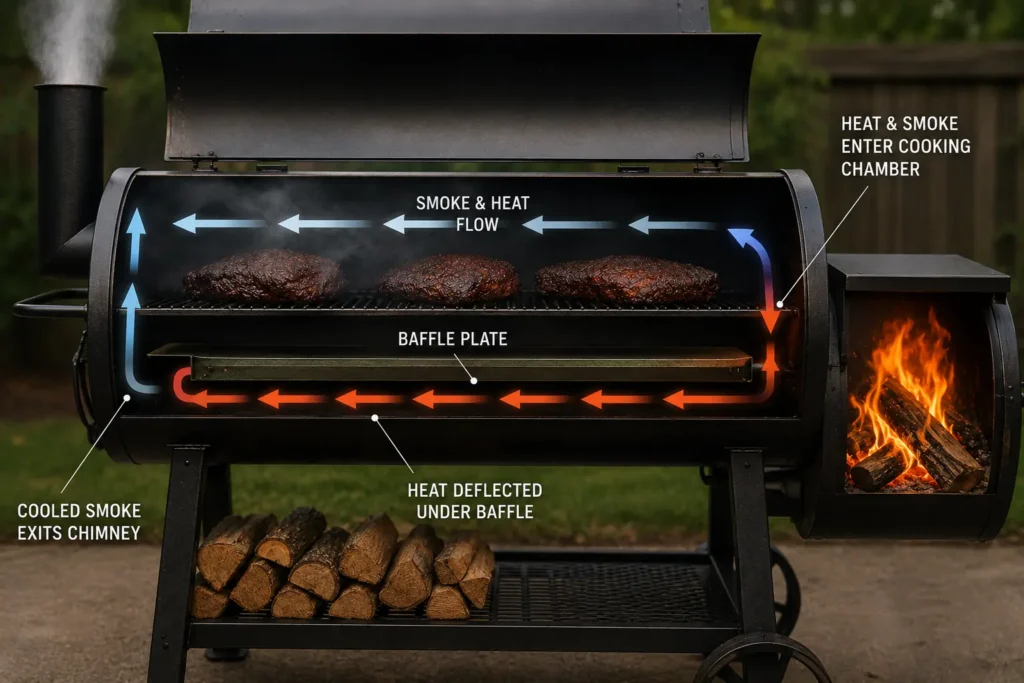
A traditional offset smoker moves heat directly from the firebox across the food and toward a chimney at the opposite end. A reverse flow smoker adds a solid steel baffle plate beneath the cooking grates. Heat travels under this plate, rises at the far end, and then reverses direction before exiting through a chimney near the firebox.
The offset smoker vs reverse flow smoker decision is therefore not about which design can produce good barbecue—both can. It is about whether you prefer flexible heat zones and faster response or more even temperatures and a forgiving cooking environment.
This offset smoker vs reverse flow smoker guide compares the two systems feature by feature so you can match the cooker to your experience, capacity requirements, and preferred barbecue style.
In the offset smoker vs reverse flow smoker comparison, a traditional offset is best for pitmasters who want distinct temperature zones, direct control, faster preheating, and easier access beneath the cooking grates. A reverse flow smoker is better for cooks who value even heat, consistent smoke circulation, reduced hot spots, and less frequent meat rotation.
Neither design is automatically superior. Choose a traditional offset for maximum flexibility and a reverse flow smoker for greater consistency across a loaded cooking chamber.
Offset Smoker vs Reverse Flow Smoker Comparison Table
| Feature | Traditional Offset Smoker | Reverse Flow Smoker |
| Airflow path | Directly across the chamber | Under the baffle, then back over the food |
| Heat distribution | Noticeable hot and cool zones | More even from end to end |
| Temperature response | Faster response to fire changes | Slower but more stable |
| Smoke flavor | Bold and direct | Balanced and consistent |
| Food rotation | Often required | Usually required less often |
| Preheating | Generally faster | Generally slower because of the baffle |
| Fuel use | Depends heavily on construction | Can be efficient after full preheating |
| Cleaning | Open chamber is easier to access | Residue can collect beneath the baffle |
| Best for | Hands-on pitmasters | Consistency-focused cooks |
The offset smoker vs reverse flow smoker table shows the overall trade-off: traditional offsets emphasize control and cooking zones, while reverse flow models emphasize stability and evenness.
What Is a Traditional Offset Smoker?
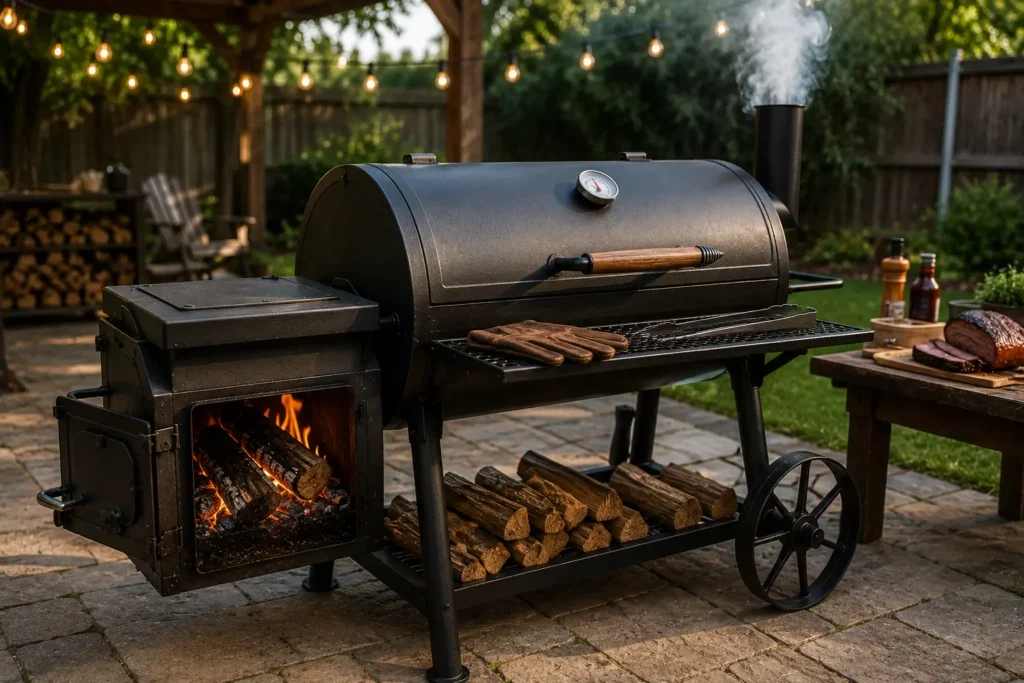
To understand the offset smoker vs reverse flow smoker debate, begin with the traditional design. A standard offset smoker has a horizontal cooking chamber, a side-mounted firebox, an intake damper, and a chimney positioned near the opposite end of the chamber.
Wood or charcoal burns inside the firebox. Heat and smoke enter the cooking chamber through an opening, travel around the food, and exit through the chimney. The side closest to the firebox normally runs hotter, while the chimney side remains cooler.
These different temperature zones are not always a disadvantage. Experienced pitmasters use them intentionally. Chicken, sausages, or vegetables can cook in the hotter zone while brisket or pork shoulder cooks more slowly farther from the firebox.
If you are new to this design, our complete offset smoker grill guide explains its main components, benefits, and basic operation.
Advantages of a Traditional Offset Smoker
In practical offset smoker vs reverse flow smoker use, the traditional design provides the following advantages:
- Creates useful hot, medium, and cool cooking zones
- Responds relatively quickly to fuel and airflow adjustments
- Provides direct control over the fire and smoke
- Often preheats faster than a reverse flow design
- Makes the underside of the cooking chamber easier to access
- Can offer more direct grilling options on certain models
- Is available in a wide range of sizes and prices
Disadvantages of a Traditional Offset Smoker
A traditional offset smoker also presents several challenges:
- Hot spots can be significant near the firebox
- Large cuts may need to be rotated during long cooks
- Temperature management requires practice
- Thin steel models lose heat quickly in cold or windy weather
- A poorly managed fire can create heavy, bitter smoke
- Different foods may finish at different times across the grate
What Is a Reverse Flow Smoker?
In an offset smoker vs reverse flow smoker comparison, the reverse flow model is still a type of offset smoker. Its defining feature is a solid metal baffle plate installed beneath the cooking grates.
Heat and smoke enter from the firebox and are forced underneath the baffle toward the far end of the cooking chamber. They then rise, reverse direction, pass back across the food, and exit through a chimney positioned closer to the firebox.
The baffle absorbs heat and acts as thermal mass. Once fully heated, it radiates energy upward and helps reduce sharp temperature differences across the grate. Lang BBQ Smokers provides a useful official explanation of how reverse flow heat moves beneath and above the baffle.
For a real-world example of this system, read our detailed Lang BBQ offset smoker review.
Advantages of a Reverse Flow Smoker
The main offset smoker vs reverse flow smoker advantage for reverse flow is its ability to create a more uniform environment across a heavily loaded grate.
Other benefits include:
- Produces more even temperatures across the cooking chamber
- Reduces major hot spots near the firebox
- Distributes smoke more consistently around multiple cuts
- Requires less frequent food rotation
- Recovers steadily after brief lid openings
- Provides a more forgiving environment for large cooks
- Uses the heated baffle to stabilize temperature fluctuations
Disadvantages of a Reverse Flow Smoker
Reverse flow smokers also have some limitations:
- Take longer to preheat because the steel baffle must absorb heat
- Usually weigh more than comparable traditional offsets
- Can cost more because of additional steel and fabrication
- Offer fewer distinct temperature zones
- May collect grease and residue beneath the baffle
- Can create strong radiant heat beneath the food
- Some models are harder to clean thoroughly
Offset Smoker vs Reverse Flow Smoker: 9 Important Differences
The following offset smoker vs reverse flow smoker differences have the greatest effect on everyday operation, cooking results, cleaning, and long-term value.
1. Offset Smoker vs Reverse Flow Smoker Airflow
Airflow is the fundamental difference between the two designs. In a traditional offset, heat takes a relatively direct path from the firebox to the chimney. In a reverse flow smoker, it must travel under a plate, rise at the far end, and return across the cooking grates.
The longer reverse flow path promotes more uniform circulation, while the traditional layout produces more noticeable cooking zones.
Neither path eliminates the need for a clean-burning fire. Both smokers need enough draft to keep combustion gases moving rather than allowing stale smoke to collect around the meat.
For practical fire-building guidance, Oklahoma Joe’s explains how to build and manage a consistent offset smoker fire.
2. Heat Distribution and Hot Spots
Heat distribution is often the deciding factor in an offset smoker vs reverse flow smoker purchase. A traditional offset normally runs hottest beside the firebox. Depending on its size and construction, the far end can be considerably cooler.
A reverse flow baffle shields the food from direct firebox heat and spreads energy beneath a larger area. This generally creates a smaller difference between the hottest and coolest sections of the cooking grate.
Traditional temperature zones are useful when cooking different foods simultaneously. Reverse flow consistency is useful when loading the chamber with several briskets, pork shoulders, or racks of ribs that should cook at a similar rate.
3. Temperature Control and Stability
The offset smoker vs reverse flow smoker temperature-control experience is different even though both use similar dampers.
A traditional offset responds faster when you change the intake vent, adjust the fire, or add fuel. That responsiveness gives skilled cooks precise control but can also create larger temperature swings.
A reverse flow smoker responds more gradually because the heavy baffle stores heat. Once the chamber is stable, the plate can soften short temperature drops caused by opening the lid or adding a fresh wood split.
Whichever design you use, make small adjustments and allow the smoker time to respond. Our guide on how to control heat in an offset smoker covers damper settings, fire size, weather, and troubleshooting.
4. Smoke Flavor and Bark
Both smokers burn the same hardwoods, so fuel quality and fire management influence flavor more than chamber design alone. Nevertheless, the offset smoker vs reverse flow smoker smoke path can affect how evenly smoke reaches the food.
A traditional offset can produce a bold smoke profile, especially on food located closer to the firebox. A reverse flow smoker circulates smoke along a longer path, which can create more uniform color and bark across several pieces of meat.
More smoke is not always better. Thick white smoke usually indicates incomplete combustion and can leave food bitter. Aim for a clean fire and thin blue or nearly invisible smoke rather than trying to fill the chamber with dense smoke.
5. Cooking Flexibility and Food Placement
Traditional offsets win the offset smoker vs reverse flow smoker flexibility category because their natural temperature zones can be used strategically.
You can place poultry or sausages closer to the heat while keeping brisket, ribs, or pork shoulder in a cooler section. This allows different foods to cook simultaneously at different rates.
Reverse flow smokers sacrifice some of those distinct zones in exchange for consistency. This is valuable when every item should cook under similar conditions, but it provides less freedom to create different temperatures inside the same chamber.
Before loading either smoker, use grate-level probes to identify its actual heat pattern. Lid thermometers show only one location and may not represent the temperature beside the food.
6. Preheating and Fuel Efficiency
In the offset smoker vs reverse flow smoker fuel comparison, build quality matters more than the label. Thick steel, tight doors, effective seals, outdoor temperature, wind, fire size, and cooking temperature all affect fuel consumption.
A traditional offset generally preheats faster because there is less steel between the fire and cooking grate.
A reverse flow smoker requires more energy at startup to heat its baffle plate. Once hot, however, that additional thermal mass can help the chamber remain stable and use fuel efficiently.
Use seasoned hardwood splits that fit the firebox, maintain a healthy coal bed, and add smaller amounts of fuel before the fire collapses. Our offset smoker fire management guide provides a step-by-step method.
7. Moisture, Radiant Heat, and Cooking Results
The baffle is another important factor in the offset smoker vs reverse flow smoker cooking experience. Because it becomes hot, it radiates heat toward the bottom of the food.
This can support even cooking but may also make the underside of meat cook faster if the plate becomes excessively hot.
Some reverse flow designs use the plate as a sealed grease channel that directs drippings toward a drain. Traditional offsets usually expose the lower chamber more directly and may use removable tuning plates or deflector panels.
Neither system automatically makes meat juicier. Final moisture depends on the cut, marbling, cooking temperature, wrapping method, internal temperature, and resting time.
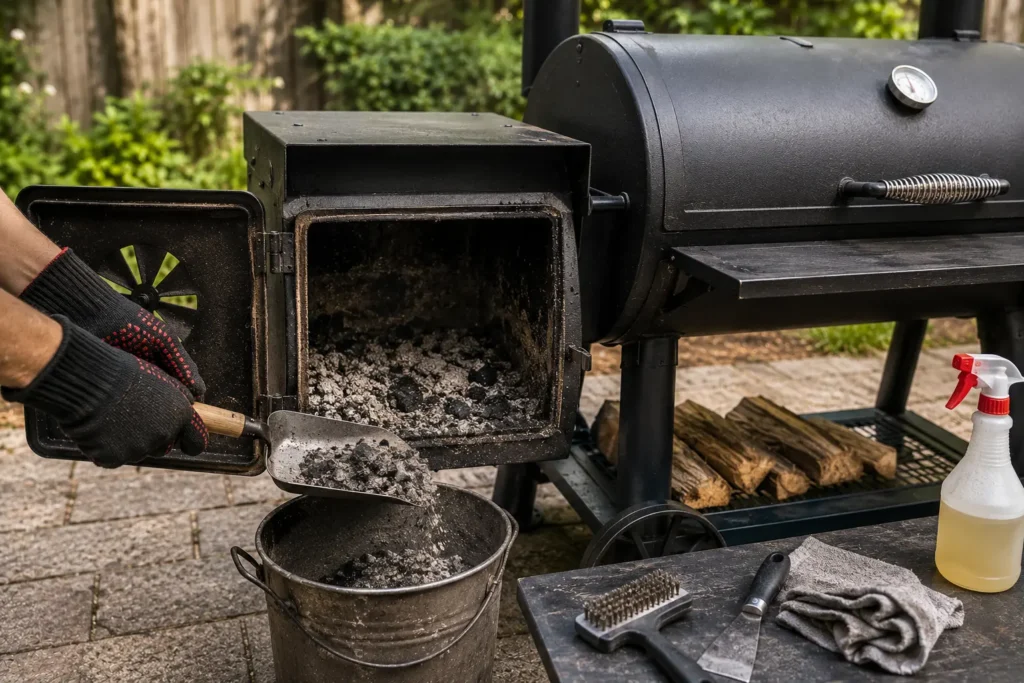
8. Cleaning and Maintenance
Maintenance is similar in the offset smoker vs reverse flow smoker comparison. You should:
- Remove cooled ash
- Brush the cooking grates
- Clear excessive grease
- Inspect the grease drain
- Protect the exterior from rust
- Keep the smoker covered when not in use
Traditional offsets are usually easier to access beneath the grates. Reverse flow models may require extra attention below or around the baffle, where grease and carbon can accumulate.
Follow the manufacturer’s cleaning instructions because some plates are welded in place while others are removable.
New smokers should also be cleaned and seasoned before their first cook. Follow our guide on how to season an offset smoker to prepare the steel and establish a protective cooking surface.
9. Price, Weight, and Long-Term Value
Price completes the offset smoker vs reverse flow smoker comparison. Traditional offsets range from lightweight entry-level models to large professional pits.
Reverse flow smokers often require more steel, welding, and fabrication, which can increase both price and weight.
Do not choose solely by design name. A well-built traditional offset with thick steel and tight doors may outperform a poorly constructed reverse flow smoker.
Examine these features before purchasing:
- Steel thickness
- Weld quality
- Firebox size
- Door fit and seals
- Cooking capacity
- Grease drainage
- Thermometer placement
- Warranty coverage
- Replacement-part availability
If you are comparing available models, our offset smoker buying guide explains the most important construction and capacity checks.
Which Smoker Is Better for Beginners?
For a beginner considering an offset smoker vs reverse flow smoker, reverse flow is often more forgiving because it reduces major hot spots and requires less meat rotation. Once the baffle reaches cooking temperature, the chamber tends to remain relatively stable.
However, a traditional offset can be a better learning tool for someone who wants to understand fire behavior, cooking zones, and active temperature control.
The learning curve is steeper, but those skills transfer to many other charcoal and wood-burning cookers.
New pitmasters can use our guide to smoking with an offset smoker for beginners before attempting a long brisket or pork-shoulder cook.
For most first-time buyers, the right offset smoker vs reverse flow smoker choice depends on whether learning live-fire control or reducing temperature variation is the higher priority.
Which Design Is Better for Brisket?
The offset smoker vs reverse flow smoker choice for brisket depends on cooking style and capacity.
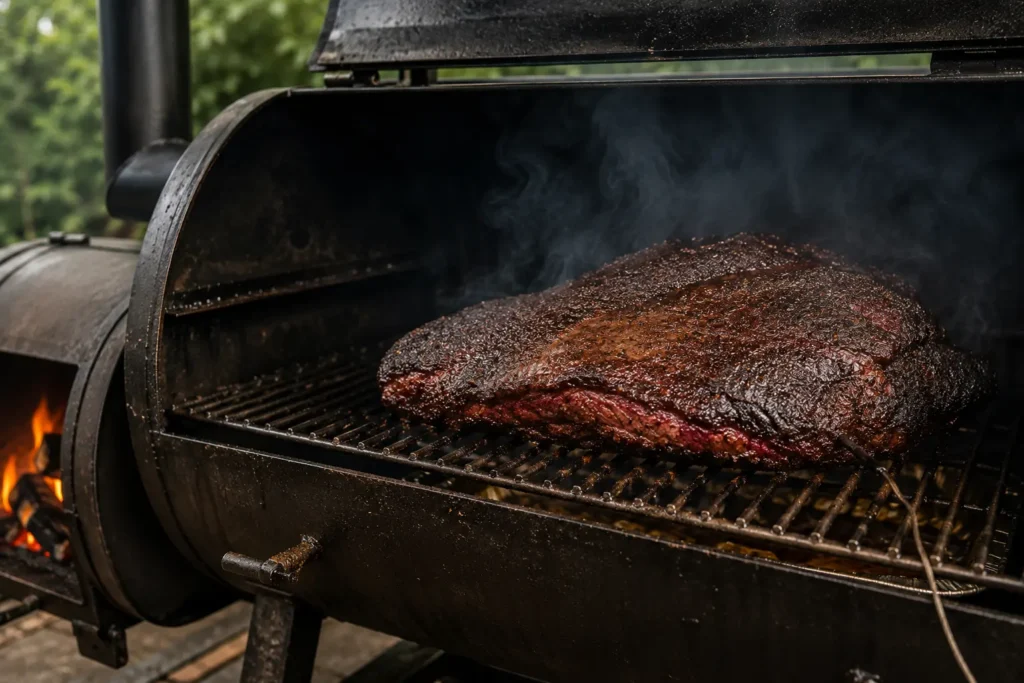
A traditional offset lets you move the brisket between hotter and cooler zones as the bark develops. This gives an experienced cook more control over how quickly different parts cook.
A reverse flow smoker is helpful when cooking multiple briskets because its more even heat reduces the need for rotation. It can also make long cooks easier to manage, especially when the chamber is heavily loaded.
Both designs can produce tender brisket with a strong bark. Fire quality, grate temperature, trimming, seasoning, wrapping, internal tenderness, and resting are more important than the smoker label alone.
How to Choose the Right Smoker
Before deciding between an offset smoker vs reverse flow smoker, answer these questions:
- Do you want distinct cooking zones or even temperatures?
- Will you cook one large cut or fill the entire cooking chamber?
- Do you enjoy rotating food and managing hot spots?
- How much time can you allow for preheating?
- Do you need direct-grilling capability?
- Is the baffle removable for easier cleaning?
- How thick is the smoker’s steel?
- Are the doors, seams, and firebox properly sealed?
- Can your patio or trailer support the smoker’s weight?
- Does the price match how frequently you will use it?
Choose a traditional offset if you value responsive control, different temperature zones, simpler access, and greater versatility.
Choose reverse flow if you regularly cook several large cuts and want predictable heat across the grate.
Your final offset smoker vs reverse flow smoker selection should prioritize construction quality and usable capacity rather than relying on the design label alone.
Essential Temperature and Food-Safety Tips
No offset smoker vs reverse flow smoker comparison is complete without food safety.
Use one thermometer at grate level and another to monitor the food’s internal temperature. Do not rely only on cooking time, smoke color, or the smoker’s lid thermometer.
The USDA smoking meat and poultry guidance recommends maintaining the smoker between 225°F and 300°F during cooking.
The USDA also provides these safe minimum internal temperatures:
| Food | Minimum Internal Temperature |
| Beef, pork, lamb and veal steaks, chops and roasts | 145°F with a three-minute rest |
| Ground beef, pork, lamb and veal | 160°F |
| Poultry | 165°F |
Brisket and pork shoulder are commonly cooked beyond their minimum safe temperatures because connective tissue needs additional time and heat to become tender. Use both internal temperature and probe tenderness when evaluating these cuts.
For suggested pit temperatures across different meats, see our offset smoker cooking temperature guide.
Why Understanding the Difference Between an Offset Smoker vs Reverse Flow Smoker Is Worth the Effort
The offset smoker vs reverse flow smoker decision comes down to flexibility versus consistency.
A traditional offset smoker is best for pitmasters who enjoy active fire management, want multiple cooking zones, prefer faster preheating, and like repositioning food to control the cook. It offers an engaging, traditional barbecue experience but demands closer attention.
A reverse flow smoker is best for cooks who prioritize even temperatures, consistent smoke coverage, fewer major hot spots, and less food rotation. It takes longer to preheat and may cost more, but its stable cooking environment is valuable when preparing multiple large cuts.
Ultimately, the best smoker is a well-built model that fits your cooking style, capacity needs, available space, and budget. With seasoned hardwood, clean airflow, accurate thermometers, and consistent technique, either design can produce exceptional barbecue.
Whichever side of the offset smoker vs reverse flow smoker comparison you choose, careful fire management and proper maintenance will influence your results more than the name printed on the smoker.
Frequently Asked Questions
Not in every situation. In the offset smoker vs reverse flow smoker debate, reverse flow offers more even heat, while a traditional offset offers more flexible temperature zones and faster response to fire adjustments.
Fuel use in an offset smoker vs reverse flow smoker comparison is not determined by airflow design alone.
Reverse flow models may use more fuel during preheating because the baffle must absorb heat. Once fully heated, the added thermal mass can improve stability. Total fuel use depends heavily on steel thickness, seals, weather, fire size, and cooking temperature.
Rotation is usually needed less often, but no smoker is perfectly even. Check temperatures at several grate locations and rotate food if one area cooks faster.
Yes. Beginners can learn with a charcoal base, seasoned hardwood, two digital probes, and small damper adjustments. A traditional offset simply requires more practice than most reverse flow models.
Yes, if the manufacturer permits it. Many cooks use charcoal to create a stable coal bed and add hardwood splits or chunks for smoke flavor.
The offset smoker vs reverse flow smoker distinction is mainly about internal airflow.
A reverse flow smoker is a type of offset smoker. Both use a side firebox, but the reverse flow design adds a baffle that redirects heat underneath the cooking chamber before sending it back over the food.
A traditional offset is often easier to access beneath the cooking grates. A reverse flow smoker may require additional cleaning around or beneath its baffle plate, depending on whether that plate is welded or removable.
Design type alone does not determine lifespan. Thick steel, quality welds, proper drainage, regular ash removal, rust prevention, and weather protection matter more than whether the smoker uses traditional or reverse airflow.