
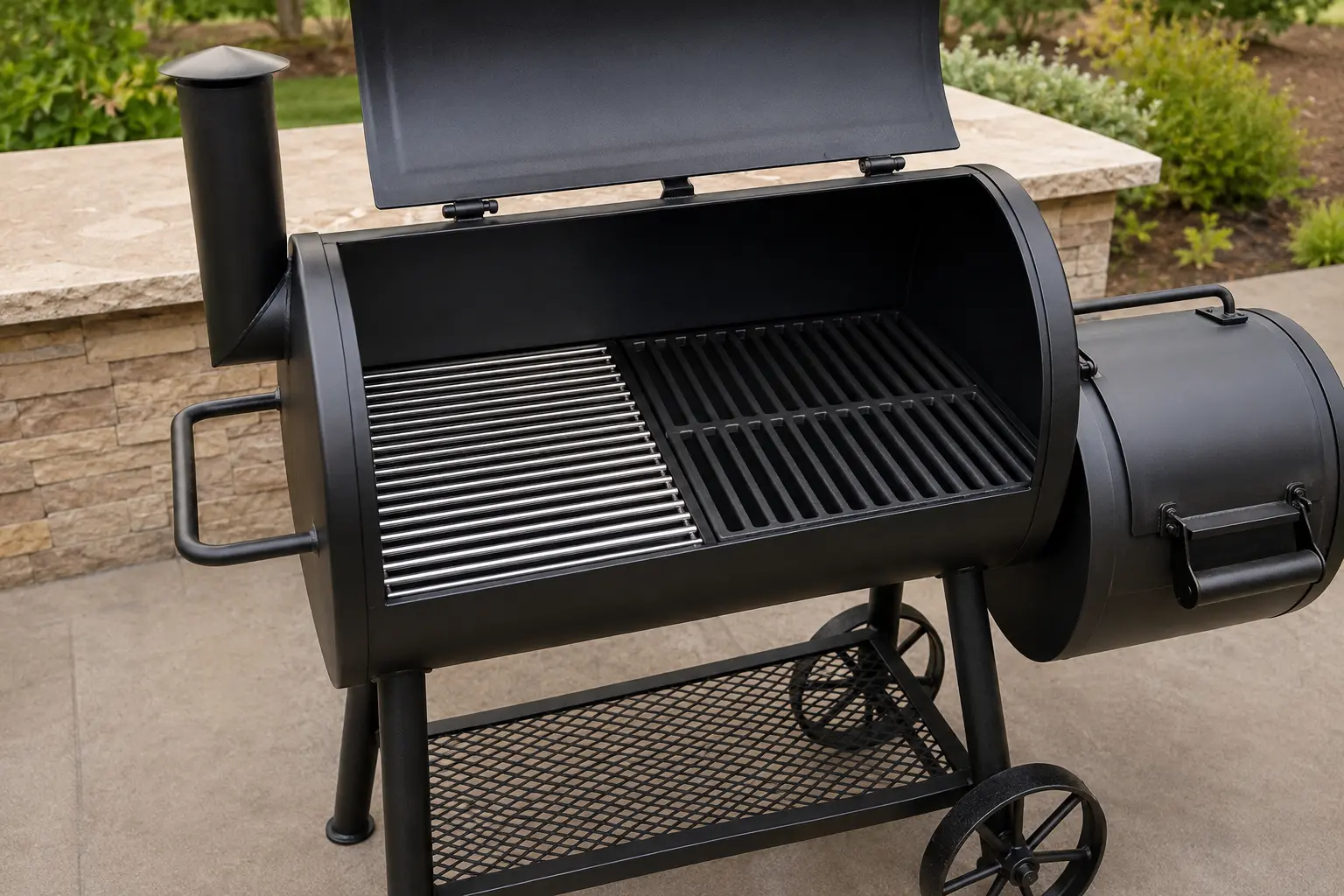
Offset smoker grill grates support the food, transfer heat at contact points, and determine how easily grease and smoke move through the cooking chamber. Their material, bar thickness, spacing, dimensions, and condition can influence browning, food release, cleaning, and usable cooking capacity. A well-fitting grate also stays stable when you turn a brisket, move a water pan, or rotate several racks of ribs.
There is no single grate material that is best for every pitmaster. Bare cast iron stores plenty of heat but requires attentive rust prevention. Stainless steel is durable and comparatively easy to maintain. Porcelain-enameled grates offer convenient food release when the coating remains intact, while plain expanded steel is affordable and common in traditional offset smokers.
This guide compares the main options, explains how to measure replacement offset smoker grill grates, and provides a practical routine for cleaning, seasoning, storage, and cooking.
Quick Answer: Choose grates that match the smoker’s exact length, width, support-rail position, bar spacing, and weight capacity. Stainless steel is a strong low-maintenance choice, bare cast iron is useful when heat retention and searing matter, and heavy expanded steel offers good airflow at a lower cost.
Best All-Round Choice: For most outdoor offset smokers, a well-made stainless steel grate provides the easiest balance of corrosion resistance, durability, cleaning, and everyday smoking performance. Compatibility and construction quality still matter more than the material name alone.
What Are Offset Smoker Grill Grates?
An offset smoker has a separate firebox connected to a larger cooking chamber. Heat and smoke travel from the firebox, across or around the food, and out through the chimney. If you are new to this layout, our complete guide to offset smokers explains how the firebox, cooking chamber, dampers, and exhaust work together.
The cooking grates sit on rails or brackets inside the main chamber. Unlike a heat diffuser or baffle, offset smoker grill grates do not exist primarily to even out chamber temperature. Their main job is to hold food securely while leaving enough open area for convection and smoke circulation. They also conduct heat into the food wherever the metal touches it.
Offset smoker grill grates may be built from parallel rods, welded wire, expanded metal, cast bars, or porcelain-enameled metal. Some smokers include multiple levels, removable sections, or a firebox grate intended for direct grilling. These parts are not automatically interchangeable. A grate designed for the cooking chamber may not tolerate direct fire in the firebox, and a replacement that looks close in size may still fail to sit safely on the supports.
Grate Styles and Construction
The original draft treated flat and V-shaped grates as the two standard shapes, but offset smoker grill grates use a wider range of constructions. “Flat” normally describes the overall cooking surface rather than a distinct material, while V-shaped channels are more common in certain grill systems than in traditional offset-smoker cooking chambers.
Rod or wire grates use parallel stainless steel, plated steel, or enameled bars. Thick rods are sturdy and create defined contact marks, while thinner wire increases open space and allows smoke to move freely. Bar spacing must be narrow enough to support the food you plan to cook; vegetables, wings, and small pieces may require a mesh basket even when the main grate is suitable for brisket or ribs.
Expanded-metal grates are cut and stretched into a diamond pattern. They offer a large cooking area, good airflow, and many contact points, which makes them popular in traditional steel smokers. The edges and welds should be smooth enough to clean safely, and unfinished carbon steel must be dried and lightly protected from corrosion.
Cast grates are formed as heavier sections with raised bars. Their thermal mass can produce stronger contact browning after sufficient preheating, but they are heavier to lift and slower to respond when the chamber temperature changes. Cast iron retains heat well; it should not be assumed to distribute heat perfectly or correct a hot spot caused by the smoker’s airflow.
Channel or V-shaped grates direct some drippings away from the heat source and may reduce flare-ups during direct grilling. In an indirect offset-smoking chamber, however, flare-ups at the food grate are normally less important because the fire is separate. Buy this style only when it is designed for your model or serves a specific direct-grilling purpose.
Comparing Grate Materials
The best material for offset smoker grill grates depends on climate, cooking method, maintenance habits, budget, and whether the grate will be exposed to direct flame. This comparison provides a practical starting point.
| Material | Main strengths | Main limitations | Best suited to |
| Stainless steel | Corrosion-resistant, durable, relatively easy to clean | Thin rods may lose heat quickly; quality varies by steel grade and thickness | Frequent smoking and lower-maintenance ownership |
| Bare cast iron | High thermal mass, strong contact browning, stable once heated | Heavy, can rust, requires careful drying and protective oil | Owners who sear and will maintain the surface |
| Porcelain-enameled cast iron | Good heat retention with a protected surface | Coating can chip; exposed iron may rust | Easy food release with careful handling |
| Porcelain-enameled steel | Affordable, smooth, simple routine cleaning | Thin steel may have lower thermal mass; damaged enamel exposes steel | General smoking on compatible factory grates |
| Plain carbon or expanded steel | Strong, inexpensive, good airflow, easy to fabricate | Prone to rust when wet or neglected | Traditional offset smokers and custom replacements |
| Chrome- or nickel-plated steel | Affordable and easy to use while plating is intact | Plating can wear, scratch, or corrode over time | Light-duty factory replacements |
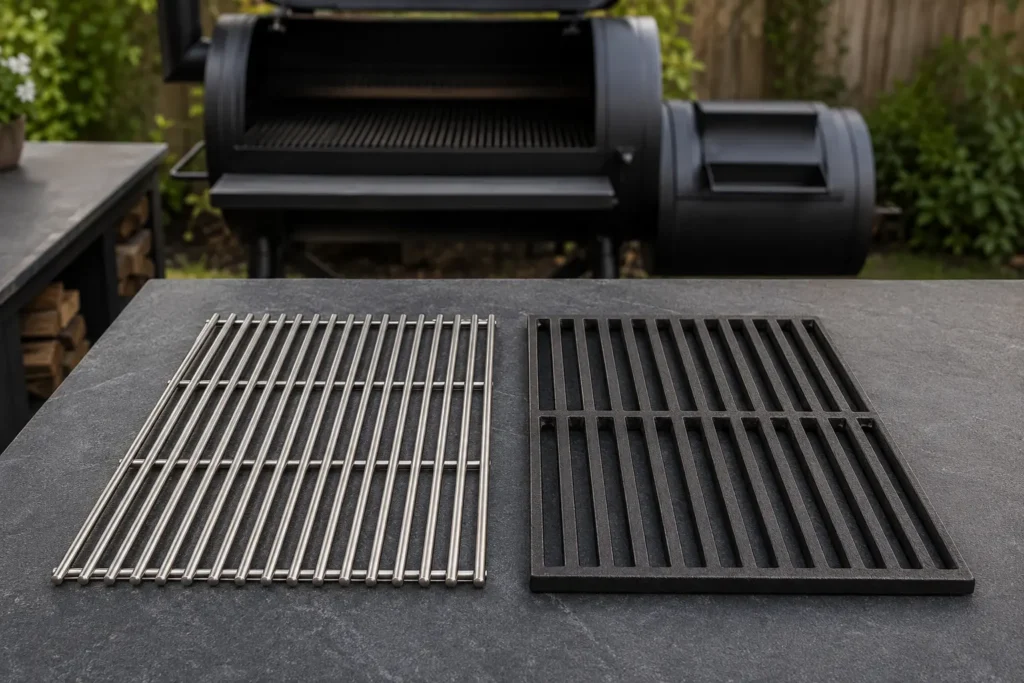
Porcelain-enameled steel, porcelain-enameled cast iron, and stainless steel are distinct choices with different heat-retention, cleaning, and longevity characteristics. The construction and thickness within each category still influence real-world performance.
Stainless steel is generally the most forgiving choice for offset smoker grill grates stored in humid conditions. It is not completely maintenance-free, and food residue can still cause staining or surface corrosion. Construction matters: a heavy, well-welded grate will remain flatter and more stable than a very thin one.
Bare cast iron performs best when it is allowed to heat thoroughly and receives regular care. Its high thermal mass can help with searing, but most traditional offset smoking happens with indirect heat at moderate temperatures. If direct searing is a priority, first confirm that the smoker or firebox is designed to hold a cooking grate safely over the fuel.
Porcelain enamel is a glass-like protective coating rather than a separate structural metal. Intact porcelain-enameled cast iron normally should not be seasoned like bare cast iron; Weber specifically states that its newer porcelain-enameled cast-iron grates do not need seasoning. Avoid metal tools or aggressive scraping that can chip the coating, and replace a badly damaged grate when exposed metal continues to corrode or the surface becomes unsafe.
Plain carbon steel and expanded steel are common because they are strong, economical, and practical for large cooking chambers. They need prompt drying and a very thin food-safe oil film when the manufacturer recommends it. Thick grease buildup is not useful seasoning; it can become rancid, trap debris, and contaminate later cooks.
7 Essential Tips for Choosing Replacement Grates
Buying replacement offset smoker grill grates by smoker width alone is risky. Use these seven checks before ordering or commissioning a custom part.
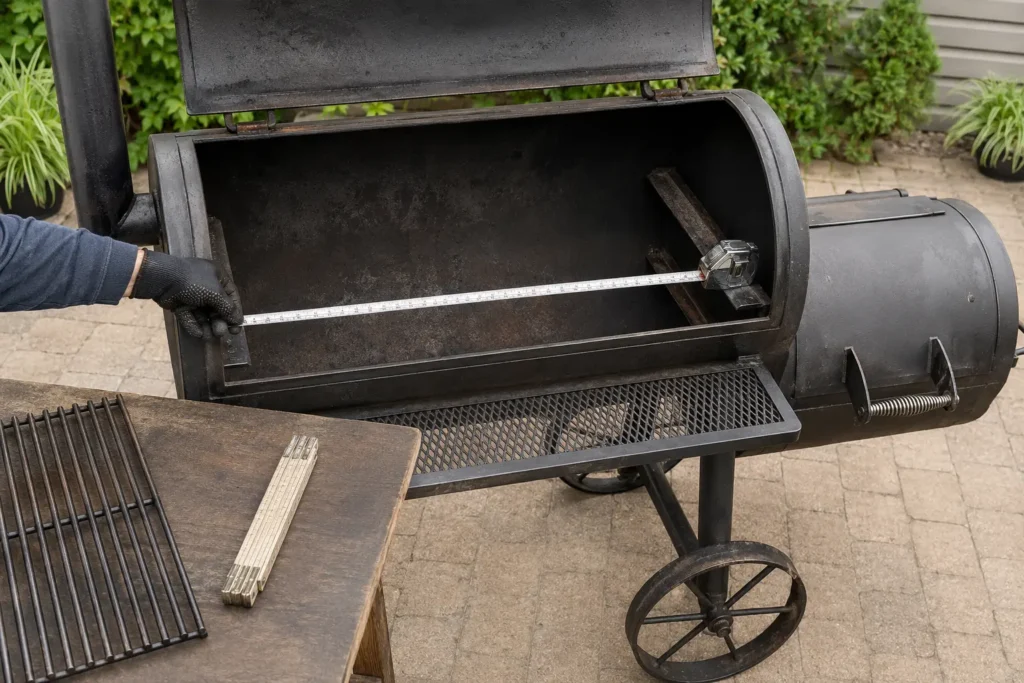
- Measure the actual grate, not just the smoker. Remove the existing grate when it is completely cool. Measure its maximum width, front-to-back depth, thickness, and any notches, rounded corners, handles, or divided sections. Record the measurements in inches and millimeters to reduce conversion errors.
- Check the support rails and insertion path. A replacement must rest securely on every rail without rocking, but it must also fit through the smoker door. Measure the narrowest opening, lid clearance, thermometer-probe clearance, and space required to tilt or slide the grate into position.
- Match the manufacturer and model where possible. Model-specific offset smoker grill grates reduce uncertainty about dimensions, weight, support points, and temperature limits. Confirm the complete model number rather than relying only on a familiar product name, because manufacturers may revise dimensions between generations.
- Choose suitable bar spacing. Wider gaps maximize airflow and make large cuts easy to handle, but smaller foods can fall through. For fish, vegetables, wings, or burnt ends, use a compatible grill basket or perforated tray rather than blocking the whole chamber with foil.
- Evaluate thickness and weld quality. Thicker metal generally resists sagging and stores more heat, but it also increases weight and preheating time. Inspect product photos and specifications for complete welds, smooth edges, rigid frames, and adequate load capacity.
- Consider maintenance and climate. Stainless steel is attractive when the smoker lives in a humid or coastal environment. Bare iron or carbon steel can still last for years, but only if you remove residue, dry the metal, maintain its protective layer, and keep the smoker sheltered.
- Verify food-contact suitability and warranty. Use a grate sold or fabricated for cooking, not unidentified scrap metal, painted shelving, galvanized mesh, or a mystery alloy. Confirm the manufacturer’s cleaning, seasoning, direct-flame, and warranty instructions before use.
If corrosion has reached more than the cooking surface, follow our full process for cleaning an offset smoker and inspect the support rails before fitting heavier offset smoker grill grates.
How Grill Grates Affect Smoking Performance
Offset smoker grill grates affect cooking mostly through contact, airflow, capacity, and food placement. They cannot by themselves eliminate the temperature gradient between the firebox end and chimney end. That gradient is primarily controlled by the smoker’s geometry, fire size, intake and exhaust settings, leaks, baffles, and weather.
Heavy offset smoker grill grates absorb energy during preheating and return some of it to the food at contact points. That is valuable for browning, but it does not mean every part of the chamber becomes equally hot. Compare grate-level readings at several positions and use our offset smoker thermometer upgrade guide if the lid gauge does not represent the temperature where the food sits.
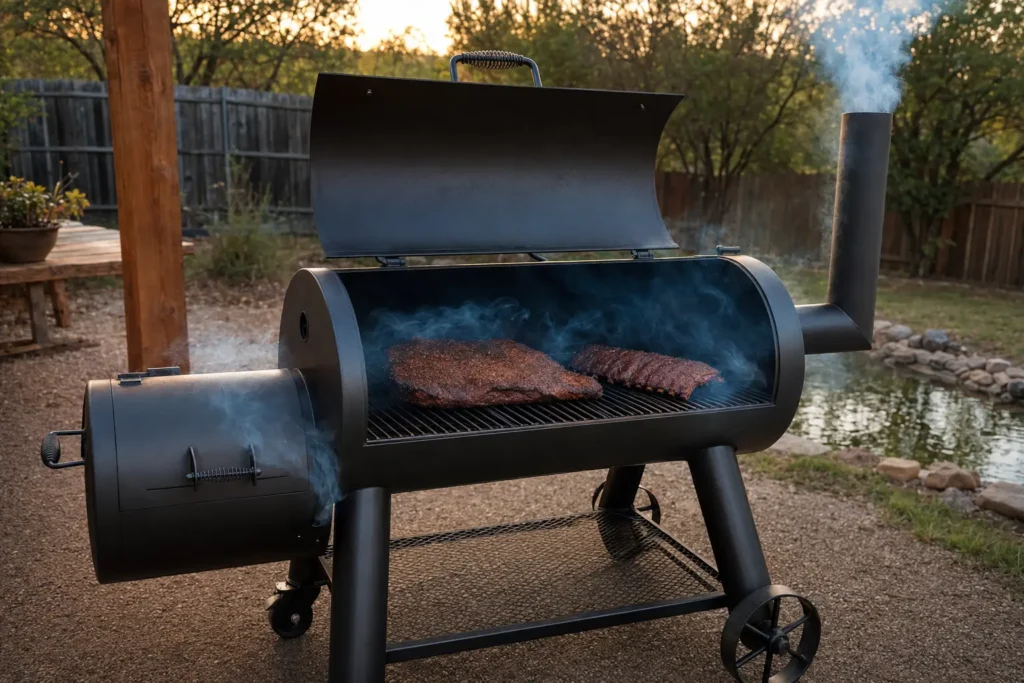
Open space between the bars allows hot air and smoke to circulate around the meat. Packing food edge to edge can restrict that movement and make it harder to rotate large cuts. Leave practical gaps between items, keep food away from chamber walls, and avoid letting foil or oversized pans cover most of the airflow path.
Grease also changes surface behavior. A clean, lightly protected grate releases food better than a cold or heavily carbonized one, while excess grease can drip into the chamber and create dirty smoke or a fire hazard. A correctly positioned offset smoker drip pan can simplify cleanup without blocking the main heat-and-smoke path.
Cleaning, Seasoning, and Rust Prevention
Allow the smoker to cool to a safe temperature, then remove loose food residue with a tool approved for the grate material. Char-Broil’s grill-grate cleaning guidance recommends letting cast-iron grates cool before cleaning them with a soft or nylon brush. Follow your smoker manufacturer when its instructions differ.
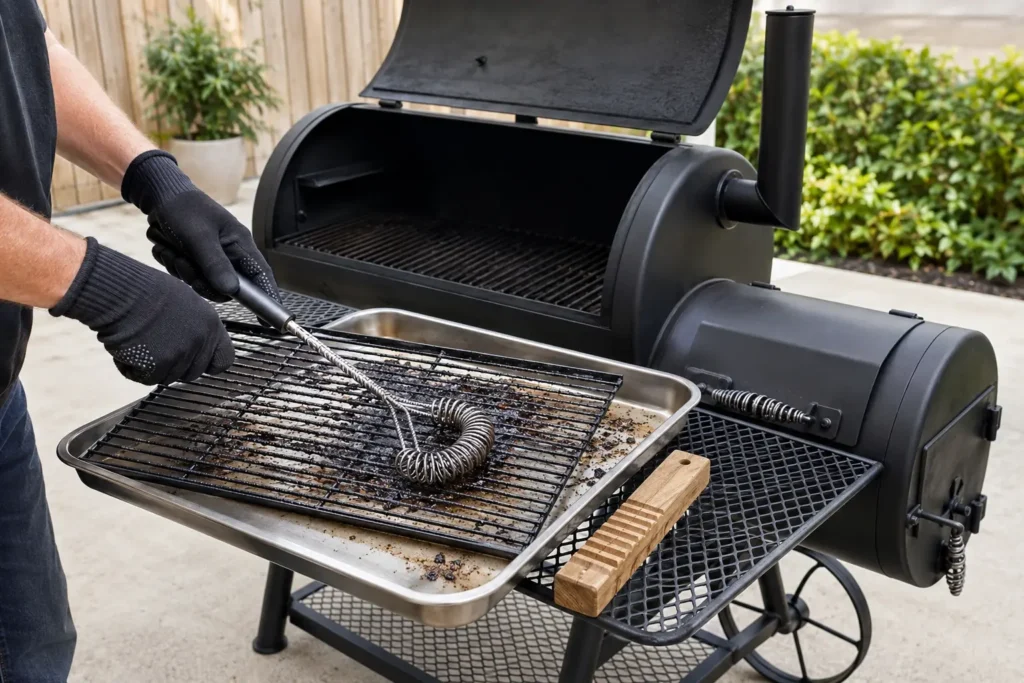
Wire-bristle brushes deserve special caution. The U.S. Consumer Product Safety Commission has warned about the ingestion hazard from detached metal grill-brush bristles, which can remain on a cooking surface and later be swallowed with food. Inspect offset smoker grill grates carefully after cleaning, and consider a non-wire scraper, nylon brush used at the permitted temperature, coiled-wire tool, or other manufacturer-approved alternative. Never use a cleaning tool that sheds, breaks, or leaves fragments behind.
For stainless steel offset smoker grill grates, brush away residue, wash with mild soap and warm water when necessary, rinse, and dry thoroughly. Clean in the direction of any visible grain and avoid chlorine bleach, harsh abrasives, or tools that can deeply scratch the surface. Heat discoloration is not automatically rust, but pitting or loose corrosion requires closer inspection.
For bare cast iron or carbon steel, avoid prolonged soaking. Clean the surface, dry it immediately, and warm it gently to remove hidden moisture. Apply an extremely thin layer of a manufacturer-approved high-smoke-point cooking oil to the clean metal, then heat it as directed. Our offset smoker seasoning guide explains how a thin oil film is polymerized instead of left sticky.
For porcelain-enameled grates, use non-abrasive tools and avoid striking the surface. Do not apply the full bare-metal seasoning routine while the enamel is intact unless the manufacturer specifically instructs you to do so. If a small chip exposes iron or steel, keep the area clean and dry and follow the brand’s repair or replacement advice.
After every cook, remove large scraps and inspect both sides of the grate, its frame, and the support rails. Empty cold ash from the firebox because ash can retain moisture. Store clean, dry offset smoker grill grates inside a dry smoker and protect the entire unit from rain; do not trap wet grates beneath a cover.
Better Cooking Results on Your Grates
Preheat the smoker and its offset smoker grill grates until the chamber is stable rather than loading cold metal immediately after ignition. The correct time depends on the smoker’s mass, grate material, weather, and target temperature. Use the offset smoker cooking-temperature guide to choose a suitable chamber range for the food instead of assuming every recipe should run at exactly the same temperature.
For meat and poultry safety, monitor both the cooking chamber and the food with reliable thermometers. The USDA recommends keeping smoker air temperature within 225°F to 300°F while smoking and checking food temperature with a thermometer in its smoking meat and poultry safety guidance. Use the safe internal temperature and rest time specified for the particular food.
Lightly oil the food when appropriate instead of pouring excess oil onto the grates. Keep pieces separated so smoke and hot air can circulate, then rotate or reposition them when grate-level readings show a meaningful hot-to-cool gradient. Good offset smoker fire management is more effective than repeatedly opening the cooking chamber to chase every small temperature change.
A water pan can add humidity and thermal mass, but it does not automatically make meat juicy or smoky. Place it where it will not block heat flow through the offset smoker grill grates, overfill it, or create a spill hazard. The largest gains still come from a clean fire, stable airflow, sensible food placement, and correct final internal temperature.
Wood choice influences aroma, but grate material does not make one species of wood burn cleanly. Start with dry, seasoned cooking wood and adjust fuel quantity and airflow together. If chamber temperature is unstable, use our guide to controlling heat in an offset smoker before changing several variables at once.
Common Problems and Practical Fixes
| Problem | Likely cause | Practical fix |
| Food sticks badly | Grate was dirty or cold; food was moved too soon | Clean and preheat the grate, lightly oil food where appropriate, and allow browning before turning |
| Grate rocks or slides | Incorrect dimensions or poor support contact | Stop using it, remeasure supports, and fit the correct model-specific grate |
| Rust returns quickly | Metal stayed wet, ash remained nearby, or protective layer failed | Remove corrosion safely, dry fully, restore the approved finish, and improve storage |
| Porcelain surface chips | Impact, metal scraping, thermal shock, or normal deterioration | Stop aggressive scraping, inspect exposed metal, and follow manufacturer replacement guidance |
| Grate sags | Metal is too thin or load exceeds its rating | Replace with a framed, heavier grate that fits every support rail |
| Food cooks unevenly | Firebox-side hot spot, crowded chamber, or poor airflow | Map grate-level temperatures, space food, rotate strategically, and stabilize the fire |
| Bitter residue develops | Grease and carbon buildup or a dirty fire | Clean the grate and chamber, improve combustion, and avoid heavy oil layers |
Do not line all offset smoker grill grates with foil to avoid cleaning. A continuous foil sheet can restrict convection, redirect grease, distort temperature readings, and potentially send drippings toward an unsafe location. A small tray, basket, or perforated liner designed for offset smoker grill grates is usually a safer option when it does not obstruct the smoker’s intended airflow.
Also avoid treating every dark surface as valuable seasoning. Stable seasoning is a thin, bonded oil layer on compatible bare metal; flaky carbon, rancid grease, mold, and loose rust should be removed. Never paint offset smoker grill grates or apply a coating that is not specifically approved for high-temperature food contact.
Frequently Asked Questions
Yes. Many factory grates are removable and can be replaced with original-equipment, aftermarket, or properly fabricated food-safe grates. Measure the grate and smoker opening carefully, verify all support points, and confirm that the replacement is rated for its intended location. A firebox grilling grate and a cooking-chamber grate may have different requirements.
Stainless steel is the best general-purpose option for many owners because it resists corrosion and is relatively easy to maintain. Bare cast iron is a strong choice for heat retention and contact browning when the owner is willing to prevent rust. Porcelain enamel is convenient while intact, and framed expanded steel is practical for large traditional smokers.
Bare cast-iron offset smoker grill grates generally benefit from a thin, properly heated layer of cooking oil after cleaning and drying. Porcelain-enameled cast iron normally does not require the same seasoning routine while the coating is intact. Check the manufacturer’s manual because surface treatments and care requirements vary.
Do not assume that offset smoker grill grates are dishwasher-safe. Cast iron and carbon steel can rust, harsh detergent may damage protective layers, and large grates can harm the appliance. Use the manufacturer’s recommended hand-cleaning method unless the product instructions explicitly permit dishwasher cleaning.
A very thin oil film can protect compatible bare iron or steel, and lightly oiling some foods may reduce sticking. Do not pour oil over a hot grate or leave a thick sticky layer. Stainless and intact porcelain-enamel surfaces should be maintained according to their manufacturer rather than automatically treated like bare cast iron.
Remove food residue, avoid long soaking, rinse only when needed, dry the grates completely, and maintain the approved protective finish. Remove cold ash from the firebox, repair water leaks, and store the smoker in a dry, covered location. Stainless steel reduces maintenance but should still be cleaned and dried.
Only when the smoker manufacturer provides or approves a cooking grate and direct-grilling setup for the firebox. A shelf or charcoal grate is not automatically a food grate. Maintain the specified clearance, use heat-resistant tools, control grease flare-ups, and never improvise with painted, galvanized, or unidentified metal.
There is no fixed replacement schedule for offset smoker grill grates. Replace a grate when corrosion causes deep pitting or holes, welds fail, the frame sags, bars become loose, sharp edges develop, or an enamel coating deteriorates beyond safe maintenance. Surface discoloration alone does not always require replacement, but structural instability does.
Why the Right Offset Smoker Grill Grates Are Worth the Investment
Choosing offset smoker grill grates is less about finding a universally superior material and more about matching the grate to the smoker, food, climate, and maintenance routine. Confirm exact dimensions and support points first, then compare corrosion resistance, thermal mass, bar spacing, weight, and manufacturer care instructions.
Once installed, keep the surface clean, dry compatible bare metal promptly, protect intact enamel from impact, and inspect the grate before every cook. Combine that maintenance with reliable grate-level temperature readings, clean combustion, adequate food spacing, and strategic rotation. Those habits will improve consistency far more than changing grate material alone.