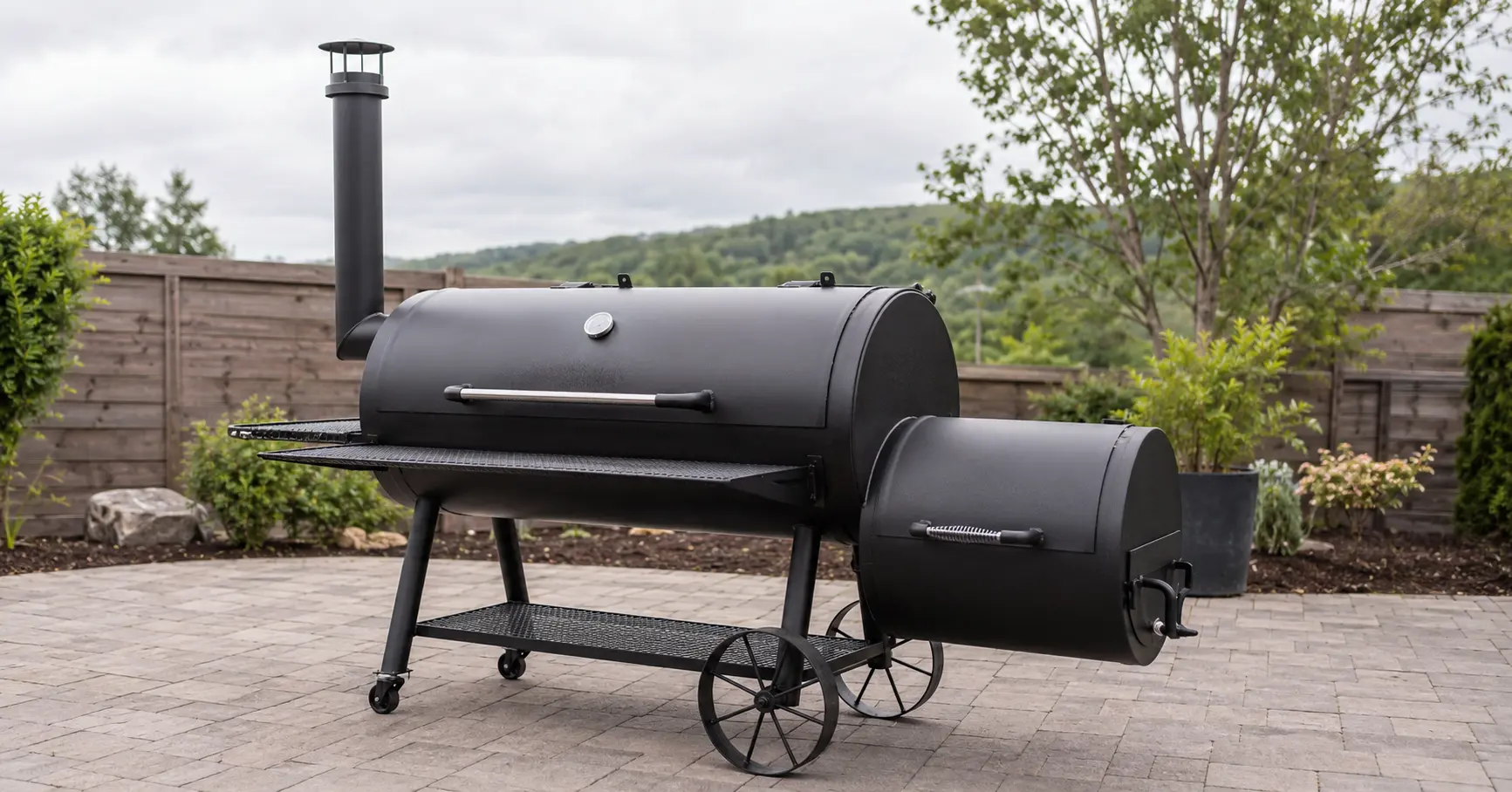
An offset smoker chimney cap sits at the top of the smokestack and helps shield the exhaust opening from rain, leaves, insects, and other outdoor debris. On many smokers, the cap is attached to an adjustable damper mechanism, allowing it to move higher or lower above the stack opening.
The offset smoker chimney cap must protect the opening without restricting the exhaust path. An offset smoker depends on steady draft: fresh air enters the firebox, supports combustion, moves heat and smoke through the cooking chamber, and exits through the chimney. If a replacement cap sits too close to the opening or becomes blocked with soot, it can weaken that flow and contribute to dirty smoke or unstable temperatures.
This guide explains what an offset smoker chimney cap actually does, how it differs from a chimney damper, how to choose and install the correct design, and how to diagnose common exhaust problems.
An offset smoker chimney cap protects the smokestack from weather and debris while leaving enough clearance for smoke to escape. Use a model-compatible, heat-resistant cap and keep the exhaust sufficiently open during cooking.
Control most temperature changes through fire size and the firebox intake. Do not close the chimney cap tightly in an attempt to trap heat or increase smoke flavor, because restricted exhaust can produce stale, bitter smoke.
What Does an Offset Smoker Chimney Cap Do?
The offset smoker chimney cap is one part of the smoker’s exhaust system. It normally sits above the top rim of the chimney rather than sealing directly against it during cooking. The gap beneath the cap allows smoke, hot air, water vapor, and combustion gases to leave the smoker.
If you are unfamiliar with the relationship between the firebox, cooking chamber, dampers, and chimney, our complete offset smoker guide explains the basic airflow path.
An offset smoker chimney cap provides three main benefits. First, it reduces the amount of rain and snow that can fall directly into the stack. Second, it blocks larger debris such as leaves and nesting material. Third, when the cap is part of an adjustable damper assembly, it can change the exhaust opening within the limits intended by the smoker manufacturer.
The offset smoker chimney cap does not create smoke flavor by itself, and it does not guarantee even temperatures across the cooking grate. Fire quality, intake airflow, chimney dimensions, smoker geometry, wind, fuel, and food placement all influence performance. A cap can support the exhaust system, but it cannot correct an oversized, smoldering, or poorly ventilated fire.
Chimney Cap, Damper and Stack Extension: What Is the Difference?
These components are often described as though they are the same, but they perform different jobs.
| Component | Location and design | Primary purpose |
| Chimney cap | Hood or plate above the stack opening | Limits rain and debris entry |
| Chimney damper | Adjustable plate, flap, or raised cap mechanism | Changes the exhaust opening |
| Smokestack | Vertical exhaust pipe | Creates a path for heat and smoke to leave |
| Stack extension | Additional compatible pipe length | Changes stack height and may affect draft |
| Spark screen | Mesh barrier in or near the exhaust | Reduces escaping embers but requires regular cleaning |
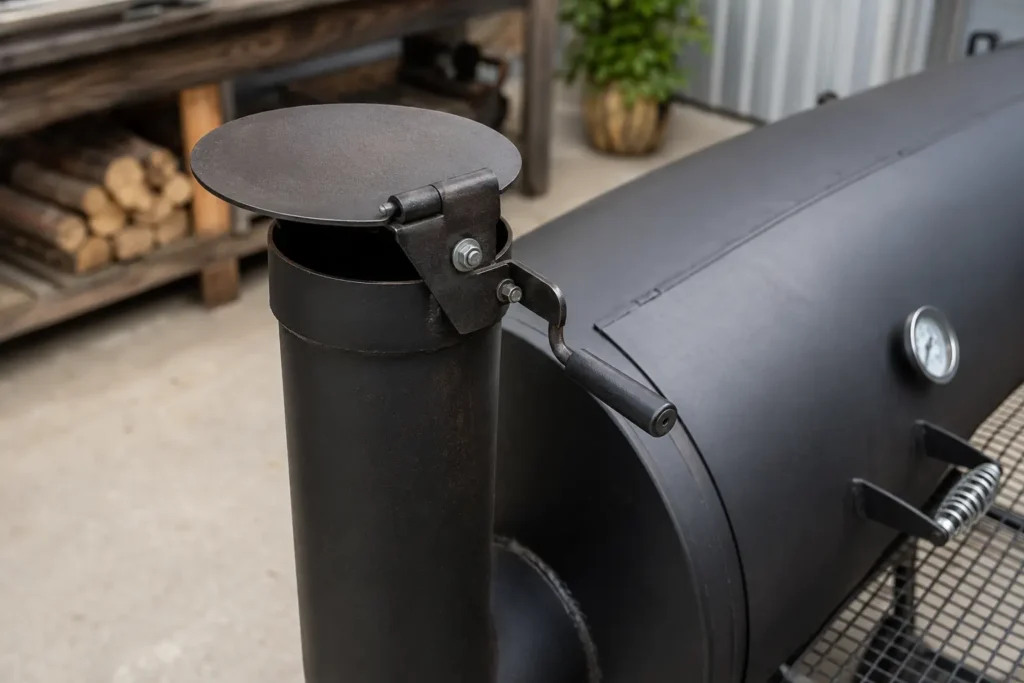
Some factory assemblies combine a rain cap and damper in one part. Turning or moving the handle changes the distance between the cap and the chimney opening. Other smokers use a fixed rain hood with a separate butterfly damper inside the stack.
Do not assume that a residential fireplace or wood-stove cap is suitable for a barbecue smoker. An incompatible part may be too heavy, use an unsafe coating, provide insufficient heat resistance, or restrict the much smaller exhaust opening.
Model compatibility matters. Char-Griller, for example, sells model-specific smokestack damper replacements for particular offset smokers rather than presenting one cap as universal for every cooker.
Benefits and Limitations of a Chimney Cap
A properly fitted offset smoker chimney cap can protect the exhaust opening without interfering with normal cooking. Its most useful benefits include:
- Reducing direct rain and snow entry
- Keeping leaves and larger debris out of the stack
- Protecting the opening during storage
- Providing a factory-designed exhaust adjustment when combined with a damper
- Reducing water accumulation inside an uncovered outdoor smoker
- Replacing a bent, missing, or heavily corroded original part
- Helping maintain the intended appearance and function of the smokestack
These benefits have limits. Wind-driven rain can still enter beneath an open cap, and condensation can form inside the chimney even when outside rain is blocked. A cap also does not replace a fitted weather cover, dry storage, rust treatment, or regular cleaning.
The offset smoker chimney cap should not be expected to “push” smoke evenly into the meat. Clean smoke moves through the chamber because of combustion and draft. Restricting the exhaust to hold smoke around the food can create a harsh flavor rather than deeper, cleaner smoke penetration.
Common Types of Offset Smoker Chimney Caps
Fixed Rain Hood
A fixed offset smoker chimney cap remains at a set distance above the stack. Its sloped or curved surface deflects rain while leaving an open path around the sides. This simple design has no temperature-control mechanism and should be sized specifically for the chimney.
A fixed hood can work well when heat is managed through the fire, firebox door, and intake damper. The surrounding clearance must remain large enough that the hood does not become an exhaust restriction.
Adjustable Screw Cap
An adjustable offset smoker chimney cap moves upward or downward on a threaded rod. Raising it increases the available exhaust gap; lowering it reduces the gap. This design is common on backyard barrel smokers and combination grill-smokers.
The offset smoker chimney cap should move freely without wobbling or binding. Grease, soot, rust, bent hardware, or damaged threads can prevent accurate adjustment. During cooking, never lower it so far that clean exhaust flow stops.
Hinged or Butterfly Damper
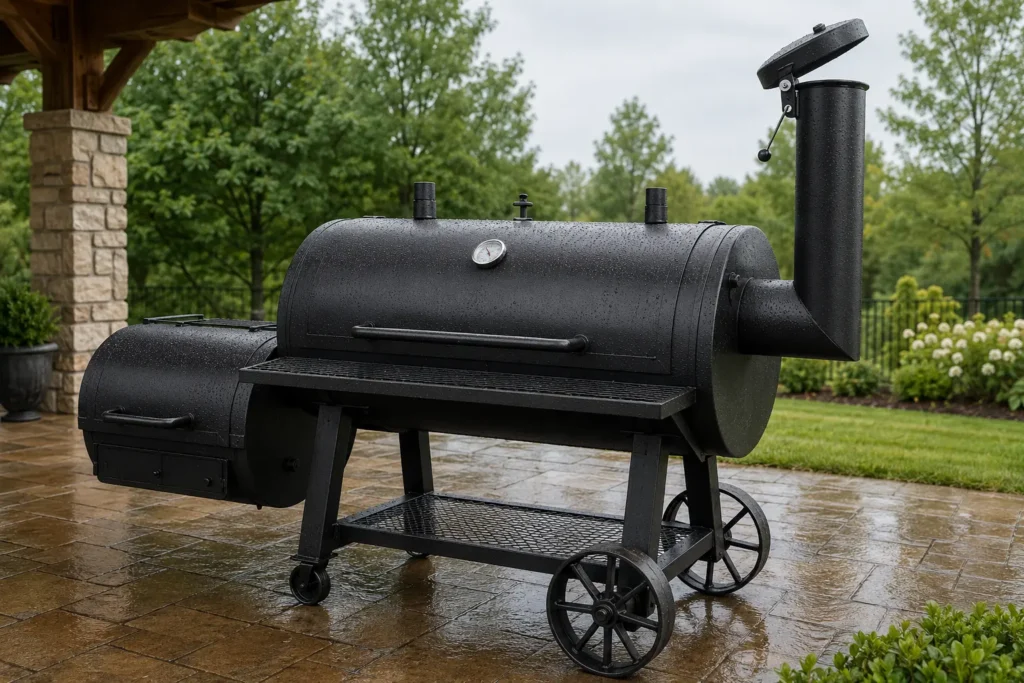
A hinged damper rotates over the stack opening, while a butterfly damper pivots inside the exhaust pipe. These parts regulate the opening but may provide less rain protection than a full hood.
Some smokers combine a damper with a separate rain shield. Use the arrangement specified for the exact model, as the operating position and replacement hardware can vary.
Wind-Resistant or Directional Cap
A directional offset smoker chimney cap attempts to reduce wind entering the stack, but it requires careful selection. A cap made for a building chimney may be unsuitable for an offset smoker and may add excessive restriction.
Before using a directional cap, first improve smoker placement. Turning the stack away from the strongest wind or using a safe, noncombustible windbreak can be simpler than modifying the exhaust. Never operate the smoker in an enclosed location.
7 Essential Tips for Choosing and Installing the Right Cap
1. Confirm the exact smoker model. Begin with the manufacturer name, model number, smokestack design, and existing hardware. Similar-looking smokers may use different chimney diameters, threaded rods, brackets, or damper assemblies. A factory replacement is usually the safest option because its clearance and mounting method are designed for that exhaust. Our Char-Broil American Gourmet Offset Smoker guide shows why model-specific chimney and damper layouts matter.
2. Measure the stack accurately. Measure the outside diameter of the chimney and the dimensions of the mounting point. For an adjustable offset smoker chimney cap, also measure the rod diameter, thread type, bracket spacing, and required open height. Do not rely on the cooking capacity or barrel size when selecting an exhaust part.
3. Choose heat-safe, corrosion-resistant material. Use steel, stainless steel, or another material approved by the smoker or cap manufacturer. Avoid galvanized, painted, plastic-coated, or unidentified metal parts unless the manufacturer explicitly confirms their suitability at smoker exhaust temperatures.
4. Preserve exhaust clearance. The offset smoker chimney cap must leave adequate space around the stack opening. Too little clearance can restrict draft, while excessive height may provide less weather protection or allow the cap to wobble in wind. Follow the model-specific installation dimensions rather than guessing.
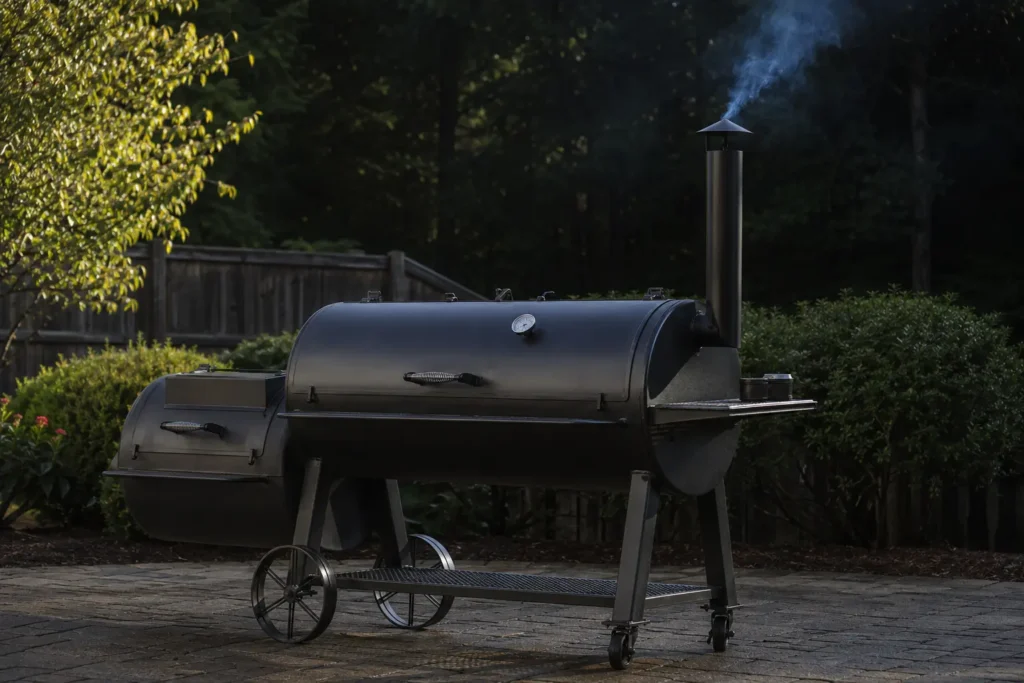
5. Secure the hardware. Use the supplied fasteners, brackets, washers, springs, and retainers. The cap should not rattle loose, fall into the cooking area, or blow away. Do not improvise with adhesives, plastic ties, or hardware that cannot withstand heat and outdoor exposure.
6. Test the movement before lighting a fire. Open and close an adjustable offset smoker chimney cap through its complete intended range. Confirm that it moves smoothly, remains aligned with the stack, and cannot accidentally seal the exhaust while cooking.
7. Perform a controlled test burn. Start with a small clean fire and the exhaust open. Watch for smoke leaking from the cooking-chamber lid or firebox instead of exiting the chimney. Compare grate-level temperature behavior before and after the installation and stop using the cap if the fire repeatedly smolders or the exhaust becomes visibly restricted.
Do not drill, cut, or weld the smokestack unless the manufacturer permits the modification and you have the correct tools and experience. Metalwork can damage protective coatings, create sharp edges, weaken the stack, or produce unsafe alignment. A qualified fabricator can make a model-specific replacement when the original part is unavailable.
How the Chimney Cap Affects Airflow and Temperature
An offset smoker works as a connected system. Oxygen enters through the firebox intake, the fire releases heat and combustion gases, and the chimney provides an exit. The temperature difference between the hot smoker and outside air, along with stack height, stack diameter, wind, leaks, and internal resistance, influences draft.
The offset smoker chimney cap should protect the opening without becoming a bottleneck. If it is lowered too close to the stack, smoke may slow down, the fire may receive less oxygen, and the wood may begin to smolder. Signs of restricted exhaust include thick white or gray smoke, bitter odors, sluggish fire response, smoke escaping from lid gaps, and difficulty maintaining a clean flame.
For most traditional offset-smoking sessions, keep the chimney sufficiently open and control heat primarily with the amount of burning fuel and the firebox intake. Char-Griller’s side-firebox setup guidance begins with the smokestack damper fully open, illustrating the importance of establishing draft before fine adjustments.
Smoker designs differ, so the owner’s manual remains authoritative for the damper position. Our guide on how to control heat in an offset smoker explains how fire size, intake airflow, exhaust flow, weather, and fuel work together.
Do not chase every small temperature change by repeatedly moving the cap. Offset smokers naturally fluctuate as wood ignites and burns down. Make one small adjustment, allow time for the smoker to respond, and follow the overall temperature trend.
Accurate monitoring matters more than a fixed cap position. Install an ambient probe at grate level rather than depending entirely on a lid gauge. Our offset smoker thermometer upgrade guide covers probe placement, calibration, and alarm settings.
Cleaning and Maintenance
Allow the smoker and offset smoker chimney cap to cool completely before inspection or cleaning. Wear suitable gloves because the cap can retain heat and may have sharp edges.
Inspect the mechanism. Check the offset smoker chimney cap for rust, bent parts, loose fasteners, missing retainers, damaged threads, and excessive movement. Confirm that an adjustable cap can open fully and remain in position.
Remove loose residue. Brush away dry soot, ash, insects, leaves, and other debris without forcing material down the chimney. If heavy buildup exists inside the stack, clean the exhaust according to the smoker manufacturer’s instructions.
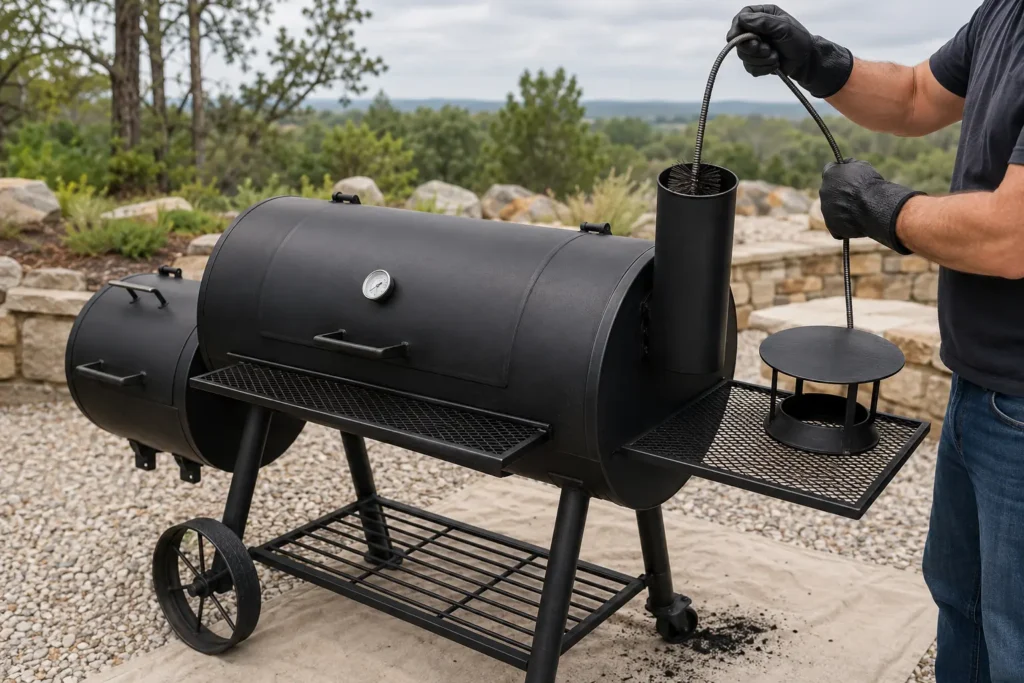
Clean safely. Use the cleaning method approved for the surface and coating. Avoid leaving water trapped inside the threaded mechanism or beneath brackets. Dry every part thoroughly before reassembly.
Protect exposed steel. Treat early exterior rust with a manufacturer-approved process. Do not apply ordinary household paint, oil, or a flammable coating to a hot exhaust surface.
Check after storms or storage. Wind can loosen the cap, while insects or birds may place material inside an unused chimney. Inspect the complete smoke path before lighting the smoker after a long break.
Maintenance should include more than the cap. Follow our complete guide on how to clean an offset smoker to inspect the cooking chamber, firebox, chimney, grease system, and grates.
Troubleshooting Common Chimney-Cap Problems
| Problem | Likely cause | Practical correction |
| Thick smoke and sluggish fire | Cap too low, chimney blocked, damp fuel, or insufficient intake air | Open exhaust, inspect stack, and use dry seasoned fuel |
| Smoke leaks from lid or firebox | Exhaust restriction or pressure from wind | Check cap clearance and remove chimney obstructions |
| Rain enters the stack | Cap too small, positioned too high, damaged, or affected by strong wind | Use the correct model-specific cap and a smoker cover after cooling |
| Cap will not adjust | Rust, soot, bent rod, damaged thread, or overtightened hardware | Cool, clean, inspect, and replace damaged parts |
| Cap rattles in wind | Loose fastener or missing spring/retainer | Install the correct hardware and tighten to specification |
| Cap repeatedly corrodes | Damaged finish, standing moisture, or unsuitable material | Replace with a compatible corrosion-resistant part |
| Temperature remains unstable | Fire size, fuel, leaks, wind, or poor probe placement | Diagnose the complete system instead of blaming only the cap |
| Bitter flavor develops | Dirty fire or exhaust restriction | Increase clean airflow and avoid trapping smoke |
If poor airflow remains after cleaning and opening the exhaust, inspect the firebox grate, ash level, intake opening, cooking-chamber passage, baffle, and chimney. Our offset smoker fire-management tips explain how fuel condition and combustion quality affect smoke.
Common Mistakes to Avoid
Closing the cap to create more smoke flavor. Heavy trapped smoke is not the same as clean wood flavor. Restricting the exhaust can create incomplete combustion and bitter deposits on the food.
Confusing the cap with the main temperature control. Temperature responds to fire size, fuel, intake air, smoker construction, weather, and exhaust flow. The chimney cap is only one part of the system.
Installing a generic building-chimney cap. Fireplace and stove caps may not fit, tolerate the same environment, or preserve the required exhaust area. Use a component intended for the exact smoker whenever possible.
Ignoring model compatibility. A cap advertised as “universal” may still require a specific stack diameter, mounting method, and open clearance. Verify all dimensions before purchase.
Operating with a blocked spark screen. Fine mesh collects soot and grease more quickly than an open stack. Inspect and clean it regularly or remove it only when the manufacturer permits.
Cleaning while the smoker is hot. Wait until the chimney and cap have cooled completely. A metal cap can remain dangerously hot after the cooking chamber begins to cool.
Using the smoker indoors. An open chimney does not make an offset smoker safe inside a house, garage, tent, vehicle, or other enclosed space. The U.S. Consumer Product Safety Commission warns that burning charcoal indoors can produce deadly carbon monoxide. Operate the smoker outdoors according to the manufacturer’s clearance instructions.
Using an offset smoker chimney cap to solve an unrelated problem. Uneven cooking temperatures, weak fires, leaking doors, wet wood, inaccurate thermometers, and undersized fireboxes require separate solutions. Start with the complete smoker system.
For smokers with a separate firebox, our offset smokers with side firebox guide explains the correct relationship between fuel, intake airflow, cooking chamber, and exhaust.
Frequently Asked Questions
The chimney should normally remain sufficiently open for clean exhaust flow. Begin with it open when starting the fire and follow the smoker manufacturer’s instructions for any later adjustment. Avoid closing it tightly to trap smoke.
Not always. A cap primarily shields the opening from rain and debris, while a damper changes the exhaust opening. Some smokers combine both functions in one adjustable assembly.
A smoker can exhaust through an open stack, but a compatible cap is useful for weather and debris protection. Replace a missing cap when the manufacturer designed the smoker to use one.
A correctly designed cap can preserve the intended exhaust path and reduce certain wind effects, but it does not automatically create stronger draft. Stack dimensions, fire temperature, intake airflow, wind, leaks, and internal restrictions remain important.
There is no universal gap for every smoker. Use the cap and smoker manufacturer’s specified open clearance. The gap must provide enough exhaust area without making the cap unstable or ineffective against rain.
Only when its diameter, material, heat rating, mounting method, and exhaust clearance are compatible with your smoker. A model-specific factory part is generally safer and easier to install.
Some leakage is common on inexpensive smokers, but heavy leakage may indicate a restricted stack, cap positioned too low, excessive fuel, wind pressure, or poor seals. Fully open and inspect the exhaust before making other changes.
The correct temperature depends on the food and recipe. Many low-and-slow cooks use approximately 225°F to 275°F, while the USDA recommends monitoring smoker air temperature and keeping it between 225°F and 300°F when smoking meat and poultry in its smoking safety guidance. Use our offset smoker cooking-temperature guide for detailed cooking ranges.
Inspect it before each cook and clean it whenever soot, grease, insects, or debris begin to restrict movement or exhaust flow. Perform a more thorough inspection after long storage or severe weather.
Replace it when rust has weakened the metal, the cap no longer stays attached, the adjustment mechanism has failed, the part is badly bent, or the correct exhaust clearance cannot be maintained.
Why an Offset Smoker Chimney Cap Is Worth Installing
An offset smoker chimney cap is a small but useful part of the exhaust system. It protects the stack from rain and debris and may form part of the adjustable chimney damper, but it should never obstruct clean smoke flow.
Choose a heat-safe cap designed for the exact stack diameter and mounting system. Maintain the manufacturer’s required clearance, secure every fastener, and test the smoker with a small clean fire after installation. During cooking, manage temperature mainly through fire size and intake airflow while keeping the chimney sufficiently open.
Regular inspection, cleaning, rust treatment, and safe outdoor operation will help the offset smoker chimney cap perform reliably without creating a bottleneck. When the firebox, cooking chamber, fuel, thermometer, and exhaust all work together, the smoker can produce steadier heat and cleaner barbecue flavor.