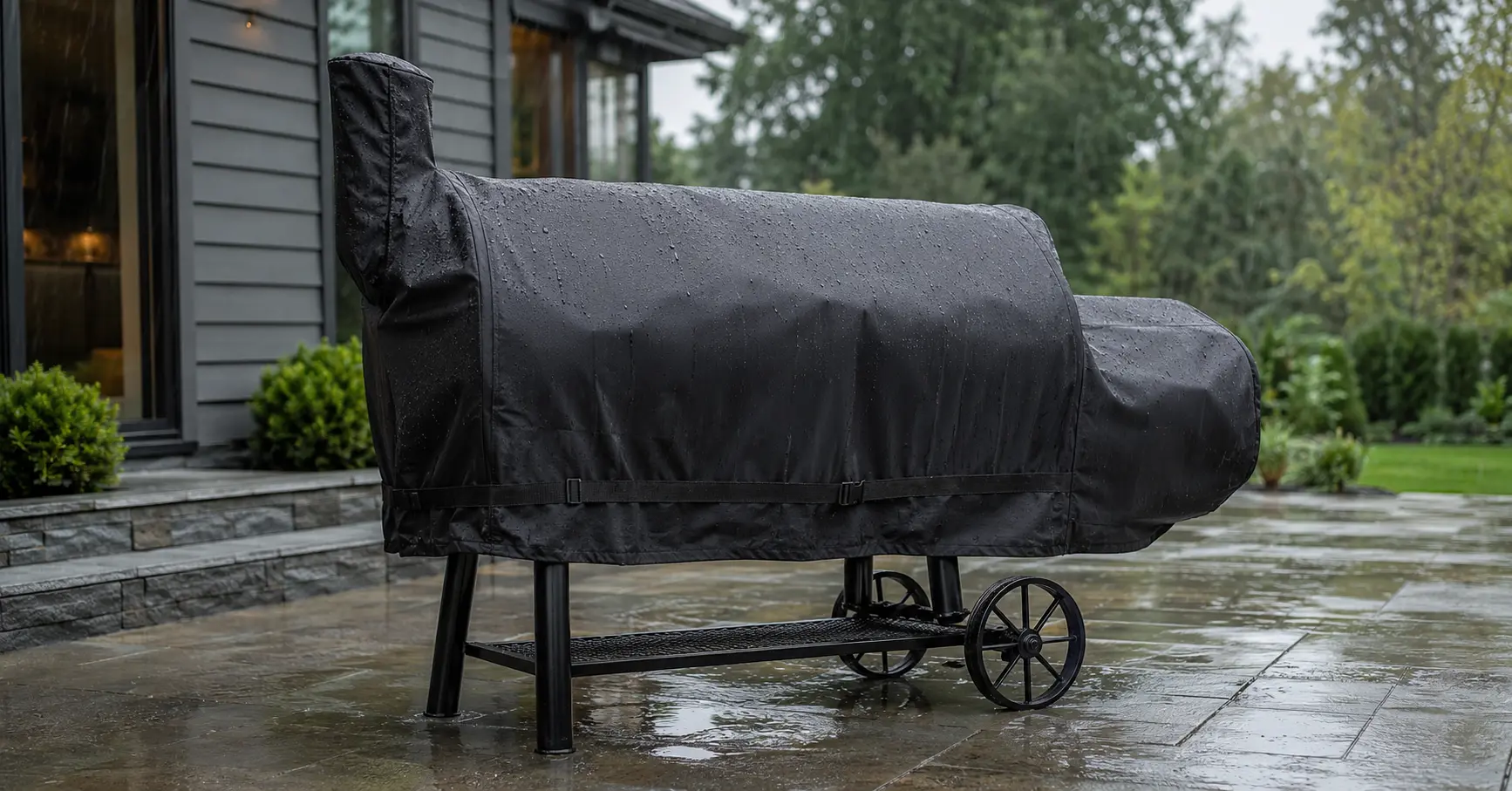
A waterproof offset smoker cover protects your smoker from rain, snow, sunlight, dust, leaves, bird droppings, and other outdoor debris. It can reduce unnecessary cleaning, slow exterior fading, and help prevent moisture-related rust when it is correctly sized, ventilated, and used only after the smoker has cooled and dried.
Not every waterproof offset smoker cover offers the same protection. Some are genuinely waterproof, while many manufacturer covers are described as water-resistant. Material strength, seam construction, ventilation, fit, and fastening systems all affect how well a cover performs in real weather.
This guide explains how to select, measure, use, clean, and maintain a waterproof offset smoker cover without trapping condensation against the steel.
Quick Answer: Choose a waterproof offset smoker cover made from durable, UV-resistant fabric with reinforced or sealed seams, covered air vents, and secure straps. It should fit the complete smoker without stretching tightly or hanging on the ground.
Most Important Safety Rule: Never place a cover over an operating, warm, or damp smoker. Extinguish the fire completely, remove cooled ash when appropriate, and wait until every exterior surface is cool and dry before covering.
Why Use a Waterproof Offset Smoker Cover?
An offset smoker normally remains outdoors and contains several areas where moisture can collect, including the firebox, cooking chamber, chimney, hinges, shelves, handles, wheels, and grease system. Even a well-painted steel smoker benefits from protection when it is not being used.
If you are still learning how the firebox, chamber, vents, and chimney work together, begin with our complete offset smoker guide.
Protection from rain and snow.
Rain can collect on flat shelves, enter loose joints, and remain around bolts or welded seams. Snow may sit against the steel for long periods before melting. A properly fitted waterproof offset smoker cover limits direct exposure to this moisture.
A cover does not make the smoker maintenance-free. Water can still rise from wet ground, enter from beneath a loose cover, or form through condensation. The smoker must be clean, dry, and inspected regularly.
UV and fading protection.
Continuous sunlight can fade paint, dry some plastic components, and weaken lower-quality cover fabrics. Look for a waterproof offset smoker cover specifically described as UV-resistant or fade-resistant rather than assuming that every dark polyester cover provides equal sun protection.
Dust and debris control.
Leaves, pollen, dirt, insects, and bird droppings can collect on the smoker or block small openings. A waterproof offset smoker cover keeps most debris away from the chimney, vents, lid, grease drain, and preparation shelves.
When the smoker does need attention, follow our step-by-step guide on how to clean an offset smoker without stripping away useful interior seasoning.
Less routine preparation.
A protected smoker normally requires less exterior wiping before a cook. You should still inspect the firebox, cooking chamber, vents, grates, and grease system before lighting a fire, especially after a long storage period.
Longer service life.
Keeping standing water, wet leaves, and direct sunlight away from painted steel helps preserve the finish. A waterproof offset smoker cover works best as part of a wider maintenance routine that includes cleaning, drying, seasoning bare interior steel, removing ash, and treating early rust.
Waterproof vs Water-Resistant Smoker Covers
“Waterproof” and “water-resistant” are not always interchangeable.
| Cover description | What it normally means | Best use |
| Water-resistant | Repels light rain for a limited time | Covered patios or moderate weather |
| Waterproof fabric | Fabric resists water penetration | Frequent rain, provided seams also resist leakage |
| Weather-resistant | Designed for a mixture of rain, sun, dust, and wind | General outdoor storage |
| UV-resistant | Designed to reduce sun degradation and fading | Uncovered sunny locations |
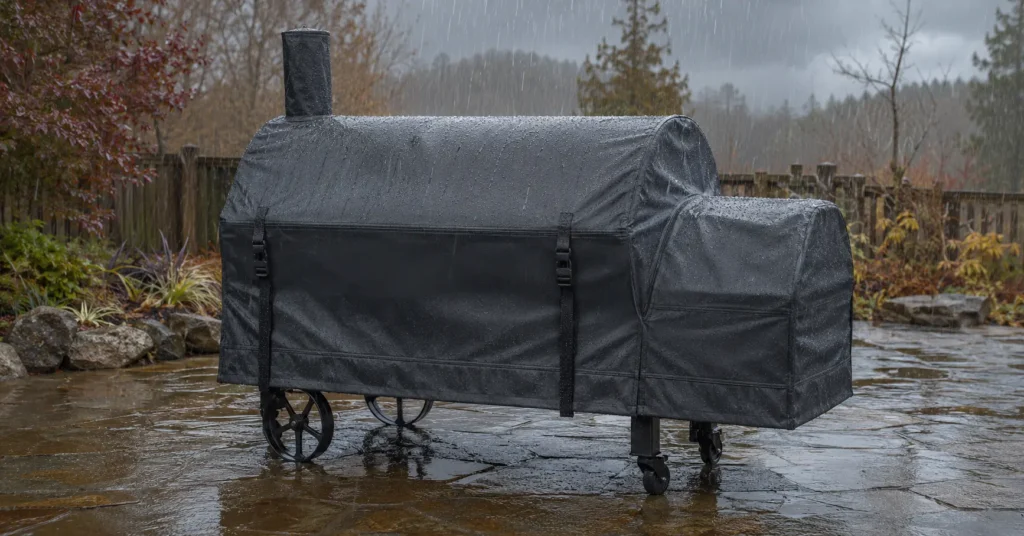
Fabric can be waterproof while stitched seams still leak. Look for sealed, taped, double-stitched, or reinforced seams, especially along the top where rain settles.
Many original-equipment covers use the more careful term “water-resistant.” For example, the official Oklahoma Joe’s Highland Offset Smoker Cover is described as using fade- and water-resistant material with securing straps.
A waterproof offset smoker cover should repel outside water while still allowing trapped humidity to escape through protected vents or clearance near the bottom.
7 Essential Features to Look For
1. Correct Size and Shape
Offset smokers are more difficult to cover than simple barrel grills because they may include a side firebox, tall chimney, front shelf, lower shelf, handles, temperature gauges, wheels, and grease bucket.
The best waterproof offset smoker cover follows the general shape of the smoker without stretching tightly across sharp corners. A tight cover can place excessive stress on seams, while an oversized cover may collect water, flap in the wind, or expose the smoker from underneath.
2. Durable Outdoor Fabric
Polyester is commonly used because it can be strong, lightweight, and resistant to stretching. Nylon may also perform well, but the fabric name alone does not reveal overall quality.
Evaluate:
- Fabric weight or denier when provided
- Tear and abrasion resistance
- Waterproof or water-resistant coating
- UV and fade resistance
- Cold-weather flexibility
- Resistance to cracking
- Manufacturer care instructions
Heavy vinyl can block water effectively but may become stiff in cold weather and can trap humidity when it lacks ventilation. Multi-layer polyester with a protective coating often provides a better balance of strength, weight, and flexibility.
3. Reinforced and Weather-Protected Seams
Needle holes are potential entry points for water. Reinforced stitching improves strength, while seam tape, binding, or waterproof sealing helps reduce leakage.
Inspect the waterproof offset smoker cover around:
- Chimney corners
- Firebox edges
- Handles
- Top-center seam
- Adjustment straps
- Lower hem
These high-stress areas usually fail before a flat fabric panel.
4. Covered Air Vents
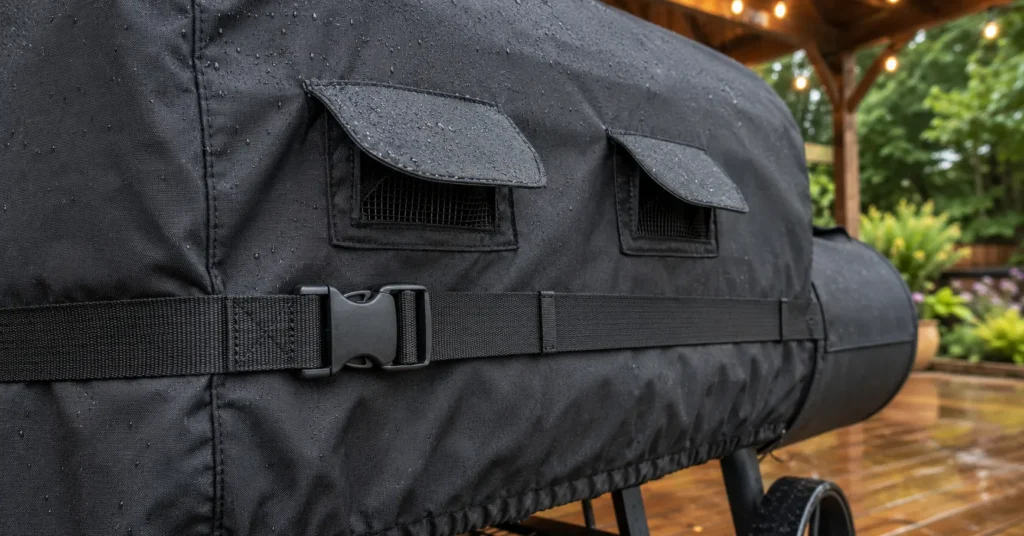
Breathability is essential because a completely sealed waterproof offset smoker cover can trap humidity around the smoker. Covered vents allow air to move while their downward-facing flaps reduce direct rain entry.
Good ventilation helps reduce:
- Condensation beneath the cover
- Musty odors
- Mold or mildew on the fabric
- Moisture remaining against painted steel
- Slow drying after humid weather
Ventilation does not excuse covering a wet smoker. Allow the equipment and waterproof offset smoker cover to dry first.
5. Secure Wind Fastenings
A waterproof offset smoker cover should remain attached during normal windy conditions. Look for hook-and-loop straps, buckle straps, an elastic hem, or a drawcord.
Fastenings should hold the lower portion close to the smoker without sealing it tightly against the wet ground. Straps near the wheels or legs usually perform better than relying on the cover’s weight alone.
Remove or firmly secure accessories such as a loose grease bucket before covering. Do not pull fastening straps so tightly that they strain the fabric or press against sharp metal edges.
6. UV and Fade Resistance
Sunlight affects both the smoker and the cover. A UV-resistant outer layer helps slow color fading, brittleness, and fabric deterioration. This feature is especially important when the smoker sits in an uncovered location throughout the year.
Fading does not always mean the cover has stopped resisting water, but rapid or uneven fading may indicate that the fabric is aging. Inspect the surface for thinning, cracking, or loss of coating.
7. Model Compatibility and Warranty
A model-specific waterproof offset smoker cover is often the easiest option because it is designed around the smoker’s chimney, shelves, firebox, handles, and wheels. Universal covers can also work when their dimensions and shape match correctly.
Before ordering a cover for an Oklahoma Joe’s model, compare the exact configuration with our Oklahoma Joe Highland Offset Smoker review. Traditional Highland and Highland Reverse Flow versions may require different compatible covers.
For other common layouts, check the measurements and features in our Char-Broil American Gourmet Offset Smoker guide and Pit Boss Offset Smoker review.
A warranty can provide useful protection against premature seam or material failure, but read the exclusions. Normal fading, storm damage, improper sizing, hot-surface damage, and ordinary wear may not be covered.
How to Measure an Offset Smoker for a Cover
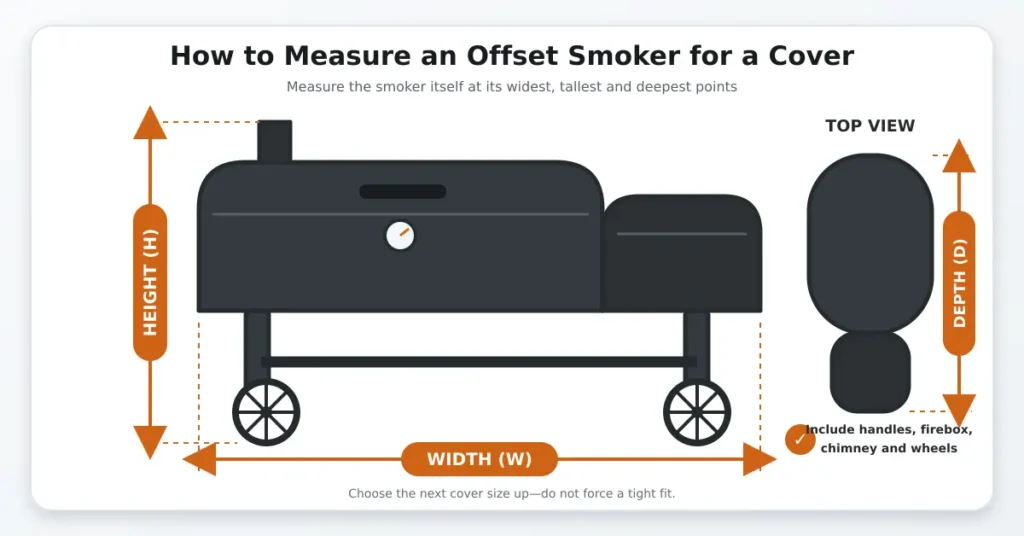
Do not select a waterproof offset smoker cover from the cooking-grate area or barrel length alone. Measure the smoker in its normal storage configuration with lids closed and shelves in the positions they will remain.
Measure the width.
Measure from the farthest point on the firebox side to the farthest point on the opposite side. Include fixed handles, shelves, tool hooks, and other permanent projections.
Measure the depth.
Measure from the frontmost fixed point to the backmost point. Include the front shelf and rear handles if they cannot be folded or removed.
Measure the height.
Measure from the ground to the highest permanent point, normally the top of the chimney. Do not choose a cover that rests heavily on a fragile chimney cap.
The standard grill measuring guide demonstrates measuring width, depth, and height before selecting a cover.
Allow practical clearance.
Choose a waterproof offset smoker cover slightly larger than the smoker’s maximum width and depth so it can be installed without pulling against corners. Avoid excessive extra material.
The bottom should remain slightly above the ground. This reduces abrasion, prevents the hem from sitting in puddles, and permits some airflow. Follow the cover manufacturer’s specific size and clearance recommendations.
How to Use a Waterproof Offset Smoker Cover Safely
A waterproof offset smoker cover is a storage accessory, not a cooking blanket or insulation wrap. Never place it on the smoker while a fire, hot coals, or smoldering ash remains inside.
Follow this routine after a cook:
- Close down the smoker according to the manufacturer’s extinguishing instructions.
- Confirm that the fire and fuel are fully extinguished.
- Allow the cooking chamber, firebox, chimney, shelves, handles, and grease system to cool completely.
- Remove ash only after it is completely cold and safe to handle.
- Wipe away spilled grease, sauces, and standing water.
- Allow all surfaces to dry.
- Place the cover over the chimney and main chamber without dragging it across sharp edges.
- Fasten the lower straps or buckles.
- Check that the hem is not sitting in water or blocking drainage.
Official Char-Broil cover instructions repeatedly state that covers are for use only when the grill is cool to the touch. The same safety principle should be applied to an offset smoker.
How to Clean and Maintain the Cover
Always follow the instructions supplied with the specific product. Coatings, fabrics, seam treatments, and inner linings can require different care.
Routine cleaning.
Remove the waterproof offset smoker cover from the smoker and shake or brush off loose debris. Use warm water with mild soap or detergent and a soft cloth or brush. Rinse thoroughly to prevent soap residue from attracting dirt.
Traeger’s official grill-cover care instructions recommend waiting until the grill has cooled, wiping the cover with warm soapy water or mild detergent, rinsing it, and avoiding harsh chemicals such as bleach.
Do not machine-wash or tumble-dry the cover unless its manufacturer specifically permits it. Aggressive washing can damage waterproof coatings and seam tape.
Drying.
Allow both sides to air-dry completely before returning the waterproof offset smoker cover to the smoker or placing it in storage. Folding a damp cover encourages mildew and unpleasant odors.
Inspection.
Check the cover periodically for:
- Loose or broken stitching
- Torn fastening straps
- Small punctures
- Cracked coating
- Worn chimney corners
- Thinned or faded fabric
- Mold or mildew
- Water pooling
Repair small problems with products approved for the cover’s fabric. Replace the cover when deterioration prevents it from protecting the smoker reliably.
Reproofing.
Some outdoor fabrics can be treated with a compatible water-repellent spray after cleaning. Do this only when the cover manufacturer permits it. Test a small hidden area first because an incompatible treatment may stain the fabric, damage the coating, reduce breathability, or affect warranty coverage.
Preventing Rust Under the Cover
A waterproof offset smoker cover reduces exposure but cannot prevent rust by itself. Corrosion control begins with keeping the smoker clean and dry.
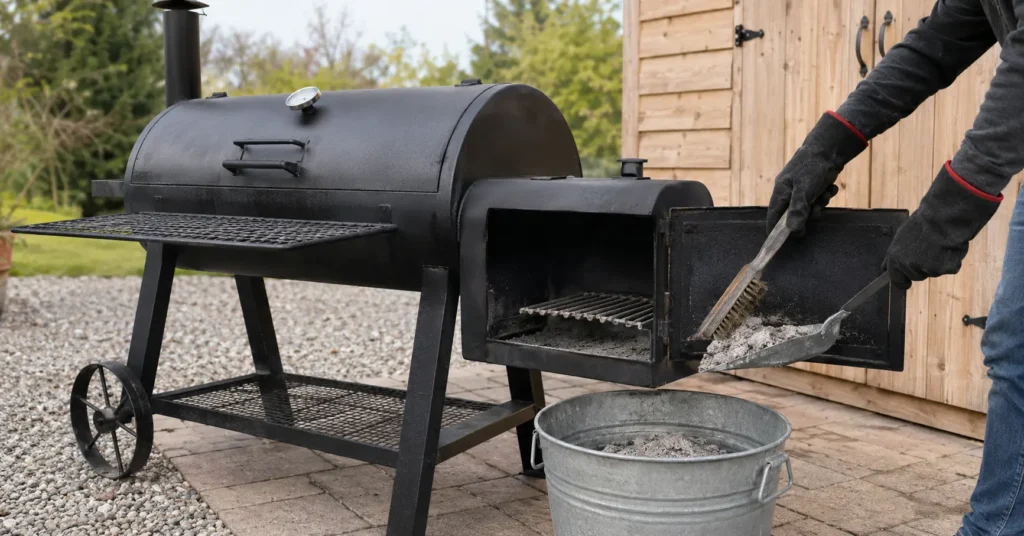
Remove cold ash.
Ash can retain moisture and promote corrosion when left in the firebox. Once everything has cooled completely, remove it and store or dispose of it safely. Our offset smoker fire-management guide explains how ash accumulation can also interfere with airflow.
Preserve interior seasoning.
Bare interior steel benefits from a thin, properly polymerized oil layer. If cleaning or rust removal exposes metal, follow our guide on how to season an offset smoker.
Treat exterior damage promptly.
Inspect welds, corners, firebox surfaces, fasteners, and the chimney for early rust or chipped paint. Remove loose corrosion and use a manufacturer-approved high-temperature coating where appropriate. Never paint cooking grates or food-contact surfaces.
Choose a better storage location.
Whenever possible, park the smoker beneath a roof or sheltered patio on a dry, level surface. A waterproof offset smoker cover provides an additional barrier, but overhead shelter and good drainage greatly reduce constant weather exposure.
New owners should also review these offset smoker tips for beginners to establish safe placement, cleaning, and storage habits.
Troubleshooting Common Cover Problems
| Problem | Likely cause | Recommended action |
| Condensation inside cover | Smoker was damp, cover lacks ventilation, or humidity is high | Remove cover, dry both surfaces, and improve airflow |
| Water reaches smoker | Leaking seams, pooling, worn coating, or poor fit | Inspect top seams, stop water pooling, repair if approved, or replace |
| Cover blows off | Loose fit or inadequate fastenings | Use compatible straps, buckles, or drawcords |
| Fabric tears at chimney | Cover is too tight or chimney edge creates stress | Use a better-fitting reinforced cover and protect sharp edges |
| Mold or mildew develops | Cover was folded or installed while damp | Clean according to instructions and air-dry completely |
| Cover fades rapidly | Limited UV resistance or severe sun exposure | Inspect fabric strength and choose a more UV-resistant replacement |
| Rust appears beneath cover | Moisture, ash, grease, damaged paint, or poor ventilation | Clean and dry smoker, remove ash, treat rust, and improve storage |
| Water pools on top | Cover is oversized or lacks sufficient slope | Tighten correctly or select a closer-fitting model |
Common Mistakes to Avoid
Covering a hot smoker.
Heat can melt fabric, damage waterproof coatings, weaken seams, and create a fire risk. Wait until every part of the smoker is fully cool.
Covering a wet smoker.
Trapping rain or wash water underneath a cover can accelerate corrosion rather than prevent it. Dry the steel and the cover before installation.
Ignoring ventilation.
An airtight sheet may block rain but also trap humid air. Choose covered vents or suitable lower clearance.
Buying by brand name alone.
A manufacturer may produce several smokers with similar names but different chimneys, fireboxes, shelves, or dimensions. Match the cover to the exact model number and measurements.
Leaving ash in the firebox.
A waterproof offset smoker cover does not isolate cold ash from atmospheric humidity. Remove ash after it has cooled completely.
Allowing the cover to touch the ground.
A long hem collects dirt, absorbs puddle water, abrades against concrete, and reduces lower airflow.
Using harsh cleaning chemicals.
Bleach, strong solvents, abrasive cleaners, or aggressive pressure washing may damage the fabric, color, coating, and seam treatment.
Assuming the cover replaces maintenance.
The smoker still requires cleaning, seasoning, rust inspection, grease control, and dry storage. The cover supports these steps; it does not replace them.
Frequently Asked Questions
Yes, particularly when it is stored outdoors. A correctly fitted cover protects against rain, sunlight, dust, leaves, and debris. Allow the smoker to cool and dry completely before covering it.
A waterproof cover may provide stronger rain protection, but seam quality, ventilation, fit, and durability are equally important. A breathable, well-fitted water-resistant cover can perform better than a poorly ventilated waterproof sheet.
No. Wait until the fire is extinguished and all exterior surfaces, including the firebox and chimney, are cool to the touch. Follow the smoker and cover manufacturers’ instructions.
Yes. Rust can develop when condensation, cold ash, grease, standing water, or damaged paint traps moisture against the steel. Use a ventilated cover and maintain the smoker regularly.
It should be close enough that it does not flap or pool water, but loose enough to install without stretching the seams. The lower edge should not sit in puddles or drag on the ground.
Cover only a completely cool and dry smoker, use protected air vents, leave suitable lower clearance, and occasionally remove the cover during dry weather if local humidity remains high.
Only if the manufacturer explicitly allows machine washing. Many coated outdoor covers should be cleaned by hand with mild soap and water because machine washing can damage the waterproof layer. Clean the cover whenever dirt, bird droppings, pollen, mold, or stains accumulate, then allow it to air-dry completely. If water no longer beads on the fabric, use a compatible waterproofing spray only when the cover manufacturer permits it.
Durable coated polyester is a common balanced option because it can provide water resistance, tear strength, UV protection, and flexibility. Construction quality and fit matter more than the fabric name alone.
Keep Your Offset Smoker Protected in Every Season
A waterproof offset smoker cover is a practical investment for protecting outdoor barbecue equipment from rain, snow, sunlight, dust, and debris. The best cover is not simply the thickest one available. It must fit the smoker properly, resist weather, release trapped humidity, and remain secure during wind.
Measure the complete smoker before buying, including the firebox, chimney, shelves, and handles. Choose durable UV-resistant material, reinforced or sealed seams, covered vents, and reliable lower straps. Most importantly, never cover an operating, warm, or wet smoker.
Combine the waterproof offset smoker cover with cold-ash removal, routine cleaning, interior seasoning, exterior rust treatment, and a dry storage location. These habits provide better long-term protection than relying on the cover alone and help keep your offset smoker ready for many future barbecue sessions.