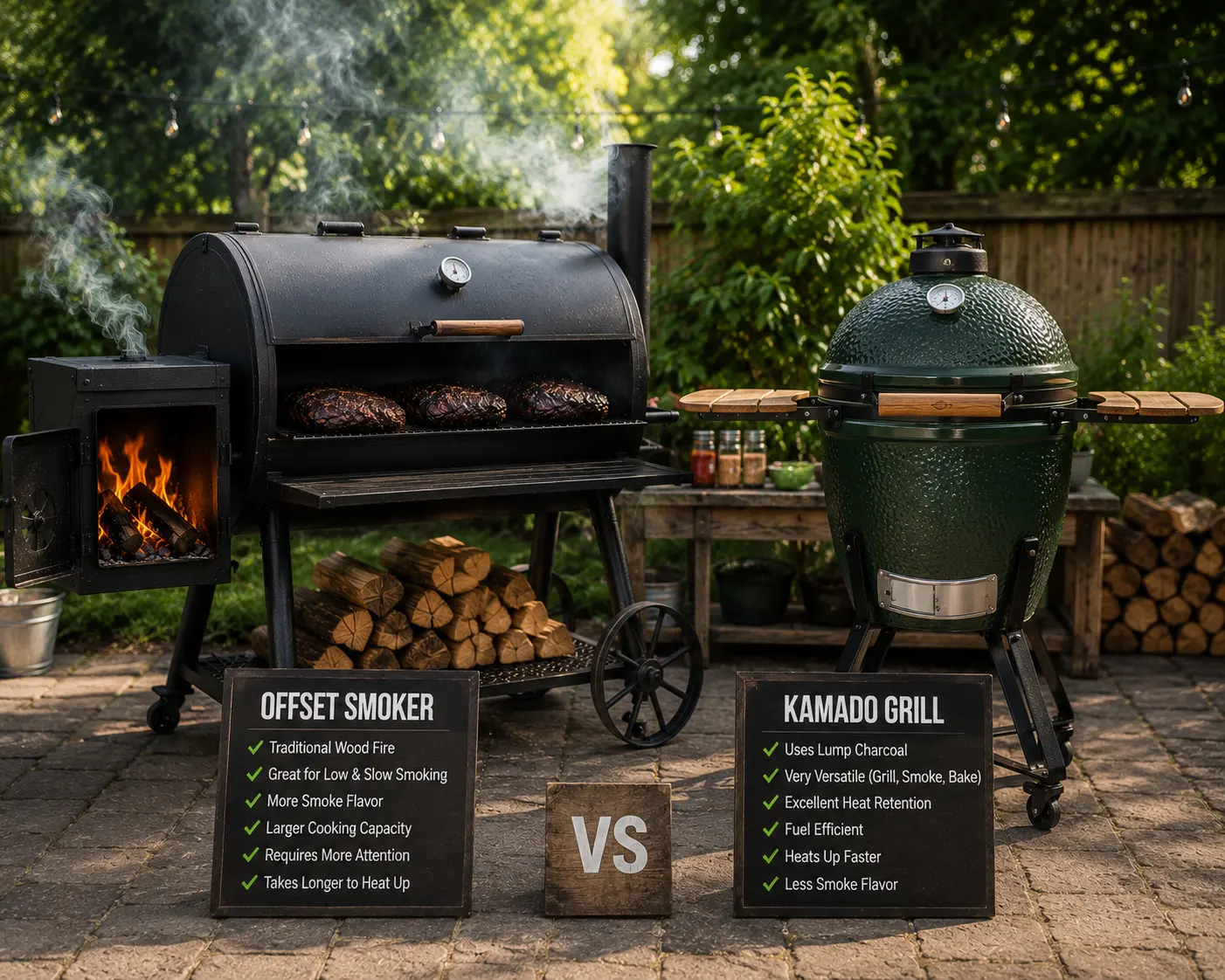
If you’re torn between a kamado grill and an offset smoker, you’re really choosing between two completely different styles of outdoor cooking. We’ve spent a lot of time comparing how these cookers are built, what they burn, and how they handle fire, and the differences run deep. An offset smoker is all about traditional wood-fired barbecue, with a separate firebox feeding a big horizontal chamber. A kamado, on the other hand, is a thick, insulated, egg-shaped cooker that can grill, smoke, roast, bake, and sear across a huge temperature range.
Here’s the good news: both cookers can turn out excellent brisket, ribs, pork shoulder, poultry, steaks, and vegetables. Where they part ways is cooking capacity, fire management, smoke flavor, fuel efficiency, temperature response, versatility, portability, and price, and those differences matter a lot once you start cooking regularly.
So which one belongs in your backyard? It comes down to what kind of cook you want to be: do you want to master a live wood fire, or would you rather have one compact charcoal cooker that does a bit of everything? In this guide, we walk through the key differences in design, fuel, cooking methods, performance, and day-to-day ownership, so you can pick the setup that fits the way you actually cook.
In the Kamado Grill vs Offset Smoker matchup, the offset wins on traditional wood-smoke flavor, big cooking capacity, fitting multiple briskets or rib racks, and the hands-on craft of managing a live fire. The kamado wins on fuel efficiency, rock-steady temperatures, high-heat searing, pizza, roasting, baking, and fitting into a smaller patio.
Go with an offset smoker if authentic stick-burning barbecue and smoking for a crowd are what you’re after. Go with a kamado if you want one compact, insulated cooker that can smoke low and slow in the morning and sear steaks over screaming heat that same evening.
Still on the fence? Ask yourself one question: does smoking capacity matter more to you, or multipurpose cooking? Your answer points straight to the right cooker.
Kamado Grill vs Offset Smoker Comparison Chart
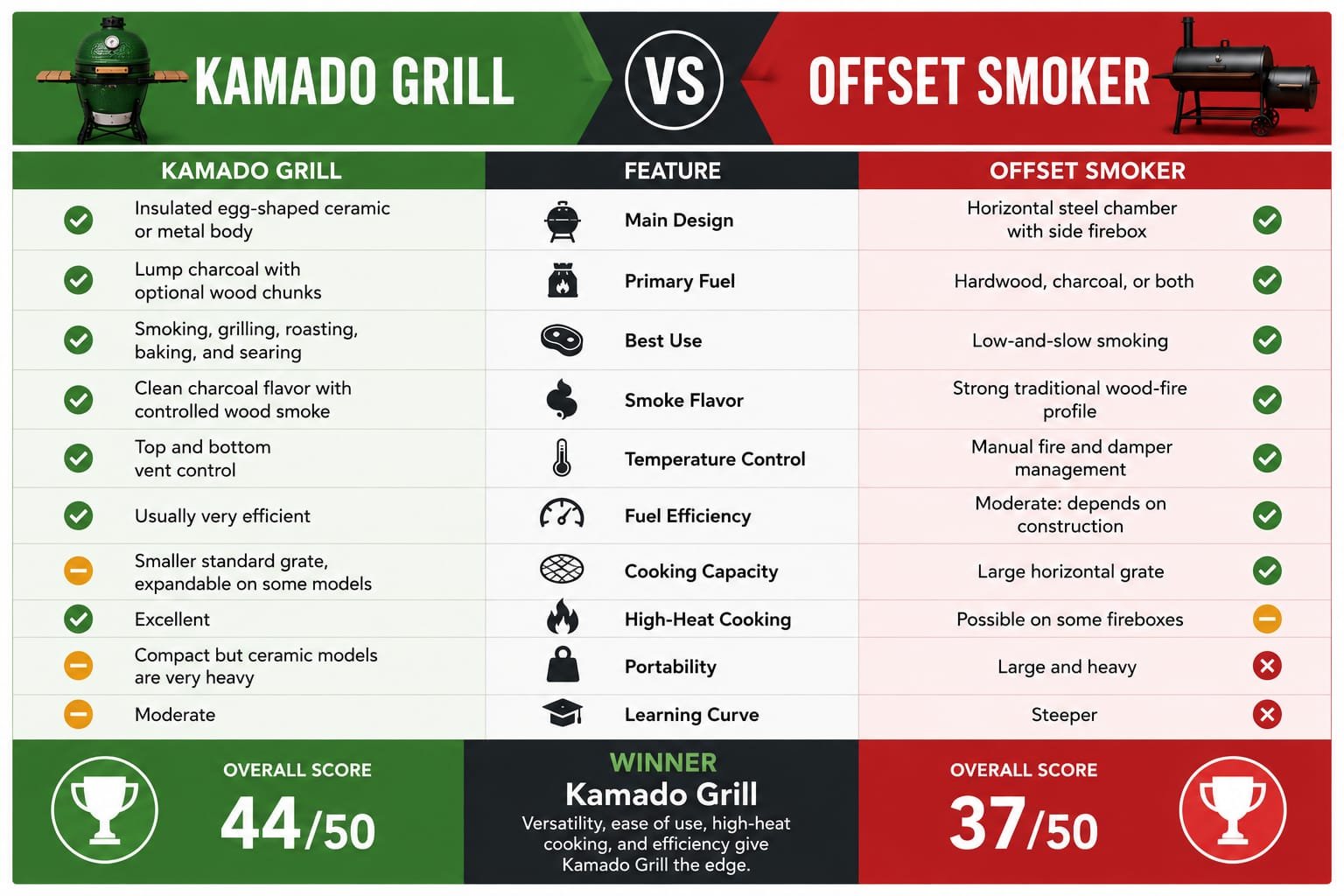
This Kamado Grill vs Offset Smoker comparison chart sums up the core trade-off nicely: the offset smoker is built around authentic wood-fired flavor and serious cooking capacity, while the kamado brings better fuel efficiency, steadier temperatures, and true all-purpose versatility.
Kamado Grill vs Offset Smoker: Side-by-Side Comparison
| Feature | Kamado Grill | Offset Smoker |
|---|---|---|
| Primary fuel | Lump charcoal | Hardwood logs / charcoal |
| Smoke flavor | Mild to medium | Strong wood-fired |
| Temperature control | Stable once adjusted | Requires active fire management |
| Fuel efficiency | High | Moderate to low |
| Cooking capacity | Small to medium | Medium to large |
| High-heat searing | Excellent | Model-dependent |
| Portability | Heavy ceramic body | Large and heavy |
| Best for | Versatile cooking | Traditional BBQ smoking |
How Offset Smokers and Kamado Grills Work Differently
Both of these cookers can hold low-and-slow temperatures for hours. They just get there in completely different ways. The real story is how each one creates, moves, and holds onto heat.
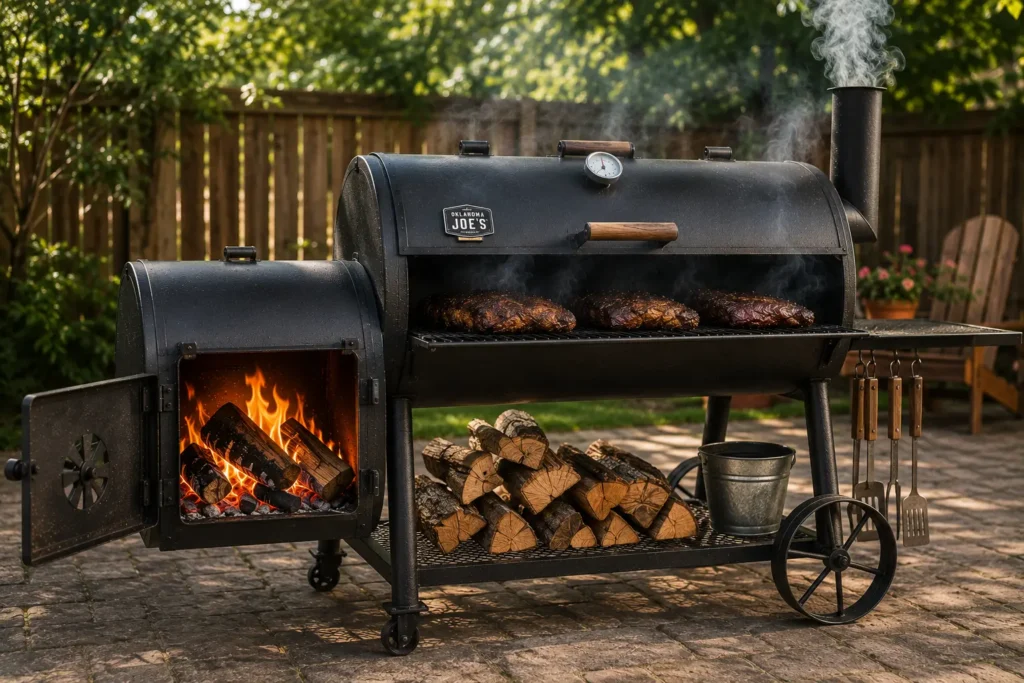
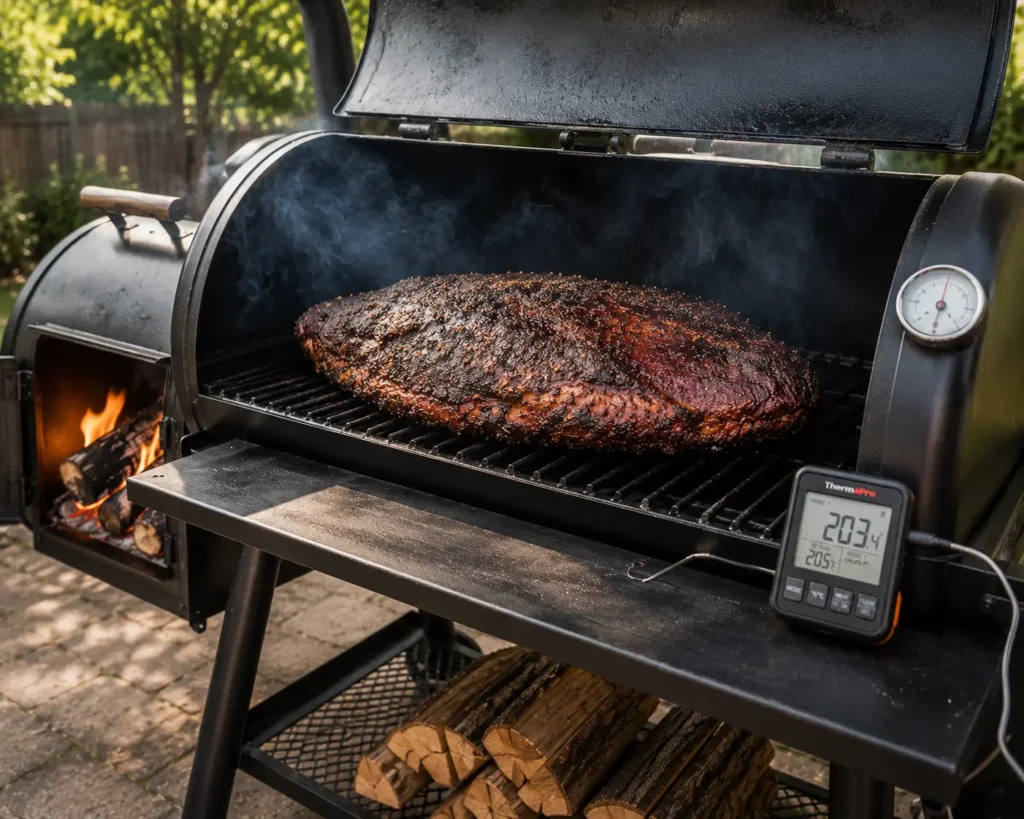
An offset smoker keeps the fire off to the side in its own firebox, attached to a long horizontal cooking chamber. Wood or charcoal burns in the firebox, and heat and smoke travel across the food before rolling out the chimney. That journey is what builds classic wood-smoke flavor, and the long chamber gives you loads of horizontal cooking space. The trade-off? That fire wants regular attention on long cooks.
Airflow is the whole game in an offset. Fresh air comes in through the firebox intake, feeds the flames, and carries heat and smoke through the chamber toward the chimney. One thing to know: the end nearest the firebox usually runs hotter, so bigger cuts sometimes need rotating during a long cook. For a deeper look at layout, airflow, dampers, and chimney setup, see our offset smoker grill guide.
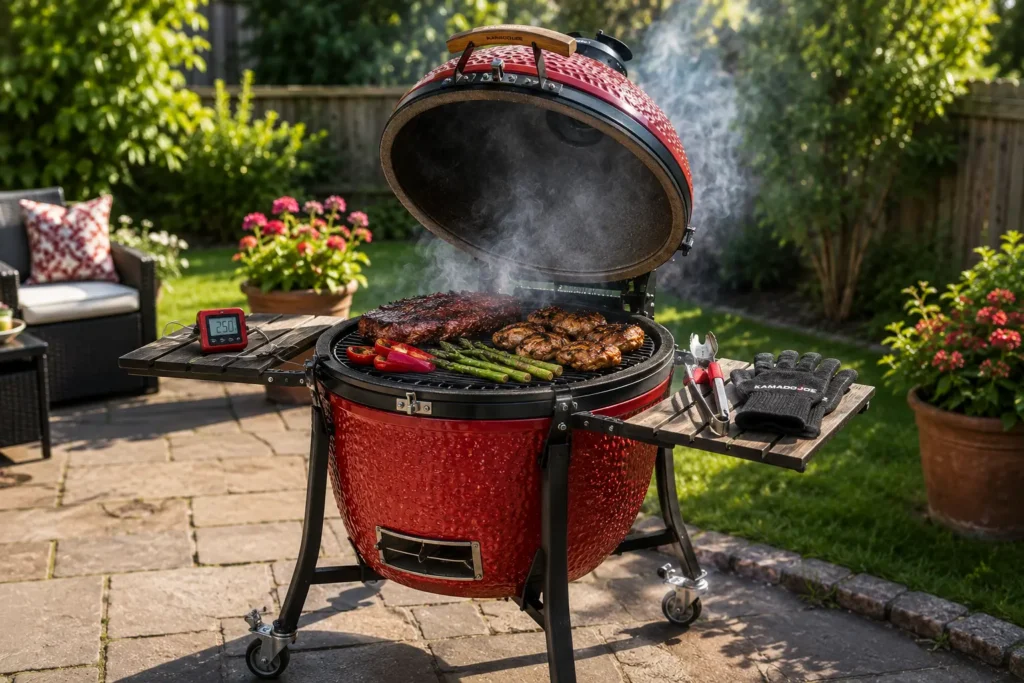
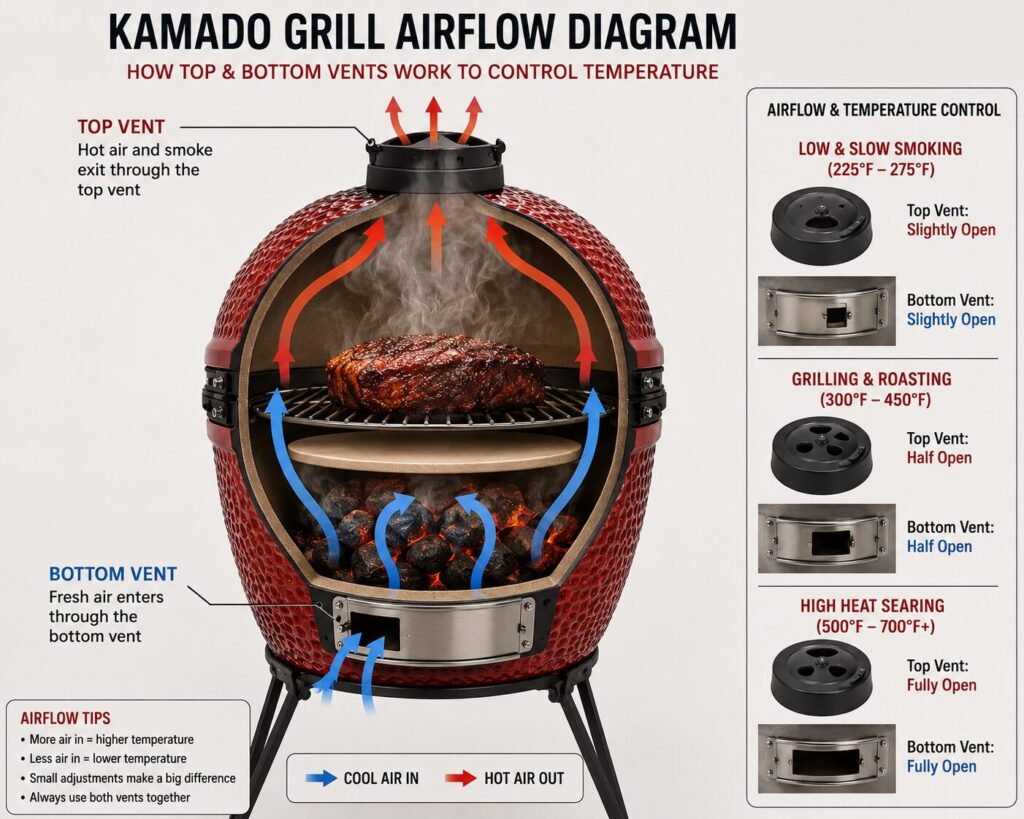
A kamado grill takes the opposite approach: a compact, insulated body, usually ceramic, with charcoal burning right under the cooking grate. Air comes in through the bottom vent and exits through the top vent, and those two vents are your entire temperature control system. Kamado Joe’s official fire and grilling guide walks through exactly how the top and bottom vents regulate airflow and cooking temperature. Less oxygen reaching the charcoal means lower heat; more oxygen means hotter. Simple as that.
Want to smoke or bake instead of grill? Slide a heat deflector between the charcoal and the food for indirect heat, and pull it out when you want direct grilling and searing temperatures. And because those thick walls hold heat so well, a kamado sips fuel and mostly stays where you set it.
So the practical trade-off looks like this: the offset gives you cooking capacity, wood-fire flavor, and the traditional craft of fire management, while the kamado gives you heat retention, fuel efficiency, and versatility. Below, we break down each difference in detail so you can figure out which design matches the way you like to cook.
Kamado Grill vs Offset Smoker: 10 Important Differences
We compared the specs, the designs, and what owners consistently report, and these ten differences are the ones that actually affect your cooking, your flavor, and your wallet.
1. Design and Construction
Let’s start with what’s obvious the moment you see them side by side: these two cookers are built nothing alike.
An offset is a horizontal steel chamber with a separate firebox bolted onto the side. A traditional kamado is a compact ceramic (or insulated metal) egg with the fire sitting directly under the cooking grate.
Offsets eat up patio space, especially once you add front shelves, big wheels, and that tall smokestack. Kamados have a much smaller footprint, but don’t let that fool you: those dense ceramic walls make them shockingly heavy.
Steel will rust if you let moisture sit on it, so a cover and occasional oiling matter. Ceramic can’t rust, but it can crack, so protect it from hard knocks and move it like the heavy, fragile thing it is.
Pro tip: Measure your patio before you buy. An offset with shelves, wheels, and a smokestack needs more floor space than most people expect.
Winner for compact placement: Kamado grill
Winner for large horizontal cooking space: Offset smoker
2. Fuel and Fire Management
What you burn, and how you babysit it, is where these two really split.
Offsets typically run on seasoned hardwood splits, charcoal, or a mix of both. Keeping that fire clean takes steady oxygen and regular attention all the way through a long cook.
Kamados run on lump charcoal, first and foremost. You can mix in a few hardwood chunks for extra smoke, but full-size logs are overkill, and unless your manufacturer specifically allows them, they can create way too much heat and smoke.
Here’s the day-to-day difference: an offset fire is something you actively manage and feed, while a kamado fire is something you throttle. Choke the oxygen and one load of charcoal burns low and slow for hours.
Winner for authentic stick-burning: Offset smoker
Winner for fuel conservation: Kamado grill
3. Temperature Range and Control
When it comes to sheer temperature range, the kamado takes this one walking away.
Both cookers hold low-and-slow smoking temperatures beautifully, but only the kamado can also rocket up to the screaming heat you want for pizza and steak searing.
On an offset, you’re juggling:
- Fire size
- Fuel additions
- Intake airflow
- Chimney draft
- Wood-split size
- Coal-bed strength
On a kamado, it’s just the bottom and top vents. That’s the whole control panel.
That insulated body holds temperatures beautifully, but it also stores heat. Crank the vents wide open and you’ll overshoot your target, then wait a while for all that ceramic to cool back down.
Pro tip: On a kamado, always sneak up on your target temperature from below. Cooling a hot ceramic cooker back down takes far longer than heating it up.
Offsets react faster when you shrink the fire or toss on more fuel. The trade-off is that they ask for those adjustments more often.
Winner for temperature range: Kamado grill
Winner for responsive live-fire adjustments: Offset smoker
4. Smoke Flavor
For a lot of pitmasters, this is the whole ballgame.
A well-run offset burns real hardwood as its main heat source, and that’s what creates the bold, unmistakable wood-smoke character people associate with classic American barbecue.
A kamado burns charcoal in a low-oxygen environment, so the smoke is cleaner and more restrained. Toss in a few hardwood chunks and you’ll get genuinely good smoke flavor. It just won’t have that all-day log-fire depth.
One thing both cookers agree on: thick, dirty smoke helps nobody. Too much wood or starved airflow turns meat bitter, so stick with properly seasoned wood and let thin, clean smoke do its work.
Pro tip: Learn to read your smoke. Thin, clean smoke flowing steadily means a healthy fire; thick white smoke billowing out is your cue to give the fire more air.
Winner for deep traditional smoke: Offset smoker
5. Cooking Capacity
If you cook for a crowd, or want to, pay close attention here.
A full-size offset gives you long, wide grates that swallow several briskets, multiple pork shoulders, or full rib racks. No folding, no trimming, no playing Tetris with your meat.
A standard kamado’s round grate is a different story: figure one brisket, several steaks, a whole chicken, or a few rib racks, depending on the diameter.
Multi-level racks and half-moon accessories can stretch kamado capacity, but once you’ve got several levels loaded, getting to the food gets fiddly.
Cooking for the family or a few friends? A kamado has you covered. Catering, competitions, or big parties? That’s where the offset’s extra real estate earns its keep.
Our Pit Boss offset smoker review walks through the kind of cooking capacity and features you’ll run into when comparing offset models.
Winner for large-volume smoking: Offset smoker
6. Cooking Methods and Versatility
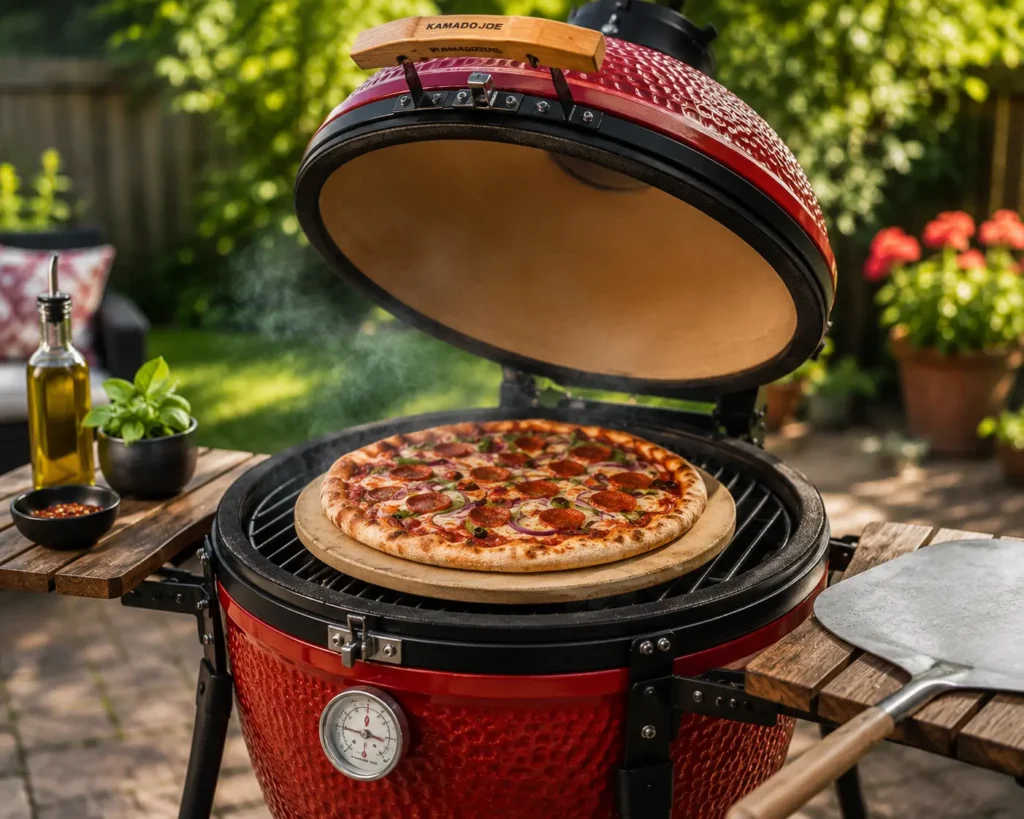
This is the kamado’s home turf. Set it up right and one cooker can:
- Smoke brisket at low temperature
- Grill burgers and vegetables
- Sear steaks over direct heat
- Roast poultry
- Bake bread
- Cook pizza on a stone
- Use direct and indirect zones
- Support rotisserie and specialty surfaces on compatible models
Offsets are specialists: low-and-slow barbecue is what they were born to do. Some have firebox grates for direct grilling, and a skilled cook can roast or bake in the main chamber, but switching gears mid-cook is nowhere near as convenient as it is on a kamado.
That versatility gap matters most if you’re hoping one cooker can replace the grill, the smoker, and the pizza oven all at once.
Winner for all-purpose outdoor cooking: Kamado grill
7. Fuel Efficiency
If you watch your fuel budget, this section matters.
A kamado sips fuel: it chokes airflow and traps heat inside those thick insulated walls, so a modest load of charcoal can carry a long cook.
An offset is thirstier by nature. It’s heating a big steel chamber while warm air pours out the chimney the whole time. Thin steel, leaky doors, cold weather, and wind can all push fuel consumption noticeably higher.
Pro tip: Wind is the silent fuel-killer on an offset. A simple windbreak can save you a surprising amount of wood on breezy days.
A premium offset built from thick steel is impressively efficient for its size, but for a small family cook, the kamado will still burn less fuel.
Winner for fuel efficiency: Kamado grill
8. Ease of Use and Required Attention
If you’re just getting into live-fire cooking, the learning curves here couldn’t be more different.
An offset asks you to stay involved:
- Repeated fire checks
- Periodic fuel additions
- Smoke observation
- Temperature adjustments
- Coal-bed maintenance
- Awareness of weather changes
A kamado asks you to learn airflow too, but once the vents are dialed in and it settles, it can maintain temperature for hours without you adding fuel.
The main skill on a kamado is patience: sneak up on your target temperature gradually. Open the vents too far and the charcoal gets ferociously hot, and because the ceramic holds heat, closing the vents won’t bring temps down right away.
Winner for reduced supervision: Kamado grill
Winner for learning traditional fire management: Offset smoker
9. Portability and Durability
Trying to pick a portability winner? It’s genuinely a toss-up.
Big steel offsets are long, heavy beasts to move, though good wheels, or a trailer rig, make it manageable.
Kamados take up less space, but all that weight is packed into a small ceramic body. Move one carefully: tip it or drop it and you’re looking at a cracked cooker.
Owners consistently report that a quality steel offset can last decades if you stay ahead of rust. A well-cared-for kamado can also go many years, though gaskets, bands, firebox parts, and ceramic pieces may eventually need adjusting or replacing.
If you’d like a lighter entry-level offset, our Royal Gourmet offset smoker review compares the construction and mobility trade-offs in detail.
Winner for compact size: Kamado grill
Winner for impact-resistant construction: Heavy-steel offset smoker
10. Cleaning, Maintenance, and Price
Last up: what it’s actually like to own one of these year after year.
An offset gives you ash inside the firebox, grease in the cooking chamber, and a whole lot of steel facing the weather. Clear out cooled ash regularly: it holds moisture and invites rust.
A kamado needs its ash cleared too, or airflow suffers. Grates, deflectors, drip pans, gaskets, vents, and the ceramic interior all deserve attention per the manufacturer’s instructions.
A budget offset can cost less than a premium ceramic kamado, but thin, cheap steel often means frustrating temperature swings.
At the high end, offsets can cost far more. You’re paying for size, thick steel, and serious welding and fabrication.
Before you buy either one, compare:
- Usable grate space
- Included accessories
- Warranty
- Replacement parts
- Fuel consumption
- Cooking frequency
- Construction quality
- Weather protection requirements
- Long-term maintenance costs
Winner for low-cost entry: Budget offset smoker
Winner for lower ongoing fuel use: Kamado grill
Which Cooker Fits Your Cooking Style?
Forget asking which cooker is “best.” The right question is which one fits your cooking. What do you cook most? How much food? And how hands-on do you want to be with the fire?
For beginners: A kamado is generally the easier first cooker once you understand the top and bottom vents. It holds heat so well that you’ll add fuel far less often. An offset demands more active fire management, but it’s a great first choice if you specifically want to learn wood-fire craft: coal beds, airflow, and reading smoke.
For brisket and ribs: When you’re cooking several briskets or full racks of ribs, the offset’s wide chamber is hard to beat. A kamado still turns out excellent barbecue, especially a single brisket or a family-size cook, while burning less charcoal and needing fewer tweaks. Just know that smaller kamados might need a rib rack, some trimming, or divided racks to fit bigger cuts.
For steak and pizza: The kamado is usually the stronger pick. It holds high heat with ease, and cooking right over the charcoal gives you a fierce sear. Add a heat deflector and a pizza stone and it doubles as a compact outdoor oven. Some offsets allow direct grilling over the firebox, but their main chambers are built for low-and-slow smoking, not fast high-heat cooking.
The simplest way to decide: match the cooker to your priorities. Pick the offset smoker for bigger barbecue cooks, deeper wood-fire character, and hands-on fire craft. Pick the kamado grill for smaller cooks, fuel efficiency, steady temps, grilling, searing, and pizza nights.
Quick Decision Guide: Kamado or Offset?
Choose an offset smoker if you regularly cook briskets, ribs, pork shoulders, or big batches, and you want traditional wood-fired barbecue with direct control over the fire. It’s made for cooks who genuinely enjoy tending fuel, airflow, and smoke through a long cook.
Choose a kamado grill if you want one compact cooker that smokes, grills, sears, roasts, and bakes pizza. It shines when patio space is tight, or when fuel efficiency and set-and-steady temperatures matter more than sheer capacity.
If authentic wood-fire smoking and capacity top your list, the offset is the stronger fit. If versatility, efficiency, and easier temperature control matter more, the kamado usually wins.
Essential Charcoal and Fire Safety
Whichever side of this debate you land on, remember: both cookers burn live fire. Always run them outdoors on a stable, heat-resistant surface with the manufacturer’s required clearance.
The U.S. Consumer Product Safety Commission is blunt about this: charcoal should never be burned indoors, not in homes, vehicles, tents, campers, or any enclosed space, because burning charcoal produces carbon monoxide.
Let coals and ash cool completely before you toss them. Never move a hot ceramic grill, never walk away from an active fire, and never use gasoline or other unapproved liquids to light your charcoal.
Smart placement matters just as much, no matter which cooker you choose.
Opening a hot kamado deserves respect: raise the lid slowly and follow the manufacturer’s procedure. And keep children, pets, combustible materials, and loose clothing clear of both cookers.
Which One Should You Buy?
Choose an offset smoker if your main goal is traditional wood-fired barbecue, bigger capacity, and learning real hands-on fire management. It truly shines with brisket, ribs, pork shoulder, and feeding a crowd.
Choose a kamado grill if you want a compact cooker that smokes, grills, sears, roasts, and bakes without guzzling fuel. Once the vents are dialed in, it’s generally the easier cooker to keep steady.
Neither cooker is automatically better for everyone. The right choice comes down to your cooking volume, available space, preferred fuel, and how hands-on you want to be with the fire.
Frequently Asked Questions
Use lump charcoal as the primary fuel unless the manufacturer states otherwise. Add a few appropriately sized hardwood chunks for smoke flavor.
Burning full logs can create excessive heat, smoke, and airflow problems in a ceramic kamado.
No. A kamado can be lit with approved fire starters placed in the charcoal. A chimney starter may be used only if the manufacturer permits it and the hot charcoal can be transferred safely.
Some offset fireboxes include cooking grates for direct charcoal grilling. Check the model’s instructions because not every offset smoker is designed for direct grilling.
Yes. With a heat deflector and suitable baking stone or cookware, a kamado can bake pizza, bread, casseroles, and desserts using indirect heat.
A kamado has a smaller chamber but requires ash removal and care around its ceramic parts, vents, gasket, and deflectors.
An offset has a larger cooking chamber and firebox that collect more ash and grease but are often easier to access.
The Kamado Grill vs Offset Smoker lifespan comparison depends more on construction and maintenance than cooker shape.
Both can last many years. Offset longevity depends on steel thickness, weld quality, rust prevention, and weather protection. Kamado longevity depends on ceramic quality, careful handling, band adjustment, gasket maintenance, and protection from impact.