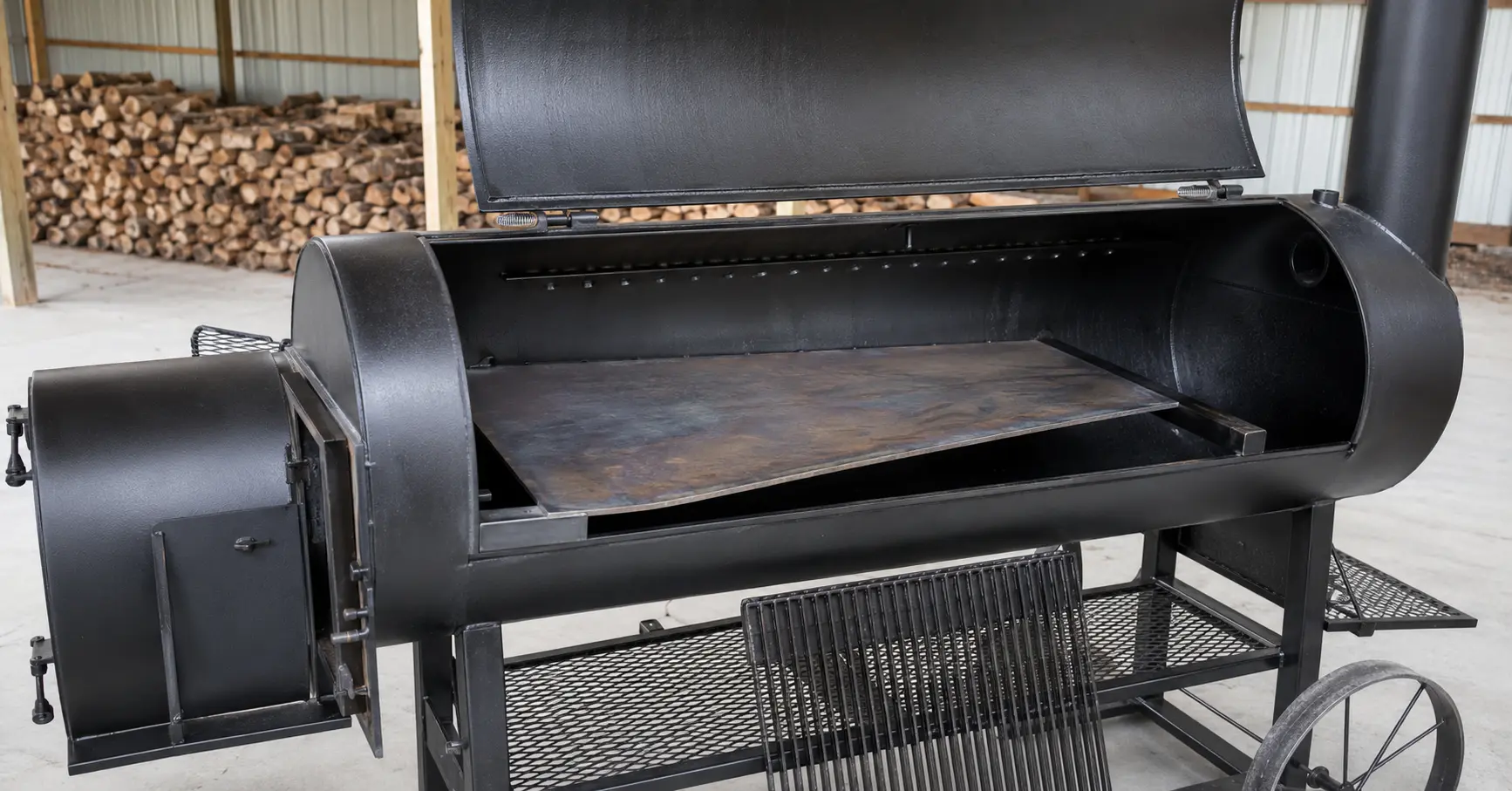
An offset smoker heat diffuser helps control the intense heat entering the cooking chamber from the firebox. By redirecting hot air and shielding food from direct radiant heat, it can reduce hot spots, improve grate-level temperature consistency, and make long barbecue cooks easier to manage.
Traditional offset smokers naturally run hotter beside the firebox and cooler near the chimney. Some temperature difference is useful, but a large gap can cause one side of a brisket or rack of ribs to cook much faster than the other. The right offset smoker heat diffuser setup, combined with a clean fire and unrestricted airflow, creates a more predictable cooking environment without removing the authentic character of an offset smoker.
Quick Answer
An offset smoker heat diffuser is a steel plate installed near or below the cooking grate to redirect the strongest heat from the firebox. For most traditional offsets, the best setup combines a fixed deflector near the firebox with adjustable tuning plates extending toward the chimney.
Best Setup
Begin with the chimney fully open, build a small clean-burning fire, and measure temperatures at several points across the cooking grate. Adjust the offset smoker heat diffuser or tuning-plate gaps gradually until the difference between the hottest and coolest test points is manageable.
What Is an Offset Smoker Heat Diffuser?
An offset smoker heat diffuser is a heat-resistant metal component positioned between the firebox opening and the food. Depending on the smoker, it may be a short angled deflector, a series of movable tuning plates, a perforated convection plate, or a solid reverse-flow plate.
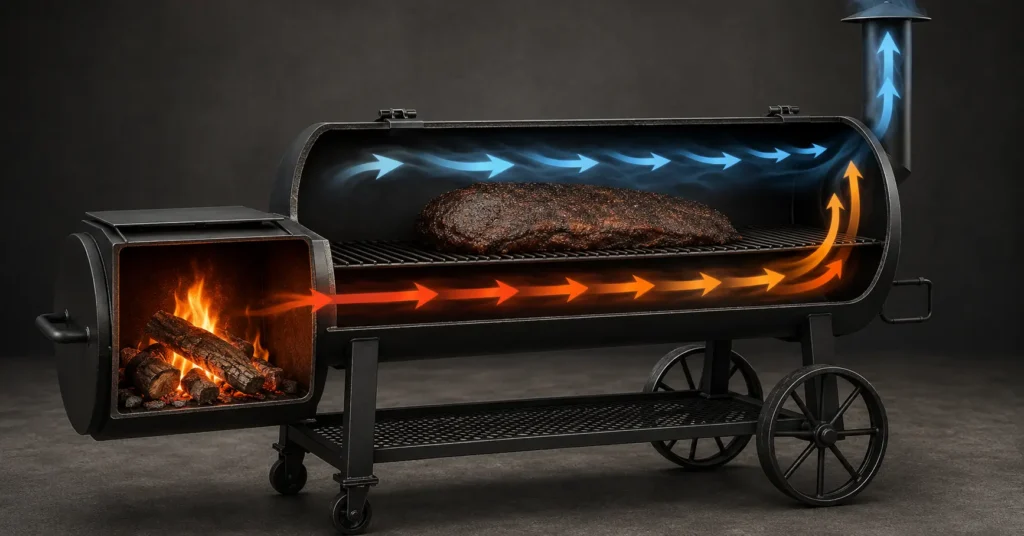
The main purpose is not to create heat. It changes the path that heat and smoke follow after entering the cooking chamber. Instead of allowing the strongest stream of hot air and radiant energy to strike food beside the firebox, the offset smoker heat diffuser absorbs and redirects part of that energy across a larger area.
If you are new to the smoker’s firebox, cooking chamber, dampers, and chimney, start with this complete offset smoker guide before changing the internal layout.
How Heat Moves Through an Offset Smoker
Heat moves through an offset smoker by conduction, convection, and radiation. The U.S. Department of Energy’s heat-transfer overview identifies these as the three basic modes of heat transfer.
Conduction
Conduction occurs when heat travels through solid metal. The fire heats the firebox and cooking-chamber walls, while hot grates and diffuser plates transfer energy through direct contact. A thick steel plate takes longer to warm but stores more thermal energy than a thin sheet.
Convection
Convection is the movement of heat through air. Hot air and smoke flow from the firebox into the cooking chamber, pass around the food, and exit through the chimney. The shape and position of an offset smoker heat diffuser influence where that hot air travels and where it rises to grate level.
Radiation
Radiant heat travels from the fire and hot metal surfaces toward the food. This effect is strongest near the firebox opening. An offset smoker heat diffuser shields the closest food from intense radiation, but the heated plate can also radiate energy upward. This is why food should not sit too close to an extremely hot solid plate.
Heat Diffuser vs Baffle Plate vs Tuning Plates
These terms are related, but they do not always describe the same component.
| Heat-management system | Design | Main purpose | Adjustability |
| Heat diffuser | General term for a plate that redirects or spreads heat | Improves overall heat distribution | Depends on design |
| Firebox baffle | Short plate beside the firebox opening | Blocks intense direct heat | Usually fixed |
| Tuning plates | Several separate plates below the grate | Controls where heat rises | Highly adjustable |
| Convection plate | Long plate with holes or slots | Distributes hot air along the chamber | Limited |
| Reverse-flow plate | Long solid plate with an opening at the far end | Sends heat underneath and back across the food | Usually fixed |
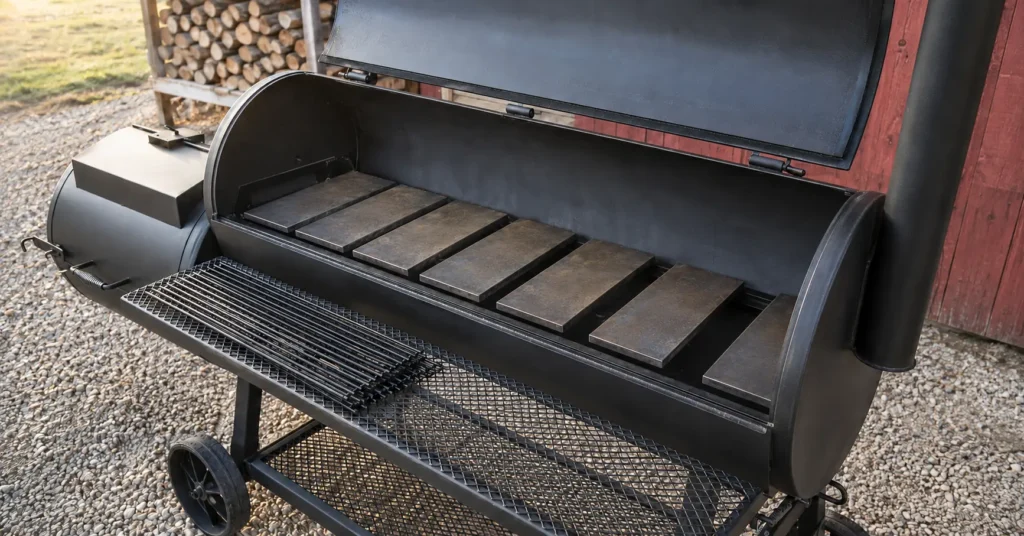
For a closer look at the individual designs, installation concerns, and material options, read the dedicated offset smoker baffle plate guide.
An offset smoker heat diffuser can refer to any of these systems. However, a reverse-flow plate changes the complete smoke path rather than simply blocking heat beside the firebox. Our offset smoker vs reverse-flow smoker comparison explains that distinction in detail. Lang BBQ’s explanation of its reverse-flow heat baffle also shows how heat travels beneath the plate before returning across the cooking area.
Benefits of an Offset Smoker Heat Diffuser
A correctly designed and installed offset smoker heat diffuser can improve smoker performance in several ways:
- Reduces the most severe hot spot beside the firebox
- Protects food from intense direct radiant heat
- Makes more of the cooking grate usable
- Creates more predictable food-placement zones
- Reduces how frequently large cuts need to be rotated
- Adds thermal mass that can soften short temperature swings
- Helps distribute hot air and smoke farther along the chamber
- Makes temperature testing and repeatable setups easier
An offset smoker heat diffuser does not automatically create identical temperatures from end to end. It also cannot compensate for a dirty fire, wet wood, blocked chimney, uncontrolled air leaks, or poor thermometer placement. Think of it as one part of the complete heat-management system rather than a replacement for fire control.
Possible Drawbacks
Adding more steel inside the smoker can create new problems if the design is incorrect. A plate that is too wide, too close to the firebox, or installed without enough clearance may restrict draft and cause incomplete combustion. It can also increase preheating time and fuel consumption.
Other possible disadvantages include:
- Excessive heat stored directly beneath the food
- Slower response when lowering the cooking temperature
- Grease pooling on a flat or incorrectly angled plate
- Restricted airflow around an oversized diffuser
- New hot spots caused by poorly positioned holes or gaps
- Reduced vertical clearance beneath the cooking grate
- Rust, grease buildup, or difficult cleaning
Never install a solid plate that blocks the complete path between the firebox and chimney. The fire must receive oxygen, and exhaust must be able to move freely through the smoker.
How to Choose the Right Heat Diffuser
The best offset smoker heat diffuser depends on the chamber diameter, firebox opening, chimney location, grate height, and existing grease-management system.
Material
Use untreated carbon steel or another food-safe metal suitable for high cooking temperatures. Avoid galvanized, painted, chemically coated, or unidentified scrap metal. Stainless steel is corrosion resistant, while carbon steel is often easier to source and modify.
Thickness
Thicker steel stores more heat and resists warping, but it takes longer to preheat and requires more fuel. A lightweight backyard smoker may not need an extremely heavy plate. Choose a thickness that the smoker can support safely, and follow the equipment or offset smoker heat diffuser manufacturer’s specifications.
Width and Length
The plate must block the most intense heat without sealing the chamber. Leave sufficient space for air and smoke to travel around, beneath, or through it. An offset smoker heat diffuser should never cover the grease drain or make grease flow toward the firebox.
Holes, Slots, or Gaps
Uniform holes do not guarantee uniform temperatures. Openings often need to become larger or more widely spaced toward the naturally cooler chimney end. Adjustable tuning plates provide more control because individual gaps can be changed after temperature testing.
How to Install an Offset Smoker Heat Diffuser
Allow the smoker to cool completely and remove all fuel, ash, grates, and loose grease before beginning. Measure the chamber carefully instead of estimating the dimensions.
- Identify the hottest area. In most traditional offsets, this is directly beside the firebox opening.
- Confirm the smoke path. Locate the firebox inlet, chimney inlet, grease drain, and any reverse-flow return opening.
- Position the first plate. Angle or place the fixed deflector so it blocks the most intense direct heat while preserving a clear airflow path.
- Add tuning plates if used. Begin with narrow gaps near the firebox and gradually larger gaps toward the chimney.
- Maintain clearance. Do not allow the plate to touch the cooking grate or prevent removal for cleaning.
- Check grease drainage. The arrangement must not collect grease near direct flame or route it toward the firebox.
- Test before cooking. Run the empty smoker and map grate-level temperatures before placing food inside.
Do not drill, cut, weld, or modify a smoker if doing so could weaken its structure, damage a protective coating, void its warranty, or create a fire hazard. When in doubt, use a model-specific part or ask a qualified metal fabricator.
How to Test and Tune the Diffuser
An offset smoker heat diffuser should be adjusted using measurements rather than appearance alone. Clip reliable digital probes at grate level, keeping them away from the chamber wall, food, water pan, and direct metal contact. Our offset smoker thermometer upgrade guide explains correct probe placement and calibration.
Preheat the smoker and let the temperature settle before recording readings. Check at least three positions: near the firebox, in the center, and near the chimney. Use the same fuel, fire size, vent position, and weather protection during every test.
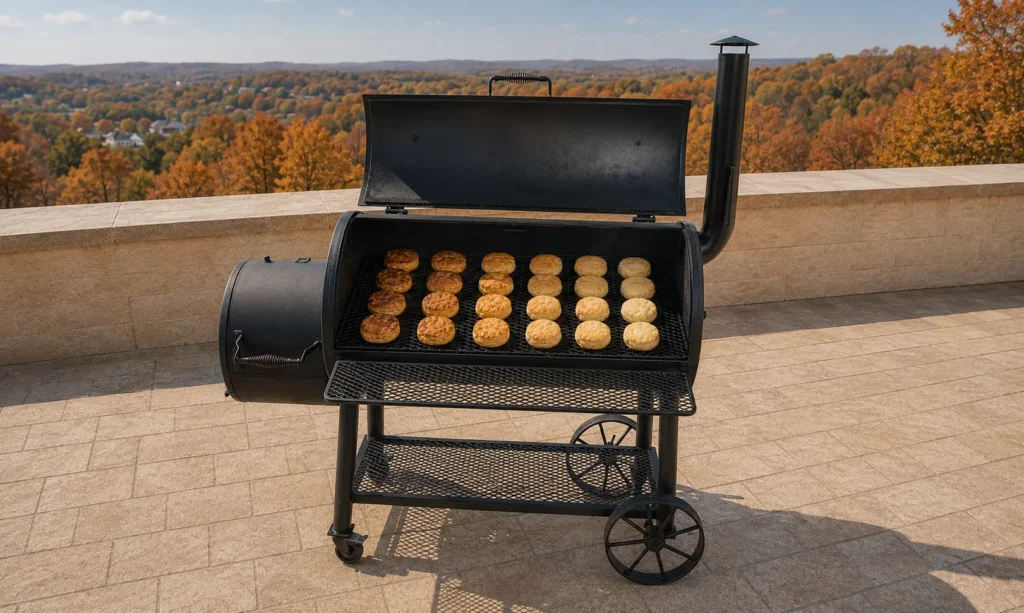
You can also perform a biscuit test by placing identical refrigerated biscuits at evenly spaced positions across the grate. Areas that brown first indicate stronger heat. A biscuit test is useful for visual mapping, but digital probes provide more accurate temperature data.
Make only one adjustment at a time. Move a tuning plate, change one gap, or alter one opening, then allow the smoker to stabilize again. If several variables change together, you will not know which adjustment improved or worsened the result.
7 Proven Ways to Improve Heat Distribution
1. Build a Small, Clean Fire
An offset smoker heat diffuser cannot stabilize an oversized or smoldering fire. Begin with a well-lit charcoal base and add small pieces of dry, seasoned hardwood as needed. A modest fire is easier to control and produces cleaner smoke.
Follow these offset smoker fire-management tips to establish a steady fuel bed and avoid thick white smoke.
2. Keep the Exhaust Open
The chimney should generally remain fully or mostly open during cooking so heat, combustion gases, and stale smoke can escape. Use the size of the fire and the firebox intake to control heat. Closing the exhaust too far can weaken draft and create bitter, dirty smoke.
3. Adjust the Intake Gradually
Opening the intake supplies more oxygen and normally makes the fire burn hotter. Reducing it slows combustion, but closing it too far can cause the wood to smolder. Make small changes and wait for the smoker to respond before adjusting it again.
For a complete damper and fuel strategy, see how to control heat in an offset smoker.
4. Use Tuning-Plate Gaps Strategically
Keep the gaps narrow near the firebox, where heat is strongest, and gradually increase them toward the chimney. If the center becomes too hot, reduce the gap directly beneath it. If the chimney end remains too cool, allow more heat to rise in that area.
Some commercial smokers use several removable baffle plates for this purpose. Oklahoma Joe’s describes four pre-installed plates in its Longhorn Reverse Flow Offset Smoker that channel heat and smoke through the chamber.
5. Add a Water Pan Carefully
A water pan absorbs thermal energy and can soften rapid temperature changes. Place it where it will not block airflow, tuning-plate gaps, or the grease drain. Start with hot water so the smoker does not waste as much energy heating cold liquid.
A water pan is different from a pan used mainly for grease collection. Review the offset smoker drip pan guide for placement and safety advice.
6. Rotate Food When Necessary
Even a well-tuned offset smoker usually retains warmer and cooler zones. Place thick or slow-cooking portions toward the warmer area and delicate portions farther away. Rotate large cuts only when your grate-level readings or food development show that it is necessary.
7. Account for Weather and Steel Thickness
Thin steel loses heat quickly in cold or windy weather, while thick steel stores more energy and responds slowly to adjustments. Shield the smoker from wind without using an enclosed space, and never operate it indoors or near combustible materials.
Use the recommended range for the specific recipe and meat. Our offset smoker cooking-temperature guide covers common barbecue ranges. For food safety, the USDA recommends using thermometers to monitor both the smoker and the food and keeping smoker air temperature between 225°F and 300°F during meat and poultry smoking in its smoking safety guidance.
Troubleshooting Common Heat-Diffuser Problems
| Problem | Likely cause | Practical correction |
| Firebox end is still too hot | Diffuser is too short or first gap is too large | Extend the protected area or narrow the nearest tuning-plate gap |
| Chimney end is too cool | Too little heat reaches the far end | Increase the later gaps or reduce excessive restriction near the firebox |
| Center of grate is hottest | Opening or plate gap is concentrated in the center | Reduce the center opening and redirect more heat farther down the chamber |
| Thick white smoke appears | Draft is restricted or fuel is damp | Open the exhaust, improve intake airflow, and use dry seasoned wood |
| Smoker takes too long to heat | Too much metal or water is absorbing energy | Allow more preheat time or reduce unnecessary thermal mass |
| Temperature stays high after reducing the fire | Thick plate has stored substantial heat | Wait for the metal to release energy; avoid aggressive vent closure |
| Grease burns on the plate | Plate is too hot, flat, or poorly drained | Improve drainage and use a correctly positioned drip pan |
| Temperature changed after adding the diffuser | Airflow path or probe environment changed | Re-map grate temperatures and revise plate spacing or placement |
Is an Offset Smoker Heat Diffuser Necessary?
Not every smoker needs an aftermarket offset smoker heat diffuser. A heavy-duty cooker with a well-designed firebox opening may already maintain a manageable temperature gradient. Some pitmasters also prefer distinct hot and cool zones because they can cook different foods simultaneously.
An offset smoker heat diffuser is most useful when the firebox side burns food before the rest of the chamber reaches the desired temperature, frequent rotation is required, or a large portion of the grate is otherwise unusable. Test the smoker in its original configuration before buying or fabricating anything.
The goal is not a perfectly identical reading at every point. A stable, repeatable pattern with a moderate difference across the grate is often more valuable than chasing exact equality.
Frequently Asked Questions
It shields food from the strongest radiant heat near the firebox and redirects hot air through more of the cooking chamber. This can reduce hot spots and improve grate-level temperature consistency.
Place it below the cooking grate near the firebox opening, where the strongest heat enters. Its exact position depends on whether it is a short baffle, tuning-plate system, convection plate, or reverse-flow plate.
A baffle plate is one type of heat diffuser. “Heat diffuser” is a broader term that can also include tuning plates, convection plates, and reverse-flow plates.
There is no universal thickness for every smoker. The correct choice depends on chamber size, available support, desired thermal mass, and the manufacturer’s design. Thicker steel retains more heat but increases weight, preheating time, and fuel use.
It may use holes, slots, gaps, or an open end. The openings must distribute heat without restricting draft. Progressively larger openings toward the cooler chimney side often work better than identical openings.
Foil may help with a brief test, but it is not a durable offset smoker heat diffuser and can tear, sag, block airflow, or collect grease. Use a properly supported, food-safe, heat-resistant component for regular cooking.
Usually not. It can reduce the difference between hot and cool zones, but fire size, airflow, weather, chamber design, food load, steel thickness, and probe placement still affect temperatures.
Use a clean, adequately sized fire, open the intake gradually, keep the exhaust open, use dry seasoned fuel, remove excess ash, and check for airflow restrictions. Do not rely on closing the chimney to trap heat because this can produce dirty smoke.
Yes, when it is made from food-safe high-temperature material, securely installed, and positioned without blocking airflow or grease drainage. Avoid galvanized, painted, coated, or unidentified metals, and allow everything to cool before adjustment or cleaning.
Some models allow direct grilling over charcoal in the firebox or cooking chamber, but the design varies. Follow the manufacturer’s instructions. Remove or reposition the offset smoker heat diffuser only if the smoker is designed for direct grilling in that configuration.
Final Thoughts
An offset smoker heat diffuser can transform an extreme firebox-side hot spot into a more usable and predictable cooking zone. The most effective setup redirects radiant heat, allows clean airflow, preserves grease drainage, and can be adjusted after accurate grate-level testing.
Start by learning the smoker’s natural temperature pattern. Install only the amount of metal needed, keep the chimney open, manage a small clean fire, and make one tuning change at a time. A diffuser will not replace fire-management skills, but it can make those skills easier to apply consistently.
When the offset smoker heat diffuser, fuel, airflow, thermometer placement, and food position work together, you gain steadier temperatures, more usable grate space, and better control over long low-and-slow barbecue cooks.