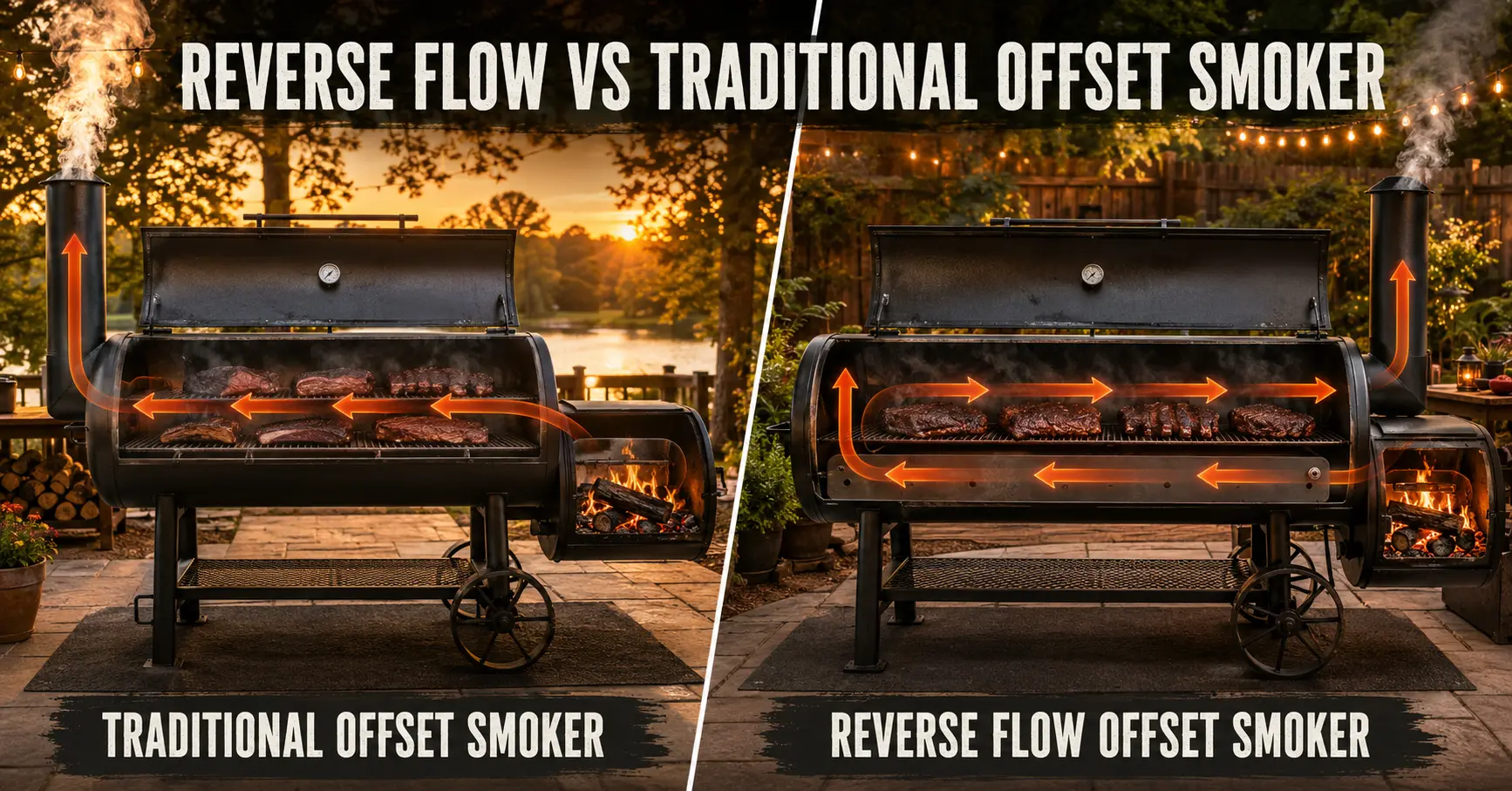
Reverse flow offset smoker vs traditional offset smoker is an important comparison when choosing the right smoker for your barbecue needs. Both designs can produce tender brisket, flavorful ribs, juicy chicken, and authentic wood-smoked barbecue. However, they move heat and smoke through the cooking chamber differently.
A traditional offset smoker sends heat directly from the side firebox across the cooking chamber. A reverse flow offset smoker directs heat beneath a solid baffle plate before circulating it back over the food. This difference affects temperature consistency, hot spots, fire management, cooking flexibility, cleaning, fuel consumption, and price.
This detailed reverse flow offset smoker vs traditional offset smoker guide compares nine important differences to help you choose the best design for your cooking style.
Reverse Flow Offset Smoker vs Traditional Offset Smoker: Quick Comparison
| Feature | Reverse Flow Offset Smoker | Traditional Offset Smoker |
| Heat direction | Under the baffle plate and back over the food | Directly from the firebox toward the chimney |
| Chimney position | Usually near the firebox | Usually opposite the firebox |
| Heat distribution | More consistent | Creates hot and cool zones |
| Baffle system | Solid reverse-flow plate | Open chamber or adjustable tuning plates |
| Meat rotation | Required less frequently | Usually required more frequently |
| Preheating time | Generally longer | Usually faster |
| Temperature response | Slower but more stable | Faster and more responsive |
| Cleaning | Baffle plate requires additional cleaning | Chamber is generally easier to access |
| Price | Usually more expensive | Available across a wider price range |
| Best for | Consistent large-batch cooking | Flexible and hands-on cooking |
What Is a Traditional Offset Smoker?
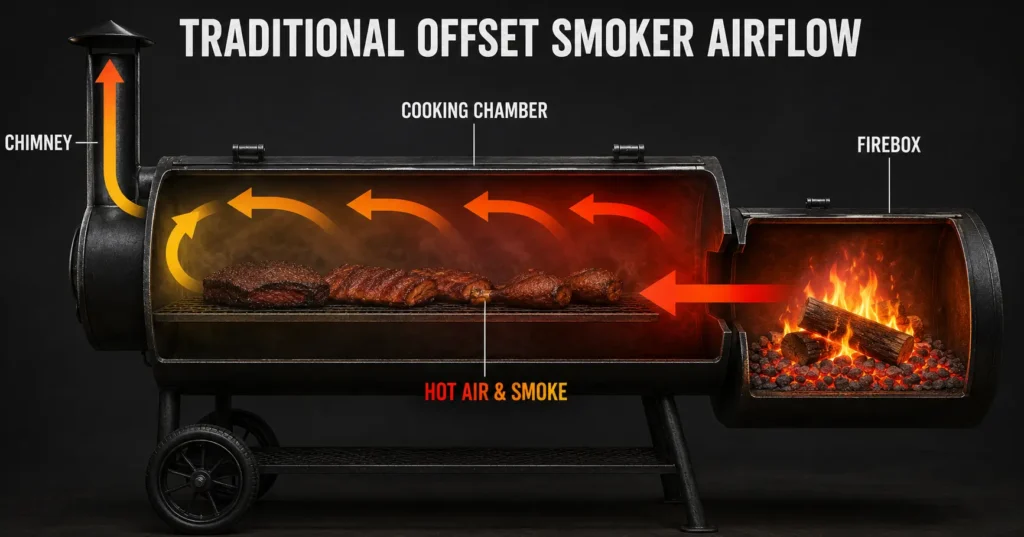
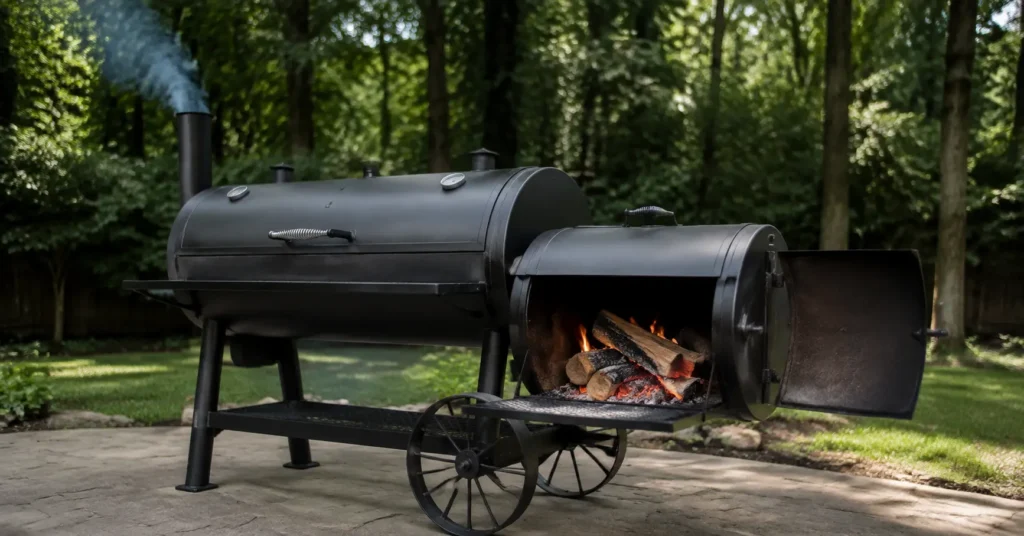
A traditional offset smoker has two main sections: a side firebox and a horizontal cooking chamber. Wood or charcoal burns inside the firebox, while heat and smoke enter the cooking chamber through an opening between the two sections.
The heat travels directly from the firebox side toward a chimney positioned at the opposite end of the smoker. As it moves through the chamber, it passes around the food before leaving through the chimney.
Because the heat enters from one side, the cooking area closest to the firebox usually runs hotter. The temperature gradually decreases toward the chimney end, creating separate hot and cool cooking zones.
These different temperature zones can be useful for experienced pitmasters. Chicken or sausages can be placed closer to the firebox, while brisket, ribs, or pork shoulder cook in a cooler area.
Main Features of a Traditional Offset Smoker
- Side-mounted firebox
- Chimney positioned opposite the firebox
- Direct heat and smoke movement
- Noticeable hot and cool zones
- Faster response to fire adjustments
- Open cooking chamber
- Wider selection of affordable models
- Greater control over food placement
Maintaining a clean and stable fire is essential with this design. Follow these offset smoker fire management tips to improve airflow, combustion, and temperature control.
What Is a Reverse Flow Offset Smoker?
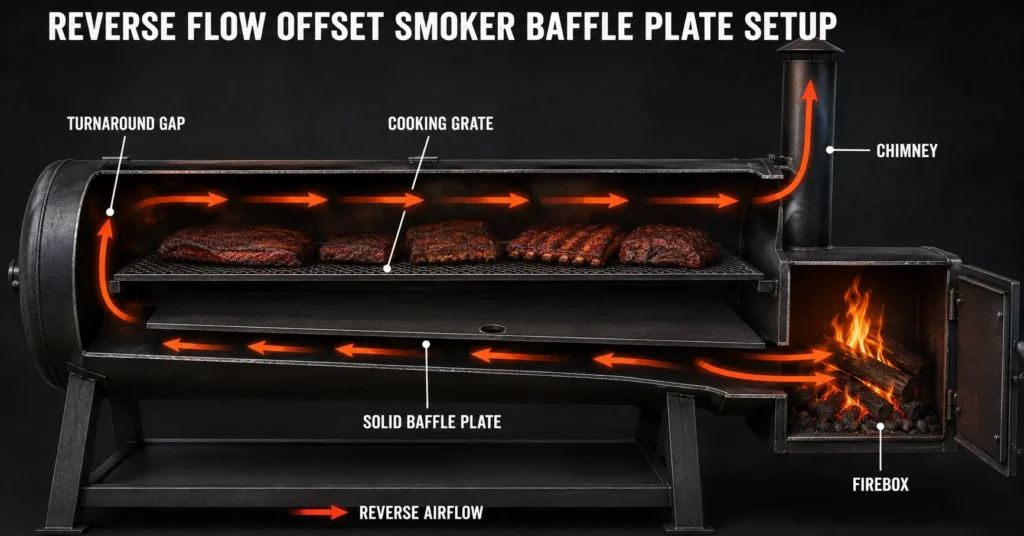
A reverse flow offset smoker also has a side firebox and horizontal cooking chamber. However, it includes a long, solid metal baffle plate installed underneath the cooking grates.
Heat and smoke enter from the firebox and travel underneath the plate toward the far end of the chamber. They then rise through an opening and reverse direction, moving back across the meat before exiting through a chimney located near the firebox.
The solid plate absorbs and distributes heat across the cooking chamber. It also protects food near the firebox from intense radiant heat, reducing severe hot spots.
This airflow pattern is the main factor that separates the two smokers in the reverse flow offset smoker vs traditional offset smoker comparison.
Main Features of a Reverse Flow Offset Smoker
- Solid baffle plate underneath the cooking grates
- Chimney positioned near the firebox
- Longer heat and smoke path
- More consistent grate-level temperatures
- Reduced direct radiant heat
- Less frequent food rotation
- Greater thermal mass
- More predictable batch cooking
Learn how different plates influence smoker performance in this complete offset smoker baffle plate guide.
1. Design and Airflow
The first major difference is how heat and smoke travel through the cooking chamber.
Traditional Offset Smoker Airflow
In a traditional smoker, heat enters directly from the firebox and moves toward the chimney. Food positioned near the firebox receives stronger heat, while food farther away generally cooks at a lower temperature.
The direct airflow allows the smoker to heat quickly. It also makes temperature changes more noticeable when fuel is added or the intake vent is adjusted.
Reverse Flow Offset Smoker Airflow
In a reverse flow design, heat cannot travel directly across the food. It must first move underneath the baffle plate, rise at the far end, and then return across the cooking grates.
This longer path distributes heat across a larger surface before it reaches the food. The result is generally more consistent cooking from one side of the chamber to the other.
Winner: Reverse flow for balanced airflow; traditional flow for faster and more responsive airflow.
2. Heat Distribution and Hot Spots
Heat distribution is one of the most important parts of the reverse flow offset smoker vs traditional offset smoker decision.
Traditional offset smokers naturally produce a hotter area near the firebox opening. This temperature difference can be useful, but it requires the cook to understand the smoker’s heat map.
You can identify hot spots by placing inexpensive biscuits across the cooking grate and observing which ones brown first. Multiple grate-level thermometer probes can provide a more accurate temperature reading.
A reverse flow smoker uses its heated plate to distribute energy across the chamber. The plate also prevents the first pieces of meat from receiving the full force of heat entering from the firebox.
No offset smoker is completely free from temperature differences. Door leaks, weather, steel thickness, smoker size, food placement, and fire conditions can still create variations.
If your traditional model has extreme hot spots, an offset smoker heat diffuser may help balance the cooking temperature.
Winner: Reverse flow for more even temperatures and fewer severe hot spots.
3. Temperature Control
A reverse flow smoker is generally more forgiving once it has been properly preheated. The heavy baffle plate absorbs energy and acts as thermal mass, helping reduce sudden temperature changes.
When the cooking chamber is opened, the heated plate can help the smoker recover some of the lost heat. However, the fire must still be managed correctly. A reverse flow design cannot compensate for wet wood, restricted airflow, an oversized fire, or leaking doors.
Traditional offset smokers respond faster when fuel or airflow is adjusted. Experienced pitmasters may prefer this responsiveness because it provides direct control over the cooking environment.
Beginners may find the same responsiveness challenging. Adding too much wood can quickly create a temperature spike near the firebox.
For better results with either design, read this guide on how to control heat in an offset smoker.
Winner: Reverse flow for stability; traditional flow for quick fire adjustments.
4. Smoke Flavor and Bark
Both smoker designs can produce excellent smoke flavor and dark, flavorful bark. The quality of the finished meat depends more on clean combustion, seasoned hardwood, airflow, temperature, and cooking technique than the direction in which the smoke travels.
A traditional smoker exposes food near the firebox to faster-moving heat and smoke. This may help bark develop quickly, but meat placed too close to the firebox can overcook or dry out.
A reverse flow smoker circulates smoke through a longer path. This can provide more uniform smoke exposure across multiple pieces of meat, particularly when the cooking chamber is heavily loaded.
More smoke contact does not automatically mean better flavor. Thick white smoke produced by incomplete combustion can leave bitter or unpleasant flavors in either smoker. Aim for a small, clean-burning fire that produces thin blue or nearly transparent smoke.
You can also select hardwood according to the meat you plan to cook. Hickory wood for an offset smoker provides a bold barbecue flavor, while oak offers a more balanced smoke profile.
Winner: Tie. Both designs produce excellent flavor when the fire burns cleanly.
5. Food Rotation and Cooking Flexibility
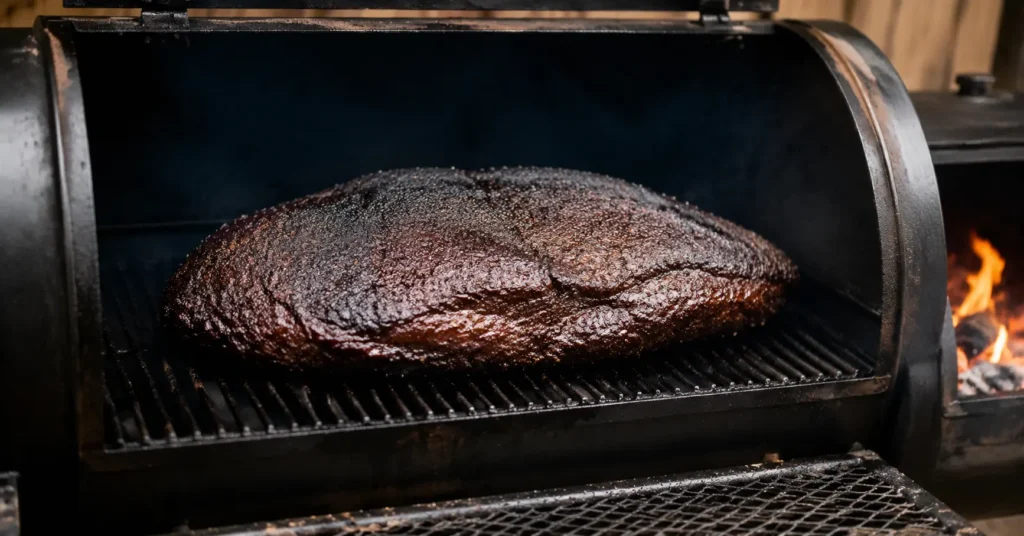
Traditional offset smokers normally require more frequent food rotation. Brisket, ribs, or chicken positioned near the firebox may cook faster than food placed near the chimney.
Rotating the meat helps expose each piece to similar heat during a long cooking session. However, every time the chamber is opened, heat escapes and cooking time may increase.
A reverse flow smoker reduces the need for frequent rotation because temperatures are generally more consistent across the grates. Rotation may still be helpful when the smoker is fully loaded or when individual meat pieces vary in size.
Traditional smokers provide greater flexibility when cooking different foods simultaneously. The hot zone can be used for chicken, while a cooler section supports low-and-slow brisket or pork shoulder.
A reverse flow smoker is more suitable when several racks of ribs, briskets, or pork shoulders need to cook under similar conditions.
Winner: Reverse flow for uniform batch cooking; traditional flow for multiple temperature zones.
6. Grease and Flare-Up Management
Grease does not normally drip directly into the side firebox of a correctly designed traditional offset smoker. It falls onto the cooking chamber floor, a drip pan, or an internal drainage system.
Flare-ups can occur if grease reaches an extremely hot surface or if the cooking chamber is also being used for direct grilling. Regular cleaning and proper drainage reduce this risk.
The plate inside a reverse flow smoker protects food from direct firebox heat. Many reverse-flow plates are slightly sloped so grease can travel toward a drain or collection bucket.
The plate must be cleaned regularly because grease and food residue can accumulate on its surface. Heavy buildup may produce dirty smoke, unpleasant flavors, or a grease fire.
An offset smoker drip pan can simplify cleaning. In a reverse flow smoker, the pan must not block the opening where heat and smoke rise from underneath the plate.
Winner: Reverse flow for protection from direct firebox heat, provided the plate and drain are cleaned properly.
7. Preheating and Fuel Efficiency
The baffle plate inside a reverse flow smoker must absorb heat before the cooking chamber becomes stable. This means reverse flow models may take longer to preheat and initially require more fuel.
Once fully heated, the plate can help maintain a consistent cooking environment. This is especially useful during long brisket or pork shoulder cooks.
Traditional smokers usually heat faster because there is less steel between the fire and the cooking chamber. However, thin metal, leaking doors, poor seals, cold weather, and strong wind can cause rapid heat loss.
Construction quality often affects fuel efficiency more than airflow design alone. A thick, well-sealed traditional smoker can retain heat better than a thin and poorly constructed reverse flow model.
A quality offset smoker firebox basket can also improve fuel organization and airflow around the fire.
Winner: Traditional flow for faster preheating; reverse flow for stable heat after preheating.
8. Cleaning and Maintenance
Traditional offset smokers generally have fewer internal components. Their open chamber floor is easier to scrape, wipe, and inspect.
Models with removable tuning plates require additional cleaning, but the plates can usually be lifted out individually.
A reverse flow smoker may require more maintenance because grease and carbon deposits collect on the large internal plate. Cleaning underneath a welded plate can also be difficult.
A removable reverse-flow plate provides better access but must be reinstalled in the correct position. Improper placement may change airflow or allow excessive heat to reach one part of the chamber.
For either smoker:
- Let ash cool completely before removing it.
- Empty the firebox after each major cook.
- Keep the grease drain open.
- Remove excessive grease and carbon buildup.
- Inspect doors, seals, welds, and vents.
- Protect exterior steel from rain and moisture.
- Re-season exposed internal metal when necessary.
Winner: Traditional flow for easier chamber access and routine cleaning.
9. Price and Availability
Price is another major consideration when comparing a reverse flow offset smoker vs traditional offset smoker.
Traditional offset smokers are more widely available and come in almost every price range. Entry-level models are suitable for beginners, while premium smokers offer thick steel, fitted doors, quality welds, and advanced airflow systems.
Reverse flow smokers are generally more expensive because they require an additional plate, return opening, suitable drainage, and different chimney placement. Many reverse flow models also use heavy-gauge steel and welded construction.
Do not choose a smoker based only on price or airflow design. Check:
- Steel thickness
- Firebox size
- Cooking capacity
- Door fit and seals
- Weld quality
- Drainage system
- Grate-level chimney position
- Thermometer placement
- Warranty
- Replacement-part availability
For an example of a reverse flow design, read our Lang BBQ offset smoker review.
Winner: Traditional flow for affordability and wider availability.
Pros and Cons of a Traditional Offset Smoker
Pros
- Available across a wide price range
- Faster preheating
- Quick response to fire adjustments
- Distinct hot and cool cooking zones
- Greater food-placement flexibility
- Easier access for cleaning
- Compatible with tuning plates and heat deflectors
Cons
- More noticeable hot spots
- Requires frequent temperature monitoring
- Food may need regular rotation
- Can be challenging for beginners
- Results may vary across the cooking grate
Pros and Cons of a Reverse Flow Offset Smoker
Pros
- More consistent temperature distribution
- Reduced direct heat near the firebox
- Less frequent food rotation
- Better for large batches of similar meat
- Strong heat recovery after opening the chamber
- More uniform smoke circulation
- Greater temperature stability after preheating
Cons
- Usually more expensive
- Longer preheating time
- Baffle plate requires regular cleaning
- Uses more fuel during initial heating
- Provides fewer distinct temperature zones
- Fixed plates can make deep cleaning difficult
Which Offset Smoker Is Best for Beginners?
A reverse flow smoker is generally easier for beginners because it reduces severe hot spots and requires less frequent food rotation. More consistent temperatures allow new cooks to focus on maintaining a clean fire and monitoring the meat.
However, a traditional offset smoker can also be a good beginner option if it is constructed from quality steel and has properly fitted doors. Affordable traditional models are widely available, making them a practical starting point.
Regardless of design, beginners should use a reliable digital thermometer at grate level. The thermometer installed in the smoker lid may display a different temperature from the area where the food is cooking.
The USDA recommends using a food thermometer to confirm that meat reaches a safe internal temperature. Review its meat and poultry smoking guidance before preparing smoked food.
Which Smoker Should You Choose?
Choose a traditional offset smoker if you:
- Want a more affordable smoker
- Prefer faster preheating
- Enjoy active fire management
- Want separate hot and cool cooking zones
- Regularly cook different foods simultaneously
- Prefer easier access for cleaning or modifications
Choose a reverse flow offset smoker if you:
- Want more consistent temperatures
- Prefer less frequent food rotation
- Regularly cook large batches
- Want protection from intense firebox heat
- Prefer stable low-and-slow cooking
- Are willing to pay more for added convenience
Reverse Flow Offset Smoker vs Traditional Offset Smoker
The final reverse flow offset smoker vs traditional offset smoker choice depends on your experience, budget, cooking style, and the amount of food you normally prepare.
A traditional offset smoker offers faster heating, responsive fire control, flexible temperature zones, easier cleaning, and wider availability. It is an excellent option for pitmasters who enjoy actively managing their fire and food placement.
A reverse flow offset smoker offers more even heat, reduced hot spots, consistent smoke circulation, and easier batch cooking. It is particularly useful for beginners, caterers, and backyard cooks who want more predictable results.
Neither design automatically produces better barbecue. Steel thickness, door seals, airflow, wood quality, fire management, and cooking experience remain extremely important. A well-built traditional smoker can outperform a poorly constructed reverse flow model.
Choose the smoker that matches how you prefer to cook instead of selecting one based only on its airflow label.
Frequently Asked Questions
A reverse flow smoker is generally better for even temperature distribution and consistent batch cooking. A traditional offset smoker is better for cooks who want separate heat zones, faster response, and greater food-placement flexibility.
Reverse flow smokers generally provide more stable grate-level temperatures after preheating. Traditional smokers respond faster to fire and airflow adjustments but may require more frequent monitoring.
It may require additional fuel during preheating because the solid plate must absorb heat. Once heated, the plate helps stabilize the cooking temperature. Fuel use also depends on steel thickness, seals, weather, chamber size, and cooking temperature.
Food usually requires less rotation, but rotation may still be helpful during a fully loaded cook. No offset smoker maintains exactly the same temperature at every point on the cooking grate.
Both designs can produce excellent smoke flavor. Clean combustion, seasoned hardwood, good airflow, and correct cooking temperature have a greater effect on flavor than airflow direction alone.
Not necessarily. The large baffle plate collects grease and residue, so it requires regular cleaning. Traditional smokers usually provide easier access to the cooking chamber floor.
Conversion is possible, but it requires a correctly sized plate, sufficient space underneath, a clear return opening, proper drainage, and suitable chimney placement. Incorrect modifications can restrict airflow and cause poor combustion.
Most traditional low-and-slow barbecue is cooked between 225°F and 275°F. The best temperature depends on the meat, recipe, desired bark, and available cooking time.